
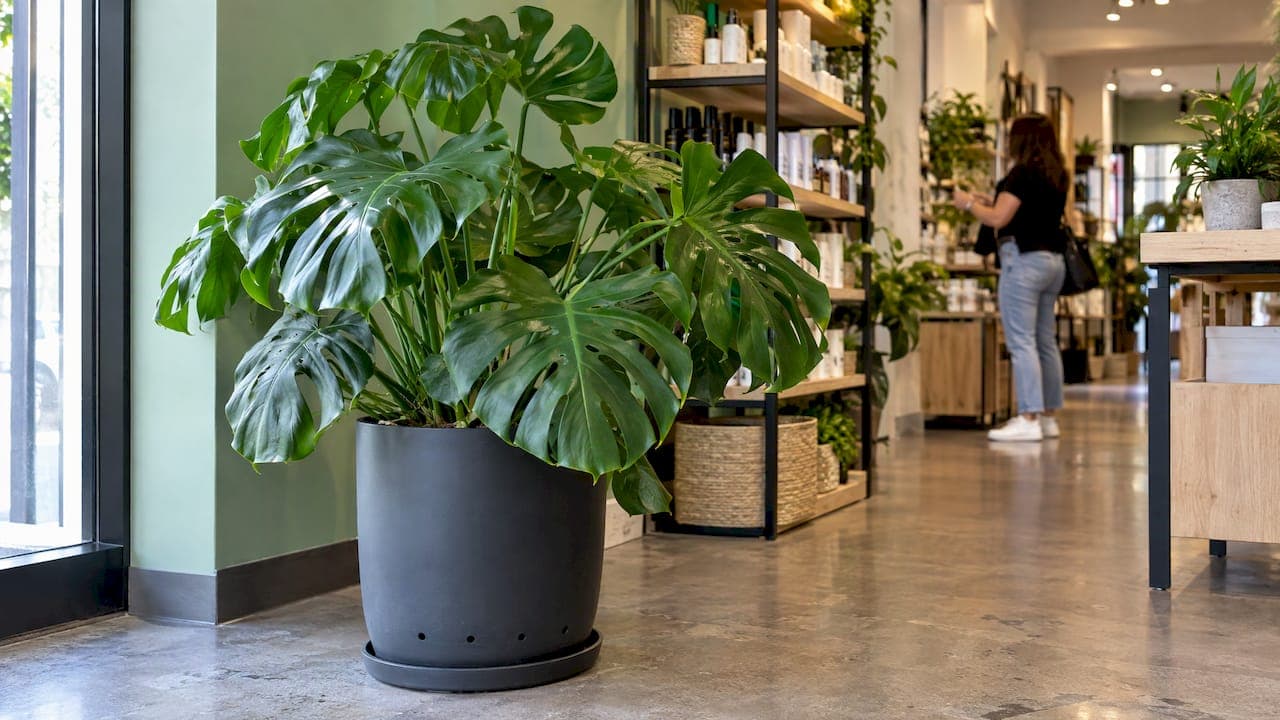
A commercial planter needs a way for extra water to leave the root zone. A drainage hole is the simplest answer. When a hole isn't possible, a drained liner inside a decorative shell does the same job. Gravel at the bottom of a sealed pot does not.
That's the short version. The longer version matters, because drainage is where good-looking plantings go wrong. A beautiful planter that holds water can lose its plant in weeks. A planter that leaks can mark a lobby floor. You want neither.
We're Greenspace Plants, Canada's leading commercial-only indoor plant service, founded in 2014. We design, install and care for plants in offices, hotels, restaurants and retail across Toronto, Vancouver and Calgary. Here is how we think about drainage, and how you can judge it in your own space.
Key Takeaways
- Roots need air as well as water. A bottom hole lets water drain freely so oxygen stays available around the roots.
- If a planter has no hole, use a drained liner or double-pot system. Never rely on a gravel layer to make up for a missing hole.
- Indoors, protect floors with a detachable saucer, a liner, or by watering at a sink. Empty any water that collects.
- Drainage is a design decision made at the start. It's much harder to fix after the planters are in place.
- You don't need to manage any of it yourself. We handle design, installation and care for a fixed monthly fee.
Table of Contents
- Why drainage matters more than the planter's finish
- Do indoor planters need drainage holes?
- What to do when the planter you love has no holes
- Protecting floors, furniture and finishes
- How to tell if a planter is draining well
- Outdoor planters need a plan too
- Drainage is a design decision
- Our perspective
- What Greenspace+ takes off your plate
- FAQ
- Sources
Why drainage matters more than the planter's finish
Plants in containers live in a small, closed volume of growing mix. Water that can't leave fills the spaces that roots need for air.
The British Columbia Ministry of Agriculture explains that poor drainage creates waterlogged, oxygen-deficient conditions linked to weak growth and root diseases such as Phytophthora and Pythium. Its guidance also notes that inadequate drainage and aeration can limit plant quality and, in severe cases, contribute to premature plant death.
You rarely see this from above. The leaves can look fine for weeks. Then they yellow, droop or drop, and by then the roots are already in trouble.
For a space that's meant to look polished, that's the real risk. The plant that fails is usually the one sitting in a stylish planter with no way out for the water.

More drainage is not the goal either
The aim is balance. Perennia, Nova Scotia's agriculture and food organization, says some leachate is needed for a healthy root zone, while excessive drainage adds no benefit and can raise root-disease risk and humidity in protected spaces.
In plain terms: water enough that a little escapes, then stop. Flooding a pot every visit wastes water, flushes nutrients and makes a mess.
Do indoor planters need drainage holes?
Usually, yes. University of Illinois Extension says a hole at the bottom of the container is critical for free drainage and root aeration.
That doesn't mean every planter in your space has to be a plastic pot with a hole. It means every plant needs a drainage path somewhere in the system. There are three common ways to get one:
- A planter with holes and a saucer. The simplest option. Works well for smaller plants you can move.
- A grow pot with holes, set inside a decorative planter. The grow pot drains. The outer shell is the look.
- A liner with a built-in water reservoir. Common for large, heavy or built-in planters where lifting isn't practical.
The second option is how most beautiful, sealed ceramic and stone planters get used safely. The plant lives in a working pot. The planter is the finish.
Where holes should go
For nursery containers, Oklahoma State University Extension reports that holes straddling the bottom corner, on both the base and the side wall, are ideal. It also gives a recommended drainage-hole area of at least 20% of the pot bottom.
That guidance is written for nursery growing, not lobbies. But the logic carries over. One tiny hole in the centre of a big base can clog easily. More openings, placed where water gathers, are more forgiving.
When we choose a planter for a project, hole size and position are part of the conversation, not an afterthought.
What to do when the planter you love has no holes
This comes up constantly in design-led spaces. A sculptural planter, a custom millwork piece, a stone trough in a hotel entrance. None of them were made with a drain.
You have good options. You don't have to give up the look.
Use a drained liner or inner pot
University of Illinois Extension advises that a decorative container without drainage should use a liner pot, or be taken to a sink for watering and allowed to drain before it goes back indoors.
Iowa State University Extension also recommends double-potting when the outer decorative container has no hole. The inner pot holds the plant. The outer one hides it.

The key rule: the inner pot must never stand in accumulated water. If water collects in the shell, it needs to be emptied. Otherwise you've built a bathtub for the roots.
Use a liner that holds a reservoir
For large installations, professional plantscaping guidelines describe liners that support the plant and contain a water reservoir, along with metal tray-and-support systems. The tray works as a reservoir, not a drip tray, so service visits need to be timed to avoid overflow.
If you want to read more on how liners contain water and support plants while preventing leaks, overflows and corrosion, these commercial landscaping ideas cover the general thinking on water-saving planting.
This is a good spot for a trained eye. The right liner depends on the planter's size, the plant and how often someone will be there to check it.
Skip the gravel trick
You'll see advice to put a layer of stones, pebbles or clay balls at the bottom of a sealed pot. It sounds sensible. It doesn't work as a fix.
Iowa State University Extension says a gravel layer does not make up for the absence of a hole. Use a drained inner pot or a container with holes instead.
Water still collects at the bottom of the growing mix. The stones just take up room you could have used for roots.
Protecting floors, furniture and finishes
This is the worry we hear most from office managers and hospitality teams. "If it drains, won't it leak?"
It shouldn't. A well-planned system drains into something, and that something is contained.
Iowa State University Extension recommends trays or saucers for indoor containers to protect furniture and floors from stains, rot or discolouration. Illinois Extension adds a caution: permanently attached saucers can hold overflow and waterlog roots. Detachable saucers should be emptied so the growing mix can dry out somewhat.
So the saucer is not the finish line. Someone has to empty it.
A simple comparison
| Method | Best for | Watch out for |
|---|---|---|
| Pot with holes and detachable saucer | Small to medium movable plants | Saucer left full after watering |
| Grow pot inside a decorative shell | Sculptural or sealed planters | Water pooling in the outer shell |
| Liner with reservoir | Large or built-in planters | Overflow if service timing slips |
| Take to a sink, drain, return | Small plants you can lift | Not practical for heavy planters |
The common thread: every row depends on someone watching the water. That's why drainage and ongoing care belong in the same plan.
Plan the install, not just the look
For large projects, professional plantscaping guidelines recommend documenting floor protection, trolley logistics, final cleaning and the first service in an installation plan. They also suggest that maintenance plans cover service frequency and timing, water access away from food areas, equipment storage and site access.
We see it the same way. Drainage is easier when it's planned alongside the install. If you're curious how that process runs, our guide on how commercial plant installation works for offices walks through it.
How to tell if a planter is draining well
You don't need a lab. A few simple checks do most of the work.
- Look underneath. Is there a hole, a liner or a reservoir? Can you see where water goes?
- Check the saucer or shell after watering. Standing water an hour later is a warning.
- Feel the mix a few centimetres down. If it's soggy days after watering, drainage is the first suspect.
- Watch the plant. Yellowing lower leaves, a sour smell or soft stems point toward too much water at the root.
- Compare water in with water out. Perennia's guidance says irrigation can be assessed by comparing water entering a pot with water leaving the bottom over the same 24-hour period. That's a grower's method, but the idea is useful: you want a little to come out, not none and not a flood.
If something looks off, don't just water less. Check the drainage path first.
Outdoor planters need a plan too
Patios and entrances bring a different set of problems. Rain adds water you didn't plan for, and winter freezes whatever is left in the pot.
The principle is the same. Water must be able to leave, and the outlets must not clog. Raised planters, sidewall outlets and a screen to keep fine particles of mix out of the openings are all common ways to manage it.
If you're planning a restaurant terrace or a hotel entrance, our outdoor patio plant services include planting and care designed around those conditions.
Drainage is a design decision
This is the part many people miss. Drainage isn't a repair. It's a choice you make when you pick the planter, the plant and the location.
A few questions help:
- How heavy will the planter be, and can anyone move it? Heavy pieces need built-in solutions.
- What's under it? Wood, stone, carpet and tile all react differently to moisture.
- How often will someone be there? A reservoir that's checked weekly is fine. One that's ignored for a month isn't.
- Is the planter meant to be seen from all sides? That affects where outlets and trays can go.
- Who handles the water? If it's "whoever notices," it won't get done.
If you're working with a designer, bring these questions early. We work with interior designers on exactly this, and our page on collaborating with interior designers shows how.
Once you know the planter, the plant matters too. Some plants tolerate a little extra moisture. Others sulk at it. Our indoor plant choices for offices and businesses is a helpful place to match plants to conditions.
Our perspective
We've been asked the drainage question more times than we can count. Usually it arrives with a photo of a gorgeous planter and the words, "Can we use this one?"
Almost always, the answer is yes. But the planter is only the outside. What matters is what's inside it and how water moves through it.
The mistake we see most often is treating drainage as a plumbing detail someone else will sort out. It isn't. It decides whether your plants are still lush in a year, or whether you're replacing them and wondering what went wrong.
That's why we don't just drop plants into containers. We look at the planter, the floor, the light and who'll be walking past it. Then we plan the plant and the water together. Our technicians, our plant clinicians, watch for the early signs that a pot is too wet long before you'd see them.
You shouldn't have to think about saucers or reservoirs. Your job is to have a space that feels welcoming and looks like your brand. Ours is to make sure the plants stay healthy behind that look.
Nicole
What Greenspace+ takes off your plate
If this all sounds like a lot to manage, that's fair. It is, if you're doing it between meetings.
Greenspace+ is our all-inclusive plant service. For a fixed monthly fee, from $299 per month, you get plant design, installation, regular care and plant replacements, with no upfront costs and no long-term commitment. Our approach is built around healthy plants, and that includes how water is handled.

We also source the planters, from standard to premium, luxury and custom, so the look and the drainage plan are chosen together. If you'd like to see how it works, start with Greenspace+, or see what happens on a visit in our plant care and maintenance overview.
We're WBE Canada certified (woman-owned). We care for 60,000+ plants in 400+ commercial locations, and we run national programs for multi-location brands, including in the US. If you manage more than one site, our National Account Plant Program is the place to begin.
FAQ
Do indoor planters need drainage holes?
Usually, yes. A bottom hole lets excess water leave so air can reach the roots. If you love a planter that has none, put a drained inner pot inside it, or use a liner designed to hold a water reservoir.
Can I use gravel instead of a drainage hole?
No. Extension guidance from Iowa State University says a gravel layer doesn't make up for a missing hole. Water still collects at the bottom of the mix. A drained inner pot is the safer fix.
How do I stop a drained planter from leaking onto the floor?
Use a detachable saucer, a liner or a double-pot system, and empty any water that collects. Don't let the inner pot sit in standing water. Larger planters usually need a liner and a service schedule that matches it.
How many drainage holes should a large planter have?
It depends on the planter's size and material. One nursery guideline from Oklahoma State University Extension suggests a total hole area of at least 20% of the pot bottom, ideally with openings reaching the bottom corner. For a custom piece, we'd look at it case by case.
Is more drainage always better?
No. A little water should escape after watering, but a flood wastes water and nutrients. The goal is a controlled balance, not maximum drainage.
Sources
- Managing Crops in Soilless Substrate (Perennia)
- Container Drainage Options (University of Illinois Extension)
- How to Select Quality Plant Containers (Iowa State University Extension)
- Containers and Media for the Nursery (Oklahoma State University Extension)
- Commercial Landscaping Ideas (Trew Landscape)