
The best conference room plants are the snake plant, ZZ plant, pothos, peace lily, and parlor palm, each chosen for a specific reason: the snake plant and ZZ plant shrug off low light and infrequent watering, pothos trails beautifully from a credenza, the peace lily adds a bloom without demanding a window, and the parlor palm gives you a compact statement piece without eating up floor space. Your next move isn't picking a favorite from that list. It's measuring the room's light and scale, then deciding who waters, dusts, and rotates these plants once they're installed.
That second step is where most offices stumble. A gorgeous fiddle leaf fig dies fast in a windowless boardroom, no matter how much anyone wants it to work.
- Snake plant — tolerates neglect and dim corners better than almost anything else on this list.
- ZZ plant — glossy, upright, and nearly impossible to overwater into trouble.
- Pothos — trailing vines soften hard edges on shelves and credenzas.
- Peace lily — tells you when it's thirsty by drooping, then bounces back fast.
- Parlor palm — a tabletop or small-floor palm that reads as upscale without the size of a full specimen.
Pro Tip: If your conference room has no windows, don't force a sun-loving species to survive there. Pair a low-light plant with a simple horticultural LED fixture, or hand the whole decision to a maintenance service that already accounts for it.
Key Takeaways
Choosing conference room plants successfully depends on matching species to measured light conditions first and committing to a consistent maintenance routine second.
| Point | Details |
|---|---|
| Match light before species | Classify each room as low, medium, or bright indirect light before picking any plant. |
| Prioritize forgiving species | Snake plant, ZZ plant, and pothos tolerate low light and irregular watering better than most alternatives. |
| Protect sightlines | Keep floor specimens off the AV axis and clear of exit signs, panels, and cameras. |
| Budget for replacement, not just purchase | Ongoing care and occasional replacement usually cost more over time than the initial plant purchase. |
| Consider a managed service | Greenspace+ bundles site assessment, design, installation, and maintenance into one fixed monthly fee with a healthy plant guarantee. |
Table of Contents
- Top 12 Conference Room Plants and Where They Work Best
- How to Choose Plants for Your Meeting Room
- Placement Rules That Protect Sightlines and Function
- A Maintenance Routine That Keeps Plants Alive
- Why Professional Maintenance Often Makes More Sense
- What Conference Room Plants Actually Cost
- Allergy Considerations When Choosing Office Plants
- What the Research Actually Supports (and What It Doesn't)
- Let Greenspace Plants Handle What Comes After Selection
- Sources
Top 12 Conference Room Plants and Where They Work Best
Picking plants for a meeting room isn't the same as picking them for a lobby or a break room. You need species that survive inconsistent light, tolerate the dry blast of HVAC vents, and don't require anyone to remember a watering schedule during a busy quarter. The 12 below cover tabletop accents, credenza trailers, and floor specimens, and every one is commonly available through Canadian plant suppliers and interiorscapers.
1. Snake Plant (Dracaena trifasciata)
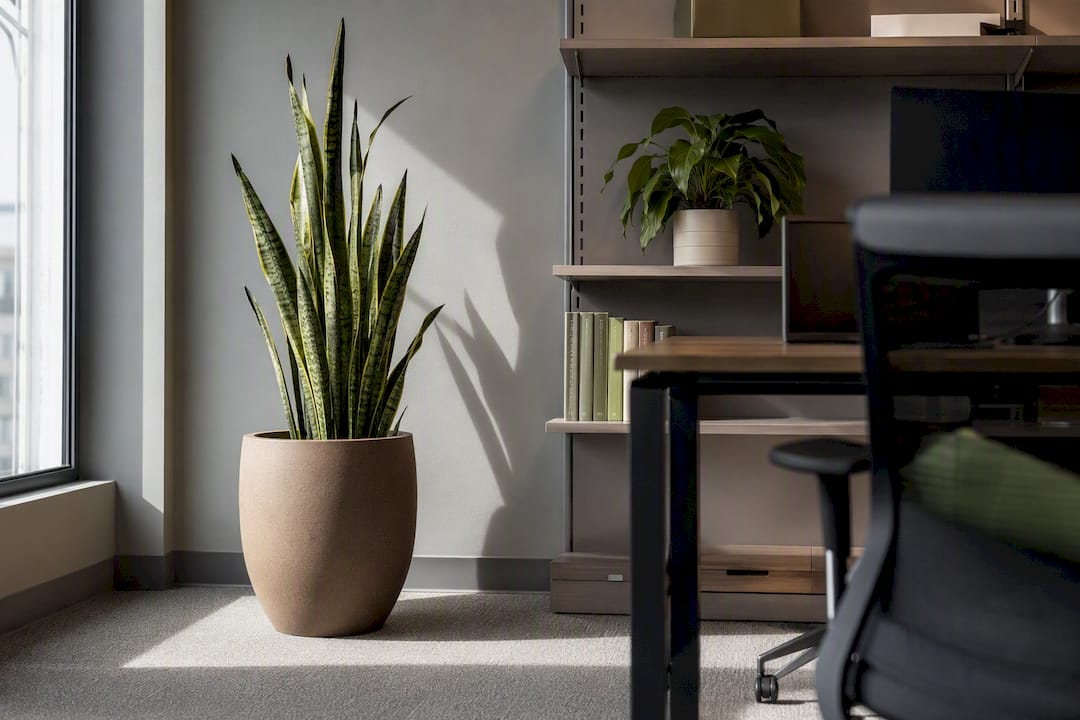
Stiff, upright leaves in deep green make this one of the most forgiving plants for interior offices. It tolerates low light and infrequent watering better than nearly any competitor on this list, and it grows slowly enough that you won't be repotting it every year. Mature height typically runs 2 to 4 feet. Place it as a corner floor specimen or in a mid-size planter on a credenza where its architectural shape reads as intentional, not accidental.
2. ZZ Plant (Zamioculcas zamiifolia)
The ZZ plant's waxy, arching leaves catch light in a way that makes even a dim room feel a little brighter. It's specifically noted for drought and low-light tolerance, which makes it one of the safest bets for an interior conference room with no windows. Expect a mature spread of a few feet. A pair flanking a doorway or a single specimen on a low table both work well.
3. Pothos (Epipremnum aureum)
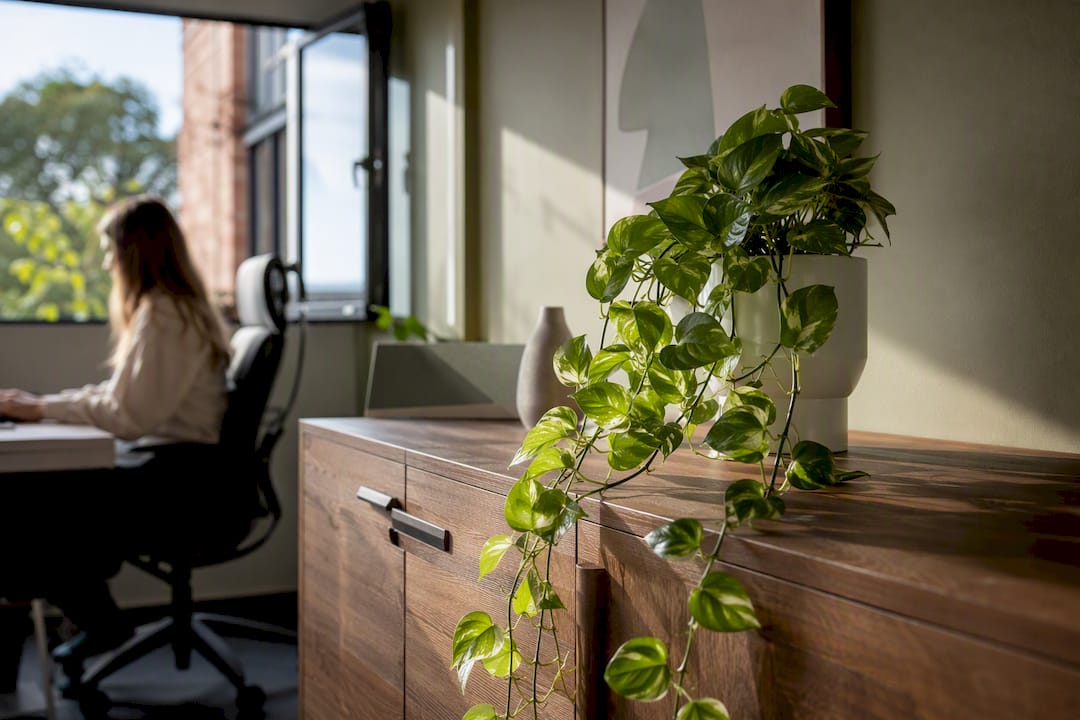
Fast-growing and famously hard to kill, pothos trails rather than stands, which makes it ideal for shelving units or a hanging planter near a window that gets filtered light. It handles medium light comfortably and only needs watering when the top inch of soil dries out. Keep it off the main table if you want a truly hands-off plant. Instead, let it cascade from a credenza where it softens the hard lines of AV equipment.
4. Peace Lily (Spathiphyllum wallisii)
This is one of the few plants on this list that visibly tells you when it needs water. Its leaves droop dramatically, then recover within hours of a good soak. It flowers periodically under medium to bright indirect light and stays compact at 1 to 3 feet, making it a strong tabletop or credenza choice for rooms with at least one window.
5. Parlor Palm (Chamaedorea elegans)
A slow-growing palm that stays relatively small indoors, the parlor palm brings a tropical, upscale feel without the maintenance demands of larger palm varieties. It tolerates lower light than most palms, which is unusual for the family, and it works well as a floor accent near a corner that needs softening without blocking sightlines to a presentation screen.
6. Cast Iron Plant (Aspidistra elatior)
True to its name, this plant survives conditions that would kill most houseplants: low light, dry air, irregular watering. It's a slower grower, topping out around 2 feet, and its dark green, leathery leaves give a room texture without demanding attention. It's an excellent choice for a windowless interior conference room paired with modest supplemental lighting.
7. Rubber Plant (Ficus elastica)
If you want a bolder floor specimen, the rubber plant delivers with broad, glossy leaves and a sturdy upright form that can reach 6 feet or more indoors. It prefers bright indirect light, so it belongs near a window rather than in the interior of a large boardroom. Its size makes it a natural fit for an empty corner that needs visual weight.
8. Chinese Evergreen (Aglaonema spp.)
Available in mottled green, silver, and even pink variegated cultivars, Chinese evergreen adds color variety that most low-light plants can't match. It stays compact, usually under 2 feet, and tolerates a wide light range, which makes it flexible for tabletop use in rooms with inconsistent natural light throughout the day.
9. Dracaena (Dracaena fragrans 'Massangeana')
Often called the corn plant, this dracaena variety grows into a tall, tree-like floor specimen reaching 4 to 6 feet, with strappy leaves that add height without a wide footprint. It handles medium light well and is a common choice for filling vertical space in larger boardrooms without crowding the table.
10. Philodendron (Philodendron hederaceum)
Closely related to pothos in care needs, philodendron offers a slightly larger leaf and a fuller trailing habit. It tolerates medium light and irregular watering, making it a solid alternative for a shelf or hanging planter in a room where pothos has already been used elsewhere in the building.
11. Money Tree (Pachira aquatica)
Its braided trunk and layered leaves give the money tree a distinctive look that reads as deliberate design rather than default office greenery. It prefers bright indirect light, so reserve it for rooms with strong natural exposure, and expect a mature height of 3 to 6 feet depending on the pot size.
12. Bird's Nest Fern (Asplenium nidus)
For a tabletop or low shelf accent with texture that contrasts against the straight lines of most office plants, the bird's nest fern's wavy, ribbed fronds do the job. It prefers higher humidity than most of this list tolerates, so it fits best in rooms with a humidifier or a tray of pebbles and water beneath the pot.
Quick note: Roughly half of this list, the snake plant, ZZ plant, pothos, cast iron plant, philodendron, and Chinese evergreen, tolerate low light well enough to work in windowless rooms, provided you supplement with a grow light on a timer.
How to Choose Plants for Your Meeting Room
Picking the right species starts with an honest read of the room, not a guess based on what looked good in a catalog. Horticultural guidance consistently points to light mismatch, not neglect, as the top reason office plants fail within their first year.
Step one: classify your light. Stand at the spot where the plant will live and check it at midday. If you need the overhead lights on to read comfortably, that's low light. If there's a window nearby but no direct sun hits the spot, that's medium or bright indirect light. Direct sunlight is rare in a typical conference room.
Step two: match plant families to that classification.
- Low light: snake plant, ZZ plant, cast iron plant, Chinese evergreen.
- Medium light: pothos, peace lily, philodendron, dracaena.
- Bright indirect light: parlor palm, rubber plant, money tree.
Step three: think about scale before you think about species. Measure the actual floor footprint or tabletop space available, then subtract clearance for chairs, AV carts, and walking paths. A floor specimen needs sufficient clearance on all sides to avoid becoming an obstacle. A tabletop plant needs to sit low enough that it never blocks eye contact across the table.
Decision point: grow lights or a maintenance contract? If the room has zero natural light and hosts meetings daily, a supplemental LED fixture is close to mandatory, since standard office lighting is frequently insufficient for sustained plant health. If the room is one of several across a building or a portfolio of offices, a scheduled professional maintenance plan usually pencils out cheaper than replacing dead plants every few months.
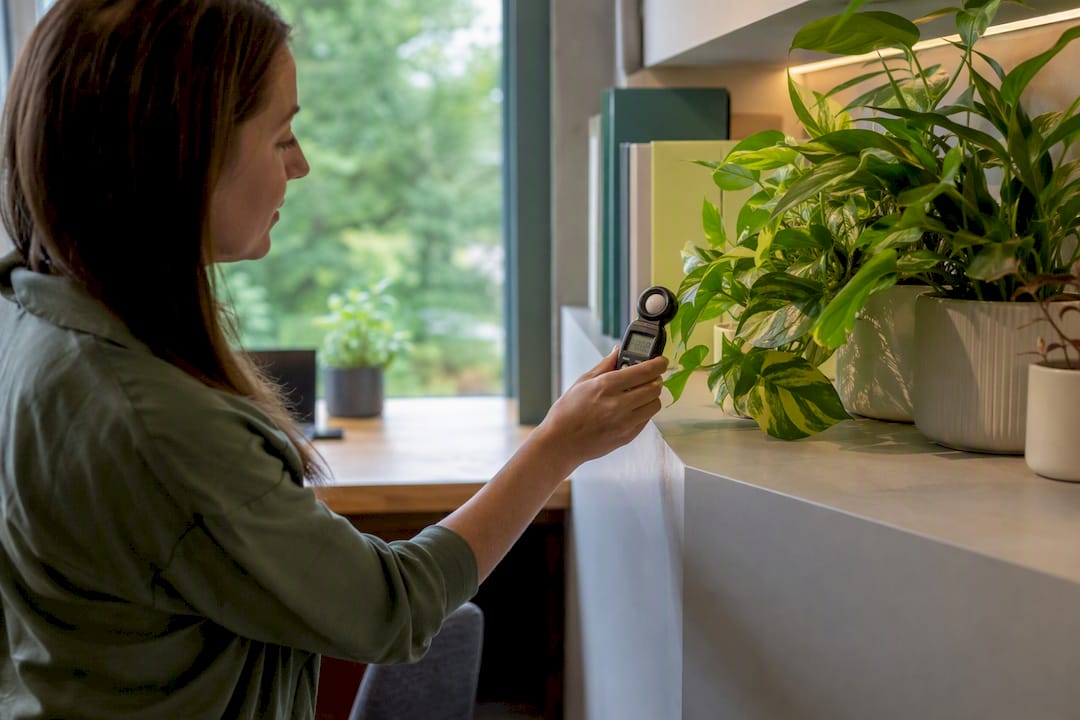
Pro Tip: Don't rely on your gut for "low" versus "bright" light. A cheap lux meter app on your phone gives you an actual number, and it takes the guesswork out of matching plants to the room permanently.
Placement Rules That Protect Sightlines and Function
A plant that looks great in a photo can still ruin a meeting if it blocks the screen, the camera, or the exit sign. Placement in a conference room has to serve the room's actual job first, decoration second.
- Keep any floor specimen off the direct sightline between seats and the presentation screen or video camera.
- Leave at least a few inches of clearance around emergency exit signs, fire panels, and light switches at all times.
- Use grouped smaller planters instead of one oversized specimen if you want acoustic softening in a large boardroom, since clusters absorb sound without creating a single obstruction.
- Choose low-odor species for shared, enclosed rooms. Fragrant flowering plants can be distracting in a small space with the HVAC running low.
- Match planter height to the furniture around it. A tall floor planter looks intentional next to standing credenzas but awkward wedged between low lounge chairs.
A slim, upright planter tucked behind row seating fills dead space without stealing legroom. A trio of small pots on a low windowsill table adds color without asking for a second glance during a presentation. If your renovation also involves adding privacy film or frosted graphics to interior glass walls, coordinate that work with your plant placement early. Frosted glass treatments change how much ambient light reaches a room, and that shift affects which plants will actually thrive there.
A Maintenance Routine That Keeps Plants Alive
Plants in shared spaces fail quietly. Nobody notices a slow decline until the leaves are yellow and it's too late to save the specimen, which is why a routine matters more than any single care tip.
- Weekly or biweekly: Check soil moisture with a finger test, wipe dust from leaves, top up any water trays, and scan the undersides of leaves for pests like spider mites or mealybugs.
- Monthly: Give each plant a quarter turn toward its light source to prevent lopsided growth, reassess whether the light level has changed (new furniture, blocked windows), and apply a slow-release fertilizer if the plant is actively growing.
- Windowless rooms: Run supplemental grow lights on a timer for several hours daily, and check humidity if you're growing ferns or other moisture-loving species.
- Replace versus rehabilitate: A plant with mushy, blackened roots (root rot) or a pest infestation that survives two treatment rounds is usually cheaper to replace than nurse back to health.
Dusting every two to four weeks matters more than most people assume. Dust blocks light absorption, and a coated leaf can't photosynthesize efficiently even in a well-lit room.
Why Professional Maintenance Often Makes More Sense
Once you're managing more than one or two plants across a boardroom, the math starts favoring a service over DIY care. Root rot, pest outbreaks, and slow declines are the most common failure modes in commercial spaces, and they almost always trace back to mismatched species or inconsistent care, not bad luck.
- Greenspace+ starts with a site assessment covering light, sightlines, and access before any plant is installed.
- The plan includes design, installation, scheduled maintenance visits, and replacement of any plant that fails, all for one fixed monthly fee with no upfront cost.
- It's particularly useful for high-use boardrooms, windowless rooms that need lighting coordination, or organizations managing plants across multiple office locations.
If your conference room sees daily back-to-back meetings or your facilities team is stretched thin, a scheduled maintenance program removes the guesswork of who's responsible for watering on any given week.
What Conference Room Plants Actually Cost
Buying a single plant for a conference room is inexpensive. A snake plant or ZZ plant in a 10 inch pot typically runs somewhere in the range of a modest one-time purchase at a garden center, while a large floor specimen like a rubber plant or dracaena in a decorative planter costs more due to its size and the planter itself. Custom or premium planters add another layer of cost on top of the plant, since finish, material, and size all vary widely.
The bigger cost driver over time isn't the initial purchase. It's replacement. A plant that dies from light mismatch or neglect within a few months means paying for a new specimen, and that cycle repeats until someone fixes the underlying care problem. Ongoing maintenance, whether handled in-house through staff time or contracted out, is the recurring cost that determines whether your initial investment holds up.
A monthly all-inclusive service folds design, installation, and ongoing care into one predictable fee with no separate bill for replacements. That structure tends to appeal to office managers who would rather budget a fixed monthly number than face a surprise expense every time a plant declines. Compare that against the alternative: buying plants outright, then either training staff to maintain them or absorbing the cost of periodic replacement when care lapses.
Allergy Considerations When Choosing Office Plants
Most common conference room plants pose a low risk for airborne allergies since the species on this list rarely produce significant pollen indoors. Flowering plants like the peace lily are the main exception worth a second look, since some people are sensitive to strong scents in an enclosed space, even without a true pollen allergy.
Foliage plants like the snake plant, ZZ plant, pothos, and parlor palm are generally considered safe choices for shared spaces because they don't flower under typical indoor conditions and don't release noticeable amounts of pollen. If anyone on staff has a known plant sensitivity or asthma triggered by mold, pay closer attention to soil moisture management rather than species selection. Overwatering creates the damp conditions where mold can develop in the soil, and that's a more realistic irritant in an office than the plant's leaves or flowers themselves.
If allergy concerns are a genuine issue for your team, stick to the low-odor, non-flowering species already recommended for sightline and styling reasons elsewhere in this guide. That overlap isn't a coincidence. The plants that work best for conference room practicality also tend to be the safest choices for shared-air sensitivity.
What the Research Actually Supports (and What It Doesn't)
Most advice on office plants treats every room the same, as if a corner office with south-facing windows and a windowless internal boardroom have identical needs. They don't, and treating them as interchangeable is where a lot of plant budgets get wasted.
The conventional wisdom oversells the productivity angle. Yes, some studies point to comfort and wellbeing gains from indoor plants, but that research is thinner and more mixed than most workplace blogs let on. The stronger, better-supported case for conference room plants is simpler: they make rooms feel less sterile, and they're inexpensive enough that the aesthetic payoff alone justifies the cost.
What gets underweighted is maintenance planning. Most guides list plants, then treat care as an afterthought. In reality, the plant selection matters less than whether someone, staff or a contracted service, actually owns the watering schedule. A perfectly chosen ZZ plant still dies without anyone checking on it for two months. Prioritize the care plan first, then let plant selection follow from the room's real light conditions, not the other way around.
— Nicole
Let Greenspace Plants Handle What Comes After Selection
Picking the right species solves half the problem. Keeping it alive through six months of back-to-back meetings, HVAC drafts, and forgotten watering schedules is the harder half, and it's the part Greenspace Plants exists to take off your plate. Rather than buying plants outright and hoping someone remembers to water them, Greenspace+ gives you design, installation, and ongoing care for one fixed monthly fee, with no upfront cost and a healthy plant guarantee if something declines.
That guarantee matters most in exactly the rooms this guide has focused on: windowless boardrooms, high-traffic meeting spaces, and offices managing greenery across multiple locations. If you're weighing a custom installation with premium planters or want to see how indoor plant design could work in your specific layout, request a site review and get a plan built around your room's actual light and traffic, not a generic template.
Sources
- 15 Best office plants — The Spruce
- The ultimate guide to office plants — RHS
- Growtronics — supplemental lighting and indoor growing guidance