
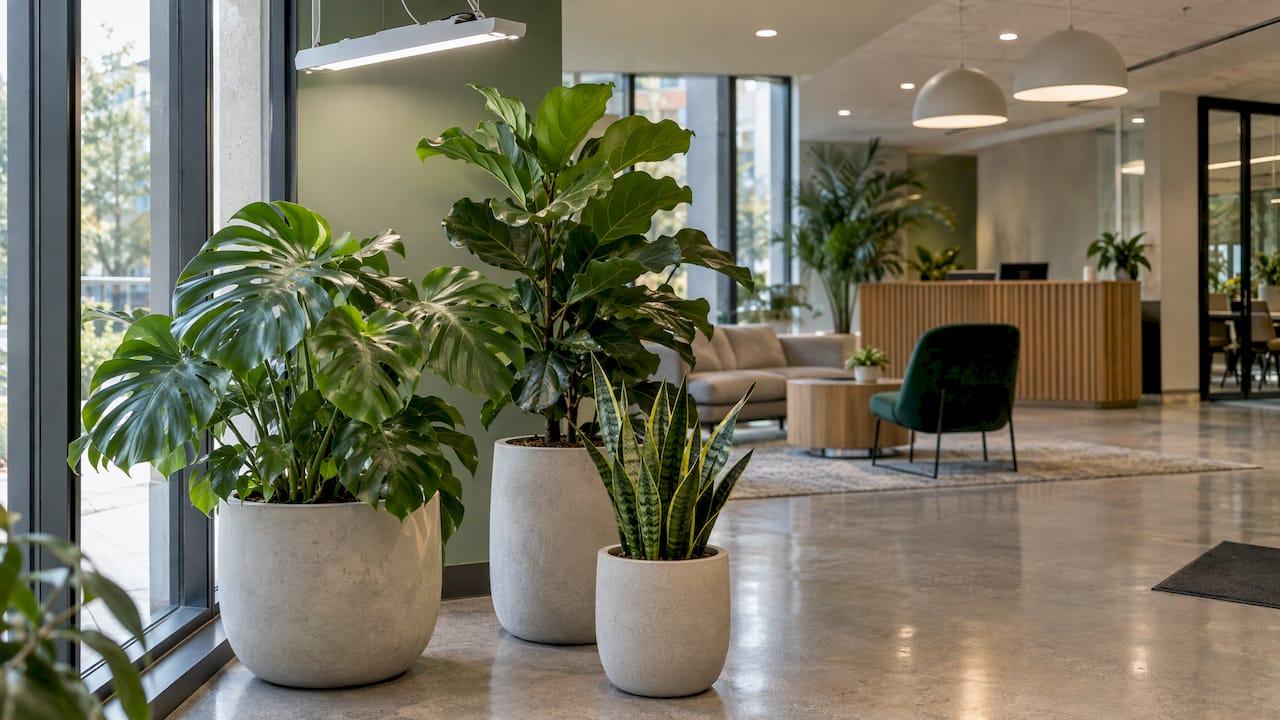
Sunlight is stronger than any grow light you'll put in an office. A good full-spectrum grow light can still keep many indoor plants healthy when a window can't. The real question is how much light your space gets, and whether the plants suit it.
We design, install and care for plants in offices, hotels, restaurants and retail across Toronto, Vancouver and Calgary. Light is the first thing we look at in every space. Here is what we've learned, backed by university research.
Key Takeaways
- Sunlight is far more intense than grow lights. The Spruce notes that grow lights are not as powerful, yet a high-quality full-spectrum light can stand in for the sun when used correctly.
- A window is weaker than it looks. Light drops sharply a few feet from the glass, so a bright room can still be dim for a plant.
- Canadian winters make the gap bigger. From October to February, natural light is limited, and that is when a grow light helps most.
- Choosing plants to match your light is often the simplest, best-looking fix, and you may not need a fixture at all.
- Spectrum matters, but duration and intensity matter more. Most failures come from too little light, not the wrong colour.
Table of Contents
- How sunlight and grow lights really differ
- Quantity beats quality
- What a window really gives you
- Why Canadian winters change the answer
- When grow lights make sense
- When sunlight (and the right plant) is enough
- Grow lights vs sunlight at a glance
- The design side most guides skip
- Our perspective
- A simple decision guide
- Greenspace+ keeps the light question off your desk
- FAQ
- Sources
How sunlight and grow lights really differ
There are two differences: intensity and spectrum.
Intensity is how much light reaches the leaves. Spectrum is the mix of colours in it.
Sunlight wins on intensity by a wide margin. The University of Kentucky Extension reports that a sunny summer day delivers 10 to 12 thousand foot-candles outdoors. Next to a south-facing window indoors, it may reach 1,000 foot-candles. Ten feet away, it can drop to 100.

That is a steep fall. A plant in the middle of a lobby may get a tiny fraction of what the same plant would get outside.
Sunlight also has every colour. The Peterborough & Area Master Gardeners explain that natural light includes the whole spectrum, which is why full-spectrum lighting is the best match for it.
Why plants care about colour
Plants use mostly blue and red light. The Royal Horticultural Society says that blue light generally stimulates growth, while red light matters for growth and for flowers.
The New York Botanical Garden's research guide adds that blue light is best for foliage, and warm red light is needed for plants to flower and fruit.
For most office plants, foliage is the point. That makes the colour balance a bit less critical than it sounds.
What LED fixtures usually deliver
Virginia Tech Extension explains that LED fixtures are generally designed with less than 20% to 30% blue light. Many have more than 70% red, because red LEDs are more energy efficient.
More blue gives smaller leaves and shorter stems. That is a tighter, more compact plant. More red can mean looser growth.
This is why some grow lights glow pink or purple. It works for plants, but it does not look great in a reception area. White-looking full-spectrum fixtures are a gentler fit for a designed space.
Quantity beats quality
It's tempting to obsess over spectrum. The research points elsewhere.
The University of New Hampshire Extension notes that failure under lamps is more often about quantity (intensity and duration) than quality (spectrum).
They use a bucket analogy in a separate fact sheet. A tomato seedling can fill its daily light bucket in about five hours of full sun. Under a fluorescent light, it may need 22 hours, because the sun puts out far more photons every second.
That bucket idea is useful for any plant. Dim light isn't wrong. It just takes longer to fill the bucket.
Light terms, in plain words
You'll see three measures on spec sheets.
- Lux or foot-candles: how bright a spot looks to the eye.
- PPFD: how much usable light reaches the plant at a moment, measured in micromoles per square metre per second.
- DLI (Daily Light Integral): the total usable light over a full day. Iowa State Extension calls it one of the most important measurements for growing plants under lights.
If you want to go deeper on matching these numbers to an office, we wrote a guide on lux, PPFD and DLI for office plants.
What a window really gives you
Many people hear "bright room" and think "sunny." Plants disagree.
The University of Maryland Extension lists what changes window light: curtains, insect screens, weather, the season, shade from trees and buildings, and even how clean the glass is. It also notes that intensity falls quickly as distance from the source grows.
It cites a peak of about 10,000 foot-candles for direct outdoor sun. Compare that with what Kentucky says most houseplants need: about 150 to 500 foot-candles for normal growth.
So a plant near a clean window can do well. A plant across the room, behind blinds, may be starving. The room looks bright to you because your eyes adjust. Plants don't.
If you're curious how designers think about brightness in work areas, this piece on office lighting levels is a good companion read.
A quick walk-through of your space
- Stand where the plant would sit at midday.
- Ask: can I see a clear patch of sun on the floor or desk? That is bright light.
- If you see soft shadows only, that is medium light.
- If you see no shadow at all, that is low light.
- Repeat in the morning and late afternoon. Light moves.
- Repeat in December. It changes more than you expect.
Why Canadian winters change the answer
Light is not constant across the year. In Canada, it swings a lot.
A HortScience study done near Hamilton, Ontario, found that low natural daily light limits greenhouse production from October to February. Natural outdoor DLI in southern Canada during those months typically runs between 5 and 15 mol per square metre per day.
That is outdoors, in a greenhouse-friendly setting. Indoors, behind glass and away from the window, the number is lower still.
The University of Saskatchewan says that grow lights are used indoors because the sun is often not strong enough in winter, and through a window, to grow fruiting plants.
For an office, this means the plant that looked happy in July can sulk by January. Leaves drop. Growth stretches toward the glass. It isn't a care problem. It's a light problem.
When grow lights make sense
Grow lights fit three situations well.
- Dark winter months. They top up weak daylight.
- Interior spaces with no windows. Think windowless corridors, meeting rooms or basement lounges.
- Plants with higher light needs. Flowering and fruiting plants want more than most foliage plants do.
HortScience notes that in some cases all of a crop's light can come from electric lamps. That is the plant-factory model. It works, but it is a designed system, not a lamp on a shelf.
How long to run them
The Spruce says a plant with a grow light as its only source will likely need 16 to 18 hours under it. When you're supplementing daylight, 12 to 14 hours is typical.
The New York Botanical Garden gives similar guidance: 12 to 14 hours if the plant gets some natural light, and over 16 if it gets little.
The University of Saskatchewan suggests a simpler 12 hours on, 12 hours off timer, with the light about 10 cm (4 inches) above the plant canopy. It also gives easy signs to read. Dry or scorched leaves mean the light is too close. Leggy, weak stems mean it is too far.
Use a timer. Plants like routine, and nobody in the office will remember to flip a switch.
Placement tips that save you trouble
- Hang the light above the plant. The NYBG guide says plants with mostly horizontal leaves need light from above, since most chloroplasts sit just beneath the top of the leaf.
- Keep it close. Artificial light loses strength fast with distance.
- Watch heat. Balance the warmth a fixture gives off against the plant's need for light.
- Choose a fixture that blends in. Slim bars, track-style heads and warm-white colour look best in a designed space.
When sunlight (and the right plant) is enough
Sometimes you don't need a fixture. You need a better match.
The University of Maryland Extension says light is probably the most important factor for healthy indoor growth. It advises choosing plants to suit the natural light you have, or supplementing with artificial light.
That first option is the one we use most. Low-light plants such as snake plants, ZZ plants and pothos tolerate dim corners well. Brighter spots can take bolder, bigger statement plants.
Our team put together a guide on low light office plants. Our post on how lighting shapes plant selection explains how we read a space before we choose.
Grow lights vs sunlight at a glance
| Sunlight through a window | Grow light | |
|---|---|---|
| Intensity | High near glass, falls fast with distance | Steady, but weaker than the sun |
| Spectrum | Full spectrum | Depends on the fixture |
| Winter in Canada | Short days, low angle | Same strength all year |
| Control | None | Timer, height, placement |
| Look | Natural | Visible fixture in the space |
| Best for | Plants near windows | Dark rooms, winter top-ups |
The design side most guides skip
A plant that is alive isn't the same as a plant that looks good. Under weak light, plants stretch and thin out. Leaves drop. Colour fades. That's the look that makes a space feel neglected.
So light is a design decision as much as a growing one. It shapes which plants you can use, where they can sit, and how full they look.
When we plan a space, we think about:
- where people enter and what they see first,
- which walls or corners need greenery to feel finished,
- how much light each of those spots really gets,
- and which plants will look full there all year.
Then we choose the plants and planters to suit. See our plant selection guide for the kinds of plants we use in commercial spaces.
Our perspective
Most people ask us whether they need grow lights. We start with a different question: what does the space look like at 3 p.m. in January?
That answer tells us a lot. If the light is decent, we choose plants that thrive in it. If a corner is truly dark, we say so and plan around it.
We've spent years caring for plants in offices, hotels, restaurants and retail. We now look after 60,000+ plants in 400+ commercial locations. The pattern is clear. Plants do best when the design starts with the light, not when we fix the light afterward.
That is why we handle design, installation, care and replacements together in Greenspace+. If a plant struggles, we replace it. You don't have to diagnose a thing.
Nicole
A simple decision guide
Use this to decide fast.
- Bright window, clear patch of sun? Pick sun-loving plants. No fixture needed.
- Medium light, soft shadows? Choose adaptable plants. Consider a light in deep winter.
- No shadows, no windows? Use low-light plants, or add a full-spectrum light on a timer.
- Want flowers or fruit indoors? Plan for added light. Sunlight through glass often falls short.
- Want it to look great without fuss? Let us handle the plan and the care.
Greenspace+ keeps the light question off your desk
We're Canada's leading commercial-only indoor plant service, founded in 2014. We are WBE Canada certified (woman-owned). We serve offices, hotels, restaurants and retail in Toronto, Vancouver and Calgary. We also run national programs for multi-location brands, including in the US.
With Greenspace+, you pay a fixed monthly fee, from $299 per month. It covers plant design, installation, regular maintenance and plant replacements. There are no upfront costs and no long-term commitments. Our healthy plant guarantee is built into how we work.

Want to see how we'd handle your space? Browse our client look-book, or start with Plant Care Maintenance if your plants are already in place.
FAQ
Is the sun better than grow lights?
Yes, for raw intensity. The sun delivers far more usable light than any indoor fixture. But a window loses much of that strength within a few feet. A good full-spectrum grow light can fill the gap in winter or in dim rooms.
Can plants grow with artificial light alone?
Many can. The Spruce says a high-quality full-spectrum grow light can substitute for sunlight when used correctly. Expect to run it longer, around 16 to 18 hours a day. Flowering plants need more light than leafy ones.
Does sunlight through a window count as direct sunlight?
Not quite. Glass, screens, curtains and distance all cut the intensity. Even next to a south window, indoor light is a fraction of full outdoor sun. Treat window light as bright or medium, not as full sun.
How many hours should a grow light stay on?
It depends on how much daylight the plant gets. The New York Botanical Garden suggests 12 to 14 hours with some natural light, and over 16 with little. A timer keeps it consistent.
What helps indoor plants grow better without grow lights?
Place them where the light is strongest, wipe dusty leaves and window glass, and choose species that suit the light you have. Rotate plants now and then so they don't lean.
Sources
- The Spruce: Do Grow Lights Work?
- University of Kentucky Extension: lighting guide
- Peterborough & Area Master Gardeners: Growing Under Lights
- RHS: Artificial Lighting for Indoor Plants
- New York Botanical Garden: Artificial Light for Houseplants FAQ
- Virginia Tech Extension: Choosing LED Grow Lights
- University of New Hampshire Extension: Optimizing Plant Growth with Indoor Lighting
- University of New Hampshire Extension: Growing Seedlings Under Lights
- Missouri Extension: Understanding Grow Lights
- Iowa State Extension: Supplemental Light for Indoor Plants
- University of Maryland Extension: Lighting for Indoor Plants
- HortScience: Microgreen Genotypes Study
- University of Saskatchewan: Lights for indoor growing
- HortScience: LED Lighting, A Grower's Guide to Light Spectra
- Upscale Interiors: The Right Lighting in the Study