
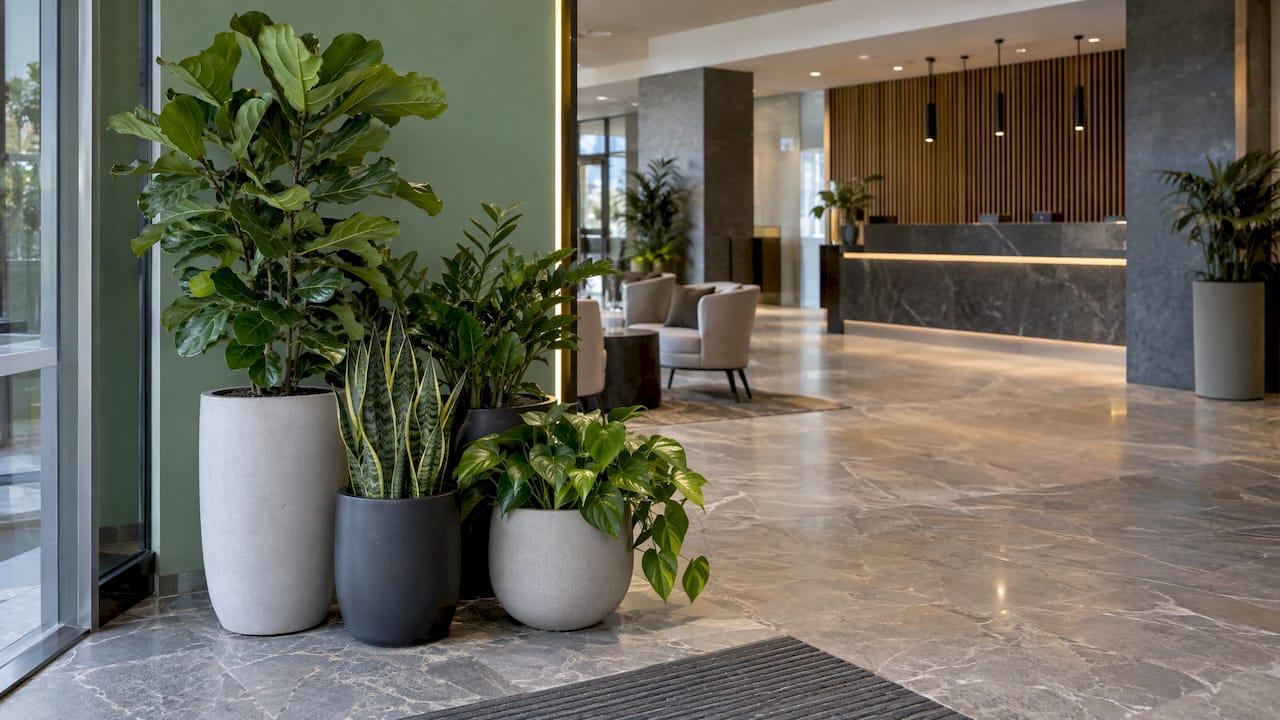
The best hotel lobby plants are the ones that still look full and healthy in month twelve. That takes three things: the right plant for your light, a layout that keeps guests moving, and a care routine that never lapses. We are Greenspace Plants, Canada's leading commercial-only indoor plant service, founded in 2014. We design, install and care for plants in offices, hotels, restaurants and retail across Toronto, Vancouver and Calgary. This guide shows you how to get the lobby right.
Key Takeaways
- Start with light, not style. Plants more than 15 feet from a window usually need added artificial light.
- Place greenery on the sightline from the entrance, and keep it out of walkways, doors and luggage paths.
- Choose non-toxic, low-allergen plants for a space where children and guests of all kinds pass through.
- Lobby plants need steady care: watering, pruning, pest checks and quick replacement of tired plants.
- A fixed monthly service takes all of this off your team's plate. Greenspace+ starts from $299 per month.
Table of Contents
- Why the lobby plant decision matters
- Start with light
- Choose plants by role
- Arrange for guests, not just for photos
- Keep guests safe: toxicity and allergies
- What lobby plants need after install
- Why a monthly plant service suits a hotel
- Our perspective
- Where to go from here
- FAQ
- Sources
Why the lobby plant decision matters
The lobby is the first room a guest sees. It sets the mood before anyone says hello.
Plants do a lot of that work. They soften hard surfaces like stone, glass and steel. They add colour and height. They make a big room feel human in scale.
But a lobby is also a hard place for a plant. Doors open and close. Light changes by the hour. Guests brush past with luggage. A plant that looks good on a mood board can fail here in weeks.
So the goal is not just "add greenery." It is to build a lobby that looks the same in February as it did on opening day. If you want to see what that looks like, our guide to well-maintained building lobbies shows real examples.
Start with light
Light decides which plants live. Everything else comes second.
Walk your lobby at three times of day. Note where the sun lands, where it never reaches and where it comes in hard through glass. Then match plants to those spots.
Two useful rules of thumb:
- Plants more than 15 feet from a window typically do not get enough natural light and need artificial light supplementation, according to an interior plantscaping guide for architects.
- Low-light stairwells and hallways are the worst spots for houseplants, says the University of Saskatchewan. Only a few species, such as sansevieria, tolerate low artificial light.
The same University of Saskatchewan source warns against putting plants near doorways and frequently opened windows. Cold drafts can kill them. In a Canadian winter, that matters most at your vestibule and main entrance.
The lesson: a lobby with a dark corner does not need a struggling plant in it. It needs a different solution, such as a planted feature lit on purpose, or a statement planter placed where the light is good.
Choose plants by role

Think of lobby plants in jobs. Each spot has one.
Arrival: the tall statement
The first thing a guest sees should have height and shape. Tall, sculptural plants in strong planters work well on the main sightline from the door. If your lobby has a double-height ceiling, our buyer's guide to plants for high-ceiling atriums covers what scales well.
Reception: soft and low
At the front desk, greenery should frame the staff, not hide them. Keep it below eye level at the counter. Use full, layered plants that soften the hard edge of the desk.
Seating: calm and private
In lounge areas, plants can create a sense of privacy and take the edge off noise. One study of indoor green spaces notes this kind of comfort role for plants alongside their looks. Group two or three plants of different heights rather than lining up identical ones.
Busy walls: a green wall
Where floor space is tight, go vertical. Moss walls and green walls add a lot of green without taking up the footprint a guest needs. We install both. See our green walls page for the options.
A quick planning table
| Lobby zone | Goal | What works |
|---|---|---|
| Entrance sightline | Make an impression | Tall, sculptural plant in a large planter |
| Reception desk | Soften, never block | Fuller, lower plants, kept off the counter edge |
| Lounge seating | Calm and privacy | Grouped plants of mixed height |
| High-traffic wall | Greenery without floor space | Moss wall or green wall |
| Dim corner | Avoid a struggling plant | Lit feature or a better-lit spot |
Arrange for guests, not just for photos
A beautiful lobby that blocks a guest with two suitcases is a bad lobby.
Build the layout around movement:
- Keep main paths clear. Hotel design guidance says to avoid putting planters in the main circulation path, and to leave enough queue space at the counter and extra room for luggage.
- Leave a clear route around floor pieces. One design article cites a 36-inch (915 mm) clear route from the 2010 ADA Standards, a U.S. accessibility standard. In Canada, check the accessibility requirements that apply to your building and province.
- Avoid pinch points. The same article advises keeping arrangements away from spots beside elevators, revolving doors and security gates.
- Mind the height ratio. It also suggests arrangements at least 1.5 times the height of their container, so the planter does not dominate the plant.
- Plan for the technician. Spots over doorways or on high ledges can be harder for technicians to maintain. The same guide recommends not placing permanent planters over pipe or electrical runs.
A large atrium project makes the point well. A 2024 study of the Hotel Jakarta atrium garden in Amsterdam stresses that accessibility for maintenance and traffic safety must be planned in from the start.
If you are planning a bigger feature, 3D renderings of planters can help you see scale and placement before anything is built.
For more on how to protect plants in busy spaces, read our guide to indoor plants for high-traffic areas.
Keep guests safe: toxicity and allergies
Hotels host families. Children touch things. Plants need to be chosen with that in mind.
A Canadian review in a medical journal reports that plants are consistently among the top causes of unintentional ingestions in children. It names holly, mistletoe, Jerusalem cherry and yew as toxic, with berries the most toxic part. It lists Swedish ivy, jade, dracaena, schefflera, African violets and coleus as nontoxic choices.
The authors also note two things many managers miss:
- Holiday stays disrupt routines, and children may have less supervision than usual. Festive decorative plants deserve extra care.
- Pot soil treated with fertilizers or pesticides can also cause poisoning if swallowed.
If a child eats any part of a plant, call your local poison control centre right away.
Allergies matter too. The 2024 indoor green space study recommends non-toxic, low-allergen plants and avoiding pollen entering the ventilation system. In practice, that means choosing foliage plants over heavy bloomers for the lobby, and keeping soil tidy and covered.
This is a good reason to plan your plant list with a specialist. Our indoor plant selection page shows how we approach it.
What lobby plants need after install
Install day is the easy part. Months three through twelve are where lobbies lose their shine.
A good care routine covers:
- Watering on a schedule matched to each plant, not one rule for all.
- Pruning. The 2024 study recommends maintenance pruning four to five times per year, plus guidance pruning in the first months.
- Pest checks every visit, so small problems stay small.
- Feeding in the growing season. A Canadian plantscaping firm's lobby guide suggests balanced liquid fertilizer during growth.
- Rotation so each plant gets even light and grows straight.
- Replacement of anything dead or wilted. The study says this should follow a horticulturist's advice.
That is a lot of small jobs. Front desk and housekeeping teams already have full days. Plants that get watered "when someone remembers" tend to decline slowly, and guests notice before you do.
Why a monthly plant service suits a hotel
Hotels run on consistency. The lobby should look the same every day, and nobody on your team should have to think about it.

That is what our all-inclusive service, Greenspace+, is built for. For a fixed monthly fee, you get plant design, installation, regular maintenance and plant replacements. There are no upfront costs and no long-term commitments. It starts from $299 per month.
We stand behind a healthy plant guarantee. If a plant is not thriving, we replace it. You do not chase a supplier or write another purchase request.

If you would rather own your plants, we also offer one-time purchases with optional ongoing care. Look at Greenspace+ or compare your options to see which fits your property.
For design-led projects, we work with interior designers and bring plant expertise to the table. See Indoor Plant Design for how that works. For lobby ideas specific to the sector, read our piece on plant design for hospitality.
Our perspective
We have been doing this since 2014. We only work on commercial spaces, and that focus shapes everything.
A hotel lobby is not a big living room. It is a stage, a waiting room and a thoroughfare, all at once. The plants have to look good under that pressure, every day.
Here is what we believe. Design and care belong together. The same team that picks the plants should be the team that looks after them. That is how you avoid the lobby that looks great for six weeks and tired by spring.
We care for more than 60,000 plants in over 400 commercial locations. We are WBE Canada certified, which means we are a woman-owned business. We also run national programs for multi-location brands, including in the US, so a hotel group can have the same standard in every city.
Our advice is simple. Pick plants for your light. Keep paths clear. Choose safe species. Then hand off the routine to people who do it every day. Your guests will feel the difference before they can say why.
Nicole
Where to go from here
If you manage one lobby, start with a walk-through. Note your light, your traffic paths and the spot a guest sees first. Those three notes will shape every plant decision.
If you manage several properties, our National Account Plant Program is built for multi-location brands. And if you want a look at our past work, the design portfolio is a good place to begin.
FAQ
What are the best plants for a hotel lobby?
The best plants are the ones that suit your light and your guests. Tall, sculptural plants work well at the entrance, and fuller, lower plants suit reception. Choose non-toxic options such as dracaena or schefflera where children are present. Our design team can match species to each spot.
How much light do lobby plants need?
Most need bright, indirect light. Plants more than 15 feet from a window usually need artificial light added. Dark corners and drafty doorways are the hardest places, so place plants away from them or light them on purpose.
Are lobby plants safe for children and guests with allergies?
They can be, with careful choices. Pick non-toxic, low-allergen plants and avoid toxic holiday plants such as holly and mistletoe. Keep soil tidy, since treated soil can cause poisoning too. If a child swallows any plant material, call poison control.
Who looks after the plants once they are installed?
With Greenspace+, we do. The fixed monthly fee covers regular maintenance and plant replacements, so your team does not have to water, prune or swap plants. Our plant care maintenance page explains the service.
Sources
- Designing with houseplants, University of Saskatchewan
- An Architect's Guide to Interior Plantscaping for Biophilic Design
- Hotel Reception Desk Design Guide for Lobbies
- Designing Floral Arrangements for Hotel Lobbies and Reception Areas
- Implementing biophilic design in architecture through three-dimensional green spaces
- Beware the mistletoe, PMC
- Lobby Plant scaping
- 3D Product Rendering for Planters and Plant Pots