
Most Canadian offices pay a range of monthly fees for professional interior plant maintenance, varying with plant count, square footage, and service frequency. Providers typically bill through one of three models: plant-as-a-service (an all-inclusive rental and maintenance fee), a purchase-plus-maintenance arrangement, or a lease structure. Whichever model you choose, normalize every quote to its annual total cost, including replacements, before comparing numbers.
TL;DR:
- Interior plant maintenance costs are heavily driven by plant size, species, service frequency, and logistical challenges, with larger projects exceeding $250 weekly.
- The most predictable total cost comes from all-inclusive programs that bundle design, maintenance, and replacements into a fixed monthly fee, typically around $380 to $500 or more for mid-sized offices.
- Comparing quotes requires converting all proposals to annual costs, including setup, replacements, and travel, rather than relying solely on monthly fees.
- Proper maintenance includes moisture checks, controlled watering, pruning, fertilization, pest monitoring, and detailed documentation, not just watering plants.
- Outsourcing plant care often saves hidden costs over in-house programs, as facilities teams benefit from predictable billing and professional management, especially in multi-location offices.
Table of Contents
- What Do the Different Interior Plant Maintenance Pricing Models Mean?
- What Actually Drives the Cost of Plant Maintenance?
- What Do Sample Monthly Budgets Look Like for Canadian Offices?
- What Should Be Included in a Professional Plant Maintenance Visit?
- How Do You Compare Interior Plant Maintenance Quotes Properly?
- Should You Maintain Plants In-House or Outsource the Program?
- How Does Greenspace Plants Structure Interior Plant Maintenance Pricing?
- A Note on Procurement Discipline From Our Editorial Team
- Get a Predictable Monthly Plant Budget With Greenspace+
- Where to Verify Canadian Plant Maintenance Pricing and Scope
- Sources
- FAQ
What Do the Different Interior Plant Maintenance Pricing Models Mean?
Understanding these three models is the first real step toward controlling your interior plant maintenance cost, because each one shifts risk and cash flow differently.
Plant-as-a-service (PaaS) bundles design, installation, weekly or biweekly maintenance, and replacements into one fee, usually billed monthly. You never own the plants. This model tends to make the most financial sense for businesses that want predictable line items and minimal responsibility for plant care. According to interior plantscaping pricing data, PaaS commonly runs $0.35 to $0.85 per square foot annually.
Purchase plus maintenance means you buy the plants and containers outright as a capital expense, then pay a separate operating fee for ongoing care. Upfront CAPEX for purchased plants can run $3 to $30 per square foot, with maintenance-only OPEX between $0.15 and $0.50 per square foot per year, per the same pricing model breakdown. You own the assets, but you also own the replacement risk.
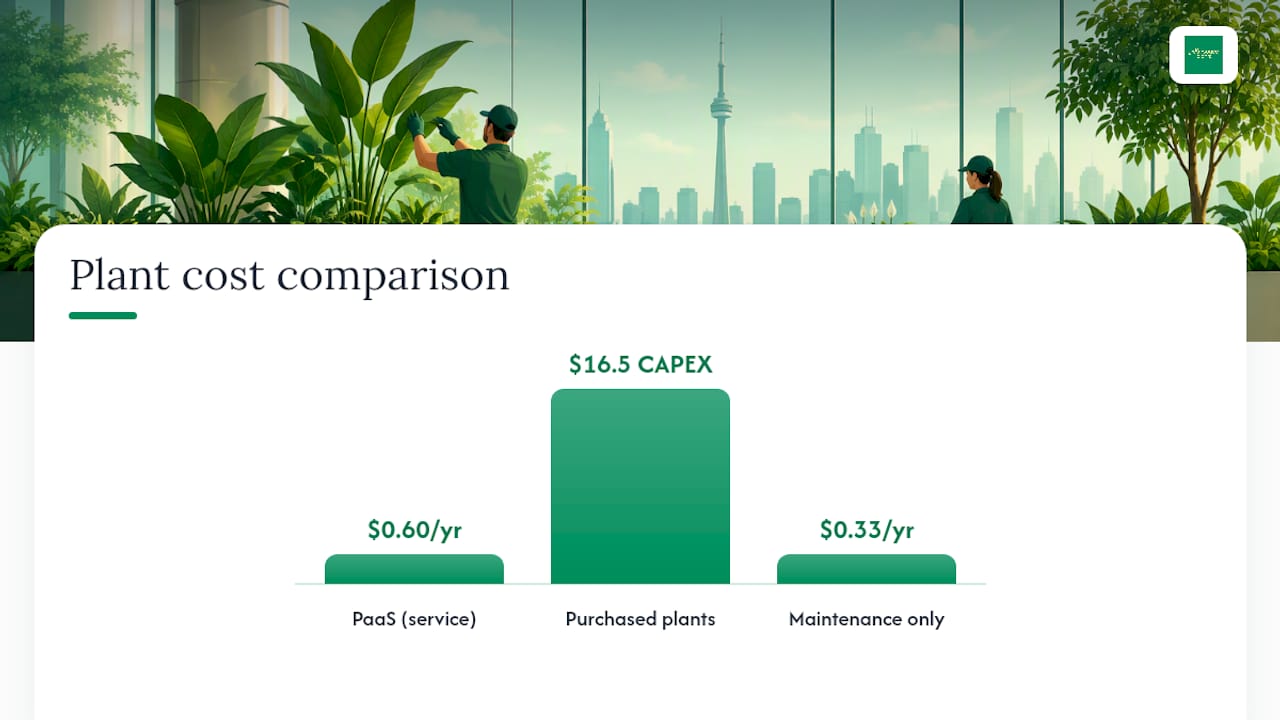
Lease or ownership-path programs sit between the two, often with contract terms tied to depreciation schedules or buyout clauses. These bands land around $0.50 to $1.20 per square foot annually, all-inclusive.
Map each model to your actual budget lines:
- Installation costs (one-time, capital or expensed)
- Recurring monthly or biweekly service fee
- Replacement allowance (built in or billed separately)
- Specialty add-ons like living walls or seasonal color rotations
What Actually Drives the Cost of Plant Maintenance?
Plant count and specimen size move the number more than anything else. A reception area with three large architectural specimens costs less to maintain than an open floor plan with 40 desk plants, simply because of the labour minutes per visit. Species matters too: a hardy ZZ plant tolerates neglect, while a fussy orchid or fern collection demands closer monitoring.
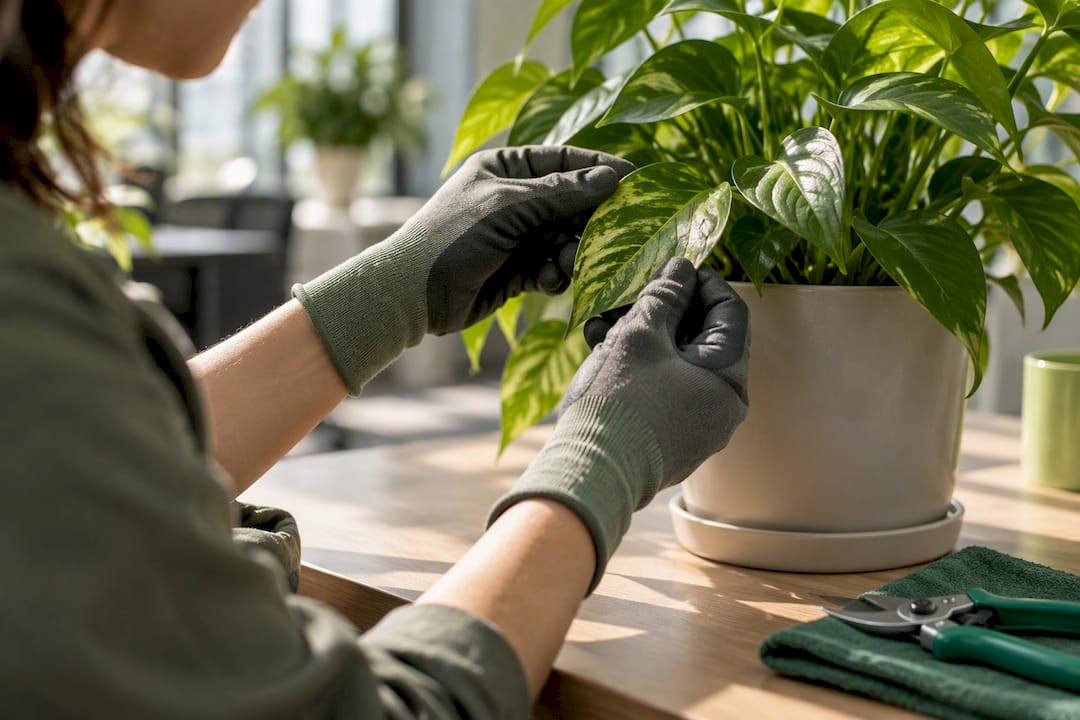
Service frequency and zone-based cadence come next. Lobbies and living walls that face constant foot traffic and lighting stress typically need weekly attention, while a back-office corner might only need a visit every two weeks.
Logistics add real cost. Multi-floor buildings, security escorts, underground parking, and after-hours access requirements all extend the technician's time on-site, and travel time between accounts is a legitimate line item, not padding.
Specialist work pushes prices higher still:
- Repotting and soil amendments for root-bound plants
- Living-wall irrigation system repairs
- Targeted pest treatment under an integrated pest management approach
- Fertilization programs tied to seasonal growth cycles
Statistics Canada's classification of interiorscape contractors confirms that estimating labour and material requirements, tendering, and supervising crews are all standard parts of this work, not hidden markups.
Pro Tip: Ask any prospective provider how they price access complexity. A quote that ignores your building's escort requirements or elevator scheduling will almost always balloon once the technician actually shows up.
What Do Sample Monthly Budgets Look Like for Canadian Offices?
Numbers help more than percentages here, so let's ground this in actual Canadian office scenarios.
A small office with 10 to 20 plants typically lands in the $95 to $175 per week range under an all-inclusive weekly billing structure, according to Greenspace Plants' own service pricing data. A medium office running 20 to 50 plants across multiple zones sits closer to $120 to $175 per week. Larger commercial programs with 50 or more plants, often spanning lobbies, living walls, and multiple floors, commonly exceed $250 per week. Translated to monthly figures, a standard mid-sized office should expect something in the $380 to $500-plus range per month for a full-service program.
To compare these numbers honestly, convert every proposal the same way:
- Multiply the monthly fee by 12 to get annual cost
- Divide annual cost by the number of scheduled visits to get cost-per-visit
- Add a replacement reserve line, since even guaranteed programs sometimes carve out exclusions
- Compare that final annual figure against a purchase-plus-maintenance path, factoring in the CAPEX you would carry on your books
Here is why this matters: a purchase-plus-maintenance program might look cheaper on a monthly maintenance invoice, but once you add the CAPEX for replacing a $400 specimen plant that didn't survive an office move, the all-inclusive model frequently wins on predictability alone.
What Should Be Included in a Professional Plant Maintenance Visit?
A visit that only involves watering is not a maintenance program. It's a liability waiting to surface. A properly scoped visit should include:
- Moisture auditing using a probe or moisture meter, not a guess based on the technician's schedule
- Controlled watering based on that reading, not a fixed volume poured on autopilot
- Drainage and liner checks to catch root rot before it spreads
- Pruning and foliage cleaning to remove dead growth and dust that blocks photosynthesis
- Fertilization on a seasonal cycle appropriate to the species
- Pest monitoring as part of an integrated pest management routine
- Environmental review of light, humidity, and airflow changes since the last visit, often included as part of environmental diagnosis services to maintain office efficiency
Documentation separates a serious provider from a hobbyist with a van. Expect written visit notes, condition flags for any struggling plant, photos when something looks off, and a clear replacement recommendation path.
Federal procurement language for interior plant maintenance contracts explicitly defines scope as covering labour, materials, equipment, supervision, and transportation. That single detail explains why two quotes with the same visit frequency can carry very different price tags.
How Do You Compare Interior Plant Maintenance Quotes Properly?
Comparing headline monthly fees side by side is how office managers get burned. Here's the sequence that actually works:
- Convert every proposal to annual total cost of ownership. Add setup fees, travel charges, replacement costs, and applicable taxes into one number, not scattered across footnotes.
- Calculate the implied cost-per-visit. Divide the annual figure by scheduled visits. A provider charging less per month but visiting half as often may cost more per visit.
- Supply a complete pre-quote package. Give every bidder the same plant inventory, floor plan, access rules, and zone priority list so quotes are apples-to-apples.
- Demand specific contract clauses. Require a written replacement guarantee, a clear definition of normal decline versus negligence, stated after-hours fees, and who pays for damage caused by cleaning crews or renovations. An Alberta procurement notice is a useful public example of how governments write these exclusions into binding contracts.
- Verify operational controls. Ask for sample visit records, technician training credentials, and confirmation of inspect-before-water discipline, since overwatering remains the leading cause of interior plant failure.
Pro Tip: Request one sample visit report before signing anything. If a provider can't produce a real example with photos and notes, assume documentation will be an afterthought once the contract is signed.
For a deeper breakdown of monthly cost ranges by office size, our guide on estimating monthly plant service costs walks through specific dollar figures for different office footprints.
Should You Maintain Plants In-House or Outsource the Program?
Running plant care with internal staff looks cheaper on paper until you count the hidden costs: training time, specialty tools, replacement plants when someone forgets to water over a long weekend, and the opportunity cost of a facilities coordinator doing horticulture instead of their actual job.
Outsourcing trades that unpredictability for a fixed monthly line item, which is exactly why so many facilities teams move toward all-inclusive contracts once they've priced out the alternative.
If you keep plant care in-house or under a purchase-plus-maintenance model, build a replacement reserve of roughly 10 to 15 percent of annual plant spend, and track every swap against that budget so surprises don't hit your quarterly numbers.
- All-inclusive programs like Greenspace+ fold that reserve into the monthly fee already.
- In-house programs need a dedicated tracking sheet for replacements, not a verbal agreement with the office manager
- Facilities teams juggling multiple locations tend to benefit most from predictable, consolidated billing
How Does Greenspace Plants Structure Interior Plant Maintenance Pricing?
One example of an all-inclusive program covers design, installation, ongoing maintenance, and plant replacements for a monthly fee starting at a published price point, with no upfront costs and no long-term commitment locking you in.
For illustrative context, a standard office program often lands between $380 and $500 or more per month depending on plant count and zone complexity, based on our own service pricing examples. We treat every visit as a documented event, not a quick watering pass, and our replacement guarantee means a struggling plant becomes our problem, not a line item on your next invoice.
A Note on Procurement Discipline From Our Editorial Team
The offices that budget well aren't the ones that find the cheapest quote. They're the ones that demand documentation. If a provider can't show you a sample visit report or a written replacement policy before you sign, that's the real cost signal, not the number on the invoice. Ask for an itemized annual total cost of ownership from every vendor you consider, and compare on that basis alone.
— Nicole
Get a Predictable Monthly Plant Budget With Greenspace+
Greenspace+ is the alternative to piecing together a plant budget from separate purchase, watering, and emergency-replacement invoices. One fixed monthly fee covers design, installation, maintenance, and replacements, with no upfront costs and no rigid contract locking your business in.
If you've read this far, you already know that the real cost of interior plants isn't the sticker price on a fiddle-leaf fig. It's the labour, the documentation, and the replacement risk that show up months later. Greenspace+ folds all three into a number you can actually put in a budget spreadsheet and defend in a quarterly review. Explore our indoor plant rental programs to see how the pricing scales for your square footage, or request a custom quote to get an itemized annual figure for your specific office.
Where to Verify Canadian Plant Maintenance Pricing and Scope
For readers who want to check the source documents behind Canadian pricing norms, the CanadaBuys award notice for interior plant maintenance shows how federal contracts define scope. The interior plantscaping pricing model breakdown offers per-square-foot norms across all three billing structures. Statistics Canada's contractor classification confirms labour and transport as recognized cost components in this industry.
Sources
- EJ196-240770_AMD 006_Interior Plants Maintenance - Award Notice | CanadaBuys
- Interior Plantscaping Pricing Models
- Indoor Office Plant / How Much Does a Commercial Indoor Plant Service Cost?
- Statistics Canada classification for relevant contractor activities
FAQ
How Much Do Indoor Plants Cost for a Commercial Office?
Indoor plant purchase prices for commercial spaces vary widely by size and species, but ongoing maintenance typically costs more over a year than the initial plant purchase. A standard office program with professional maintenance often runs $380 to $500 or more per month, depending on plant count and zone complexity.
What Is the Lowest-Maintenance Indoor Plant for an Office?
Snake plants (Sansevieria) and ZZ plants are widely considered the most forgiving options for office environments because they tolerate low light and irregular watering. They still need periodic dusting, pest checks, and moisture monitoring under a professional program, just less frequently than ferns or flowering species.
Which Plant Removes the Most Airborne Mold?
Certain common houseplants, including English ivy and some ferns, have shown mold-reduction results in controlled studies, though real-world office air quality depends on far more than plant selection alone, including ventilation and humidity control. No single plant is a substitute for proper HVAC maintenance.
How Do You Maintain Interior Plants in a Commercial Space?
Professional maintenance covers moisture auditing, controlled watering, drainage checks, pruning, foliage cleaning, fertilization, and pest monitoring on a set schedule matched to each zone's risk level. Providers should document every visit with written notes and photos, and a program like Greenspace+ folds all of this, plus replacements, into one monthly fee.