
The plants that consistently thrive on living walls are ferns, heuchera, bergenia, sedum, thyme, and indoor trailers like pothos, but the species list matters less than most people assume. Whether any of them survive comes down to matching irrigation capacity and system type (pocket, tray, or trellis) to the plant's root habit and water needs. Before you pick a single plant, confirm your wall's light exposure and which system you're building. That decision filters your options faster than any plant list can.
TL;DR:
- Proper irrigation and zoned watering systems are critical, as most living-wall failures occur due to irrigation issues within 48 hours of a plant's roots drying out.
- Wall orientation significantly influences plant selection, with shaded walls favoring ferns and heuchera, while sunny walls require drought-tolerant species like sedum and thyme.
- Matching plant root habits to the chosen system (trellis, modular, or freestanding) is essential; deep-rooted climbers won't thrive in shallow pockets, and shallow perennials need reliable irrigation.
- Planting density should be around 40 to 50 plugs per square meter, emphasizing evergreen species to maintain visual consistency through winter, with layout designed for easy maintenance and plant replacement.
- Ensuring structural support, waterproofing, and correct integration from the outset prevents long-term issues, and outsourcing maintenance through a managed service guarantees sustained wall health.
Table of Contents
- Plant Types and Where They Work
- Which Plants Work Best for Each Exposure?
- How Does the System Type Change Your Plant Choices?
- How Many Plants Do You Need Per Square Meter?
- Why Irrigation Failure Is the Top Cause of Living Wall Death
- What Happens to Living Walls in Winter?
- How Do You Choose the Right Plants for Your Wall?
- How Do You Manage Pests and Disease on a Living Wall?
- What Nutrients Do Living Wall Plants Need?
- What Are the Best Practices for Installing a Living Wall?
- What Environmental Benefits Do Living Walls Provide?
- What I've Learned Watching Living Walls Succeed and Fail
- Get a Managed Living Wall Without Managing It Yourself
- Sources
Plant Types and Where They Work
Living walls fail or thrive based on category, not just species. Six broad plant groups cover almost every vertical growing scenario, and each one behaves differently once you turn a garden bed on its side.
Climbers like clematis, star jasmine, and climbing hydrangea root in the ground or a deep planter and grow up a trellis or wire framework. Their root systems need real depth and soil volume, which makes them a poor fit for shallow modular pockets but a natural choice for freestanding trellis structures.
Modular pocket perennials are the workhorses of felt and tray systems. Heuchera, bergenia, and tiarella have fibrous, shallow roots that adapt well to a few inches of growing medium, provided moisture stays consistent.
Annuals like petunias and lobelia deliver fast, dense color for a single season but need full replacement each year, which raises long-term maintenance cost.
Succulents such as sedum and sempervivum store water in their leaves and tolerate drought better than almost anything else on this list, but they resent constant moisture and rot quickly in an over-irrigated pocket panel.
Edibles like strawberries, lettuce, and herbs work in vertical systems with good drainage and consistent feeding, though pollination and harvest access become real design constraints.
Tropical and indoor foliage such as pothos, peperomia, and maranta thrive in the stable temperatures and filtered light typical of interior spaces, but most cannot handle direct sun or frost.
- Climbers: deep roots, low water once established, need real soil volume
- Modular perennials: shallow fibrous roots, need reliable irrigation
- Annuals: fast color, full seasonal replacement
- Succulents: drought tolerant, hate overwatering
- Edibles: need drainage and feeding, harvest access matters
- Tropical foliage: stable indoor conditions only, no cold tolerance
Which Plants Work Best for Each Exposure?
Wall orientation decides more of your plant list than personal preference ever will. Research evaluating 34 perennials across three years in textile-based living walls found that plant performance depends heavily on exposure and the limited root space each pocket provides, with winter survival varying widely by species. Get the orientation-to-species match wrong and even a well-irrigated wall will thin out by year two.
Shaded or north/east-facing outdoor walls need plants built for lower light and steadier moisture. The RHS recommends hardy ferns like Dryopteris and Polystichum, along with heuchera, bergenia, and tiarella for these conditions.
- Hardy ferns (Dryopteris, Polystichum)
- Heuchera
- Bergenia
- Tiarella
- Vinca (as a trailing ground cover)
Sunny south or west-facing walls call for drought-tolerant species that can handle heat radiating off masonry or siding. Thyme, sedum, and sempervivum top this list, alongside dwarf grasses like Carex oshimensis.
- Thyme
- Sedum
- Sempervivum
- Dwarf Carex oshimensis
- Erigeron
Indoor green walls live in a different world entirely, one of filtered light and stable temperature rather than weather extremes. Pothos, spider plant, maranta, peperomia, dracaena, and tradescantia handle the lower light of most offices and lobbies without dropping leaves.
Succulents in pocket panels deserve a caution: felt pockets hold moisture longer than a typical garden bed, and root rot shows up fast if the irrigation schedule was designed for thirstier neighbors. Isolate succulent zones on their own drip line whenever possible.
Edible vertical planting works well for herbs and strawberries but comes with caveats. Tomatoes and squash need too much root volume for most panel systems, and any fruiting plant depends on pollinator access, which a tightly packed indoor wall simply doesn't offer.
How Does the System Type Change Your Plant Choices?
The structure you build changes which plants can survive on it, sometimes more than climate does. Design guidance across the industry stresses treating a living wall as part of the architecture from the outset, choosing the structure to match both exposure and how much maintenance the owner can realistically commit to, as detailed with custom wall murals & large-format graphics.
Trellis and climbing systems let plants root in the ground or a deep planter, so once a climber establishes, it needs far less irrigation attention than a panel system. This is also the cheapest route: DIY trellis walls cost less than professionally installed modular systems, largely because they skip the irrigation and labor overhead.
Modular pocket and tray systems demand shallow, fibrous-rooted plants and dependable watering. Felt pockets and rigid trays behave differently here. Felt panels dry unevenly and usually need a dripper per pocket, while rigid trays hold more growing medium and forgive an occasional missed watering cycle better than felt does.
Freestanding frames work as room dividers or privacy screens and typically use deeper planters than wall-mounted panels, which opens up options like small shrubs or larger perennials that pockets can't support.
- Trellis/climbers: deep roots, low water once established, lowest cost
- Modular pockets/trays: shallow roots, high irrigation reliance
- Freestanding frames: deeper planters, more species flexibility
Pick your system before your plant list. Trying to force a deep-rooted climber into a two-inch felt pocket, or a shallow perennial onto bare trellis wire, is how good species choices turn into wasted budget.
How Many Plants Do You Need Per Square Meter?
Full coverage in a single growing season requires planting density most first-timers underestimate. Industry guidance puts the target at roughly 40 to 50 plugs per square meter, tight enough that individual plants merge into a solid green surface rather than leaving visible gaps between pockets.
Evergreen ratio matters just as much as density. Aim for a majority evergreen palette, an industry rule of thumb that keeps a wall from turning into a patchy brown grid every winter.
- Density target: 40 to 50 plugs per square meter for full-season cover
- Evergreen share: majority of the palette, ideally 60% or more
- Group plants with similar moisture needs on the same irrigation zone
- Mix cascading trailers near the top with ground-cover types lower down
- Leave an access pattern so individual pockets can be swapped without disturbing neighbors
Layout affects long-term maintenance almost as much as species selection does. A wall designed with repair access in mind, meaning individual pockets or plugs you can pull and replace without tearing into the whole panel, saves real labor when a section inevitably needs a refresh.
Why Irrigation Failure Is the Top Cause of Living Wall Death
More living walls die from bad irrigation than from bad plant choices. Practical guidance across the industry is blunt about this: irrigation problems, not species selection, cause most living-wall failures. A modular pocket panel behaves like a container plant tipped on its side, and it can dry out within 24 to 48 hours without a working drip system. That's a punishing timeline compared to a garden bed, which buffers moisture swings with real soil volume.
A functional irrigation setup for most walls includes:
- A drip header line running along the top of each irrigation zone, feeding individual drippers down to pockets or trays
- Zoning for tall walls, splitting the height into upper and lower sections so gravity and pressure loss don't starve the bottom rows
- A timer controlling cycle length and frequency, adjusted seasonally rather than left on one setting year round
- A reservoir and pump for walls without a direct water line, sized to the wall's total plant count and pocket volume
Summer cycles typically run shorter and more frequent, since heat and wind pull moisture out of shallow pockets fast. Winter cycles shrink dramatically, sometimes to a fraction of summer frequency, since plants are dormant and evaporation slows.
Ongoing maintenance beyond irrigation includes weekly visual checks for clogged drippers, seasonal pruning to control phototropic growth (plants bending toward their strongest light source), a seasonal feed, and a modest annual replacement rate for plants that simply don't make it through a full cycle. Even systems marketed as low maintenance still need this species specific moisture pairing and a set maintenance schedule to hold up over time, a point documented in practical living wall guidance.
Pro Tip: Before you finalize a plant list, ask what happens if the irrigation controller fails for 48 hours. If the honest answer is "most of the wall dies," redesign the zoning or swap in more drought-tolerant species before installation, not after.
Weight, fixings, and moisture protection matter just as much as the visible plants. A living wall holds significant water weight once saturated, so mounting hardware needs to be rated for that load, and a waterproof membrane behind the panel protects the wall structure from long-term moisture damage. Skipping the membrane to save money is one of the more expensive mistakes in this category.
What Happens to Living Walls in Winter?
Annual plants and tender perennials are gone by spring in most climates, and that's normal rather than a design failure. Perennial-heavy palettes fare much better, though winter survival still varies considerably by species, even among plants marketed as hardy.
Before the first hard freeze, insulate or drain exposed irrigation lines and cut back cycle frequency sharply since dormant plants use far less water. Pump-fed systems in cold climates often need a full winterization: draining the reservoir and disconnecting outdoor lines entirely.
- Build the palette around an evergreen core rather than annuals to reduce spring replanting labor
- Choose sheltered orientations where possible to reduce freeze-thaw stress on shallow pockets
- Reduce irrigation cycles as soon as growth slows, not after the first freeze
How Do You Choose the Right Plants for Your Wall?
A short checklist keeps plant selection from becoming guesswork, whether you're designing yourself or vetting a contractor.
- Measure your wall's aspect and light exposure across a full day, not just at noon.
- Choose your system (trellis, modular pocket, tray, or freestanding) based on maintenance capacity and budget.
- Confirm an irrigation plan exists before selecting a single plant, including zoning for height.
- Choose plant categories matched to that system's root volume and your exposure reading.
- Calculate plugs needed using the 40 to 50 per square meter benchmark, then adjust for evergreen ratio.
If you're hiring an installer, ask direct questions: How was the site assessed for light and structural load? How is irrigation zoned across the wall's height? What's the policy on spare plugs and plant replacement? Is there a winter plan for the irrigation system?
Watch for red flags before signing anything. No documented irrigation plan, a vague or unspecified plant list, and coverage promises that sound too fast for the square footage involved are the three most common signs of a wall that will look great for one season and struggle after that.
How Do You Manage Pests and Disease on a Living Wall?
Dense planting and constant moisture create ideal conditions for a handful of recurring problems. Aphids and spider mites favor the tender new growth on heuchera and tropical foliage, while fungal issues like powdery mildew and root rot show up wherever airflow is poor or irrigation runs too long.
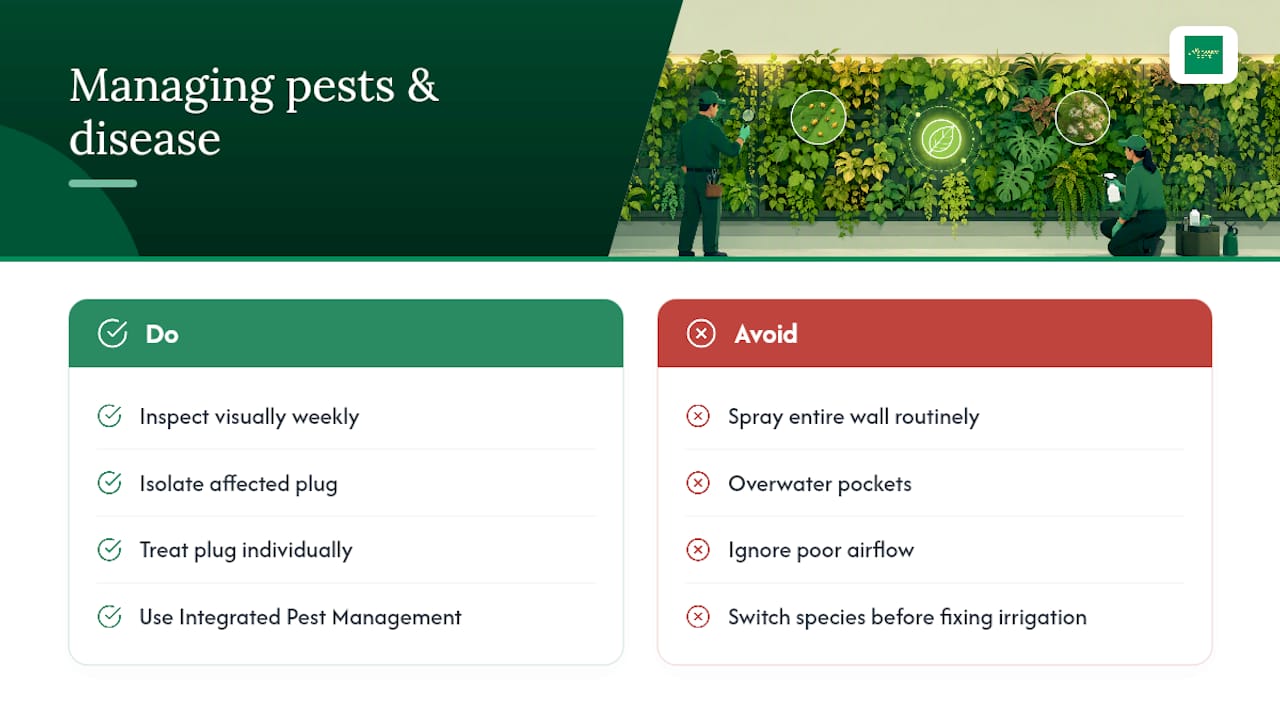
Weekly visual inspection catches most problems early, before an infestation spreads across adjacent pockets. Isolating an affected plug and treating it individually, rather than spraying the entire wall, limits chemical use and protects beneficial insects that may already be managing minor pest pressure on their own. Integrated Pest Management, meaning combining monitoring, targeted treatment, and prevention rather than routine blanket spraying, works better on a living wall than it does on a single houseplant because one overreaction can stress dozens of neighboring plants at once.
Overwatering is the root cause of most fungal problems on vertical systems, more so than the plant species itself. A pocket that never fully dries between cycles becomes a breeding ground for root rot regardless of which perennial is planted in it. Fixing the irrigation schedule usually resolves a recurring disease problem faster than switching plant species does.
What Nutrients Do Living Wall Plants Need?
Living wall substrates hold a fraction of the nutrient reserve found in garden soil, since pocket and tray systems use lightweight, free-draining growing media by design. That means plants exhaust available nutrients faster and need a more deliberate feeding schedule than the same species would in a bed.
A seasonal feed timed to active growth, generally spring through late summer, replenishes what irrigation constantly leaches out of shallow pockets. Slow-release fertilizer incorporated at planting reduces the frequency of manual feeding, while a diluted liquid feed added periodically through the drip system works well for ongoing maintenance without extra labor.
Reduce or stop feeding once growth slows in fall, since pushing new growth right before dormancy or frost leaves tender tissue vulnerable to cold damage. Matching fertilization to the plant's active season, rather than feeding on a fixed calendar, keeps the palette healthier through the transition into winter.
What Are the Best Practices for Installing a Living Wall?
Site preparation determines more of a living wall's long-term success than most people expect going into a project. Structural assessment comes first: confirming the mounting surface can bear the saturated weight of the system, plants, and growing medium combined, not just the dry weight at installation.
A waterproof membrane behind the panel protects the underlying wall from moisture migration, and proper drainage at the base directs runoff away from the building rather than pooling against the foundation. Fixings need a rating that accounts for wind load on outdoor installations, since a fully grown wall catches far more wind than the same wall on install day.
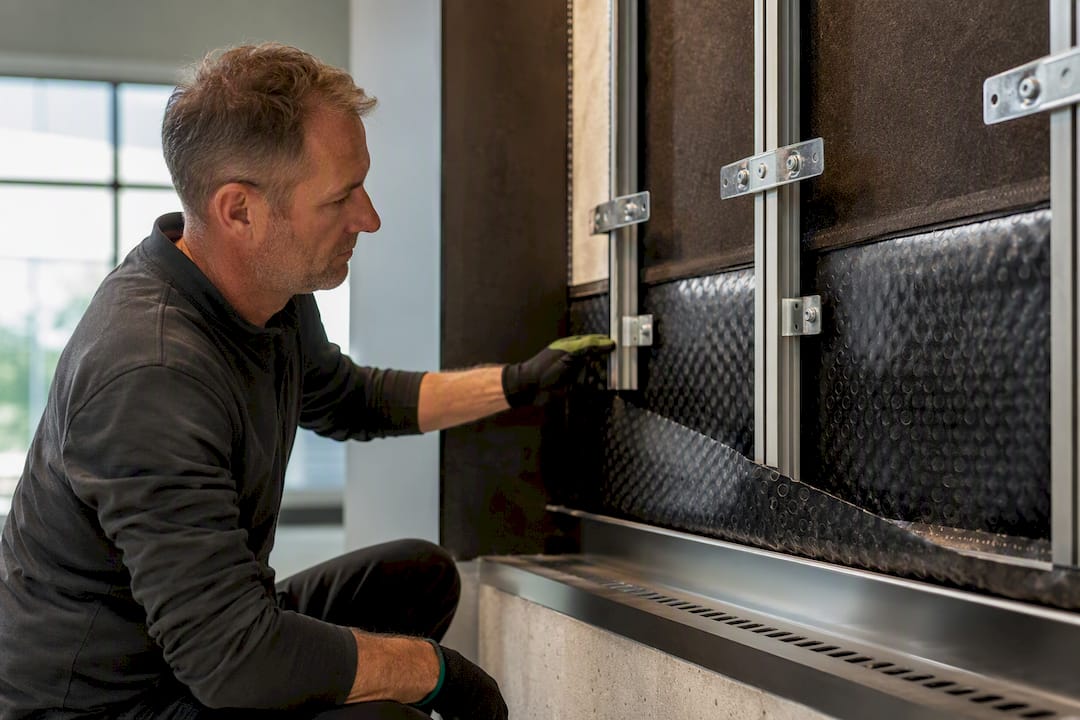
Planting sequence matters too. Installing irrigation lines and testing the full system before placing a single plug avoids the common mistake of discovering a dead zone in the drip coverage after the wall is already planted. Integrating the wall into the surrounding architecture and landscape from the design stage, rather than treating it as an afterthought bolted onto a finished space, produces a more cohesive result and fewer structural surprises later.
What Environmental Benefits Do Living Walls Provide?
Living walls do measurable work beyond decoration. Dense foliage filters particulates and volatile compounds from the surrounding air, which is part of why indoor greenery correlates with better air quality and occupant wellbeing in office environments. A wall covering several square meters moves noticeably more air through leaf surfaces than a scattering of potted plants ever could.
Outdoor living walls add a layer of thermal insulation to a building's exterior, moderating surface temperature swings and reducing heat gain in summer. That insulating layer also softens ambient noise, which matters for walls facing busy streets or loading areas.
The plants themselves support local pollinators when the palette includes flowering perennials like thyme or erigeron, turning a purely decorative feature into a small, functional habitat patch even in a dense urban setting.
What I've Learned Watching Living Walls Succeed and Fail
The biggest misconception clients bring to a living wall project is that plant selection is the hard part. It isn't. Species choice is a solvable problem once you know your exposure and system. Irrigation reliability is where projects quietly fail, often months after installation when nobody's watching closely anymore.
I've seen gorgeous plant lists, textbook combinations of ferns and heuchera and sedum, fail on walls where the irrigation zoning simply wasn't matched to the wall's height or where nobody accounted for how fast a felt pocket dries out in July heat. Meanwhile, a fairly conservative palette on a wall with solid zoning and a real maintenance rhythm will outperform an ambitious one every time. On the commercial installs Greenspace Plants works on, that maintenance rhythm, not the plant catalog, is what separates a wall that still looks intentional at year three from one that's been quietly patched with substitutions nobody planned for.
If you're designing your own wall, spend your planning time on the irrigation plan and the evergreen backbone before you fall in love with a specific species list. The plants are replaceable. A poorly zoned drip system is a much bigger headache to fix after the fact.
— Nicole
Get a Managed Living Wall Without Managing It Yourself
Building a living wall that still looks intentional two years in takes ongoing irrigation checks, seasonal pruning, feeding, and a steady replacement rate for plants that don't make it. That's a real time commitment for an office manager or property owner who has other priorities most weeks. A managed service can remove that maintenance burden entirely through an all-inclusive monthly service covering plant design, installation, irrigation-aware maintenance, and plant replacement without upfront cost or long-term contract.
This model fits best for larger commercial walls, teams without dedicated plant care staff, and any business that wants a healthy-plant guarantee rather than a gamble on DIY irrigation zoning. Whether the goal is a lobby feature or an outdoor patio installation, a managed service means the plant palette stays full and the irrigation system stays tuned without anyone on your team learning drip zoning firsthand. Explore Greenspace Plants' green wall services to see what a fully maintained installation looks like for a space your size, and get a quote before your next planting season starts.
Sources
- Green walls | RHS Advice
- Vertical plants: Plant design of Living walls – evaluation of 34 perennials
- Living Walls: Build a Green Wall That Lasts | Garden UK