
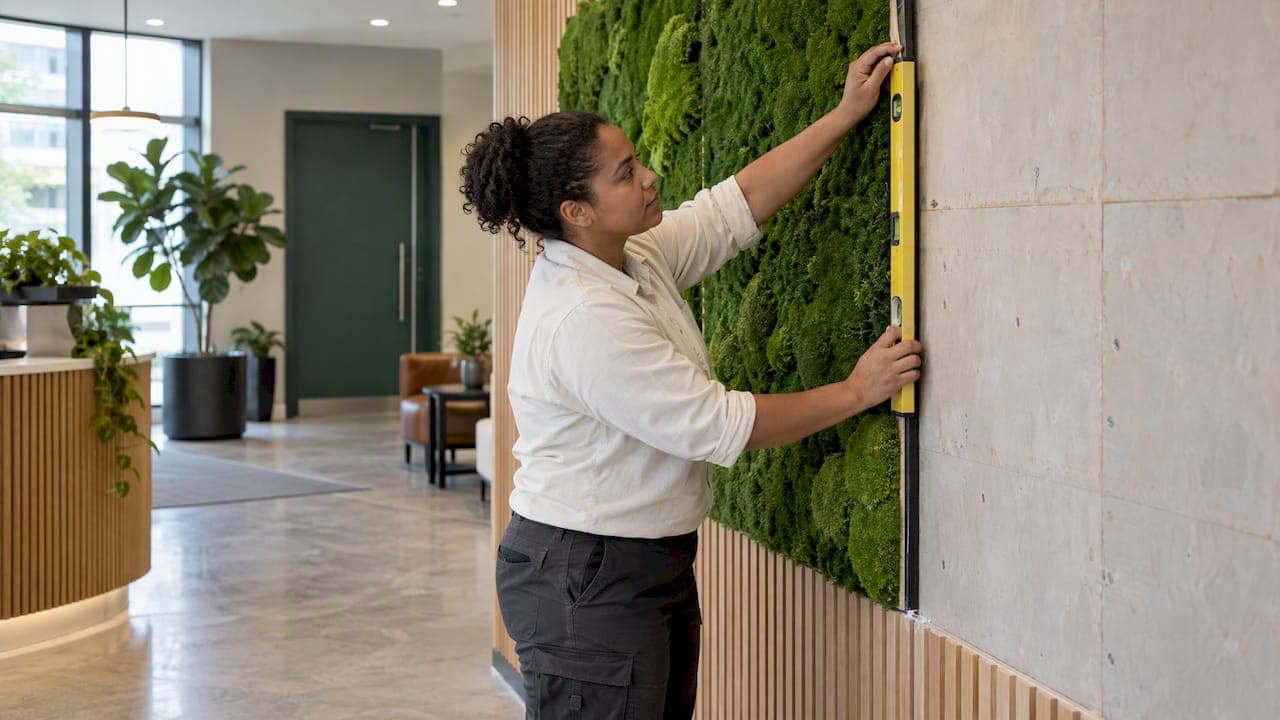
A moss wall installation takes a blank wall and turns it into a soft, textured focal point. For most commercial spaces, that means preserved moss panels built off-site, then mounted on a prepared wall in a day or two. The work is quick. The decisions before it are what make the result look right.
We are Greenspace Plants, Canada's leading commercial-only indoor plant service, founded in 2014. This guide walks you through the process the way we explain it to office managers, hospitality teams and interior designers. It covers the steps, the prep, the limits and the questions to ask before you say yes.
Key takeaways
- Most commercial moss walls use preserved moss. It needs no watering, no light and no soil, so it suits lobbies, restaurants and meeting rooms.
- Installation is mostly planning. The wall, the size, the colour palette and the access matter more than the mounting itself.
- Panels are built on rigid backing, left to dry, then fixed to the wall so the seams disappear.
- Preserved moss still needs gentle care. Keep it out of direct sun and humid spots, and dust it.
- A good provider handles design, install and care together, so you never manage it yourself.
Table of Contents
- Preserved or living: pick before you plan
- Choose the right wall
- Plan the design
- The installation steps
- What it looks like on the day
- Downsides and limits to know about
- Care and how long it lasts
- What drives the cost
- Our perspective
- How Greenspace Plants can help
- FAQ
- Sources
Preserved or living: pick before you plan
The first choice shapes everything else. A preserved moss wall uses real moss that has been treated to hold its colour and softness. It is no longer alive. A living moss wall is growing, and it needs controlled moisture, light and drainage.
For offices, hotels, restaurants and retail, we almost always recommend preserved. Here is why:
- No plumbing or irrigation. You do not need a water line or a drain behind the wall.
- No light requirement. It works in a windowless corridor as well as a bright atrium.
- Consistent look. The colour does not shift with the seasons or the HVAC.
- Lower risk. There is no leaking, no mould from over-watering and no dead patches.
Living walls have their place, mostly in spaces designed around them, with a proper system behind the wall. If that is your project, our green walls page is the place to start. The rest of this guide focuses on preserved moss, since that is what most design-conscious teams are after.
One note on the term. A preserved moss wall is an installed feature, not a plant. It adds texture, calm and colour. It does not replace the air-quality benefits of living plants, and we would not claim it does.
Choose the right wall
Walk the space before you fall for a sample. We look at five things.
Sightlines
Where do people actually look? Reception walls behind a desk, the end of a corridor and the wall facing a lift are all natural stages. A moss wall in a spot nobody sees is wasted.
Light
Preserved moss does not need light, but it does not like strong, direct sun. Over time, UV can fade the colour. A wall that gets harsh afternoon sun through a west-facing window is a poor choice unless you can manage the glare with blinds or film. Filtered or indirect light is ideal.
Humidity and heat
Avoid walls next to dishwashers, open kitchens, steam, or a vent that blows hot or damp air straight onto the surface. Restaurants can still use moss well. We just place it away from the pass and the dish area, in the dining room itself.
Wall condition
The wall should be sound, dry and flat enough to take a fixing. Check for damp patches, flaking paint and loose drywall. Fix those first. A moss wall will hide a lot, but it will not hide a wall that is failing.
Surroundings
Think about traffic. A wall beside a busy doorway, a luggage path or a bar stool line will get touched, bumped and scuffed. Higher up or set back is better in those areas. Moss is soft, so it is tempting to touch. We plan for that.
Plan the design
This is the part we enjoy most. A moss wall can be a single flat sweep of green, a pattern, a logo, or a mix of moss types with different textures and depths.
Before you commission anything, settle these points:
- Size and proportion. Measure the wall, then decide whether you are covering all of it or framing a section. A wall covered edge to edge feels architectural. A framed panel feels like art.
- Colour palette. Greens are the classic choice. Deeper forest tones feel calm and premium. Brighter shades feel fresh and playful. Match them to your brand, your furniture and your lighting.
- Texture mix. Flat sheet moss, mounded moss and fuller clump moss each catch light differently. A mix adds depth.
- Logo or graphic. A cut-in logo is a strong brand moment, but it needs crisp edges and careful planning of the backing.
- Lighting. Soft wall washers or a warm ceiling spot make moss glow. Harsh downlights can flatten it or cast shadows across the texture.
If you want ideas, our post on moss wall ideas shows how commercial teams use them. For layouts that bring moss and living plants together, our indoor plant design service is built for exactly that.
The installation steps
The specifics vary by provider and by wall. The overall flow is steady and the same almost everywhere.
Step 1: Site visit and measurements
We visit, measure, photograph the wall and check the surface, access and lighting. This is also when we ask about your brand, your colours and who walks past it each day.
Step 2: Design and sign-off
You see a layout or mock-up with colour and texture choices. You approve it before anything is built. This is the stage to ask for changes. After this, changes cost time and money.
Step 3: Panels are built off-site
The moss is glued onto rigid panels. Common backing materials are MDF, metal or Dibond, and a Canadian preserved-moss guide describes the same approach. The panels are left to dry for at least 12 hours before they travel.
Building off-site has real benefits. It lets us control quality in a workshop, and it cuts the time we spend in your space. Your team has less disruption and less dust.
Step 4: Prepare the wall
On install day, we clear and check the wall. We mark the layout, locate studs where needed, and confirm the surface is clean, dry and flat. Where the wall will not take a fixing, we plan another route.
If you are comparing mounting methods, it helps to know how adhesive and no-drill systems work in general. These adhesive wall panel options show the logic behind clean, damage-free mounting. For commercial moss walls, we choose the fixing by panel weight, wall type and lease terms.
Step 5: Mount the panels
Panels attach to the wall with Velcro or screws, depending on the weight and the wall. Each panel is fitted tightly against its neighbour so the seams do not show. We check alignment as we go, using a level and a straight edge, because a small drift at the start becomes a visible gap by the end.
Step 6: Finish and tidy
We blend the joins with matching moss, trim the edges, clean the surface and leave the area spotless. Then we walk you through the wall and how to look after it.
Most walls are done in a day, though large or complex ones can take longer. We schedule installs outside busy hours when you need it.
What it looks like on the day
Picture it from the office manager's side. You have a start time. Our team arrives with panels wrapped and labelled. We protect the floor, mark the wall and start mounting. You keep working nearby.
There is no mess to speak of. There is no water. There is no soil. By the end of the shift, the lobby looks different. Visitors notice it on the next day.
Downsides and limits to know about
We would rather you hear this from us than learn it later.
- It is not a living plant. Preserved moss does not clean the air the way living plants do. It is a design feature.
- Sun and heat can fade it. Direct sun, hot vents and very dry or very humid air shorten its life.
- It can be touched. Soft texture invites hands. Over time, high-touch areas can wear.
- It is a custom item. The more complex the design, the longer the lead time.
- Acoustics are a bonus, not a promise. Moss absorbs some sound, but do not treat it as a substitute for acoustic treatment. Our post on moss wall acoustics explains what to expect.
None of these are reasons to skip a moss wall. They are reasons to place it well and plan for it.
Care and how long it lasts
Preserved moss is low effort, not no effort. Dust it gently. Keep it away from direct sun, sprinklers and humidifiers. Do not water it. If a panel is damaged, replace that section instead of the whole wall.
With sensible placement and care, a preserved moss wall can last for years. We cover the typical lifespan and what drives it in our guide to preserved moss care, and the routine in moss wall maintenance.
If you would rather not think about it at all, that is what our care visits are for. See plant care maintenance.
What drives the cost
Prices vary because every wall is custom. We do not publish a price for moss walls, and we would not trust a figure that ignores your wall. These are the factors that move the number most:
- Size. Area is the biggest driver.
- Design complexity. Logos, patterns and mixed textures take more hours.
- Moss type and colour range. Some varieties and colour blends cost more.
- Wall and access. Height, lifts, stairs and wall type all affect the install.
- Care plan. Whether you want a one-time purchase or ongoing care.
For a deeper look at budgets, see our moss wall cost guide for Canadian businesses.
Our perspective
We have installed and cared for plants in offices, hotels, restaurants and retail across Toronto, Vancouver and Calgary. Today we look after 60,000+ plants in 400+ commercial locations. Moss walls are one of the most requested features in that work, and also one of the most misunderstood.
People assume a moss wall is a plant that needs nothing. It is closer to a piece of furniture made from nature. It needs the right wall, the right light and the right hands. When those line up, it is the quietest, most striking thing in the room.

Our advice is simple. Start with how you want the space to feel. Then choose the wall, and let the design follow. Do not start with the material.
We are also WBE Canada certified (woman-owned), and we run national programs for multi-location brands, including in the US. That matters for moss walls because consistency across sites is hard. A brand that wants the same look in Toronto and in Chicago needs one team with one standard.
— Nicole
How Greenspace Plants can help
We design, install and care for commercial plantscapes, including moss walls. Our Greenspace+ plan starts from $299 per month. It covers plant design, installation, regular maintenance and plant replacements, with no upfront costs and no long-term commitments. You can learn more on the Greenspace+ page.
If you are planning a moss wall, a living green wall or a full lobby refresh, talk to our team and we will look at your space with you.
FAQ
How long does a moss wall installation take?
The panels are built in advance, so the on-site work is short. Most walls go up in a day. Larger or more complex designs can take longer, and the design and build stage before install adds time.
Do I need to prepare the wall first?
Yes, a little. The wall should be dry, clean, sound and reasonably flat. We check it on the site visit and tell you what, if anything, needs fixing before install day.
Can a moss wall go in a restaurant?
Yes. Place it in the dining area, away from the kitchen, dish station and steam. Keep it out of splash zones and strong direct sun. Restaurants are one of the settings we install in most often.
Does a preserved moss wall need water or light?
No. Preserved moss is not alive, so it needs neither. It does best in indirect light and moderate humidity, and it should be dusted gently from time to time.
Are moss walls still in style?
Yes. Texture, natural materials and calm colour are still strong in commercial interiors. A moss wall also works as a quiet brand backdrop, which is why reception areas and hospitality spaces keep using them.