
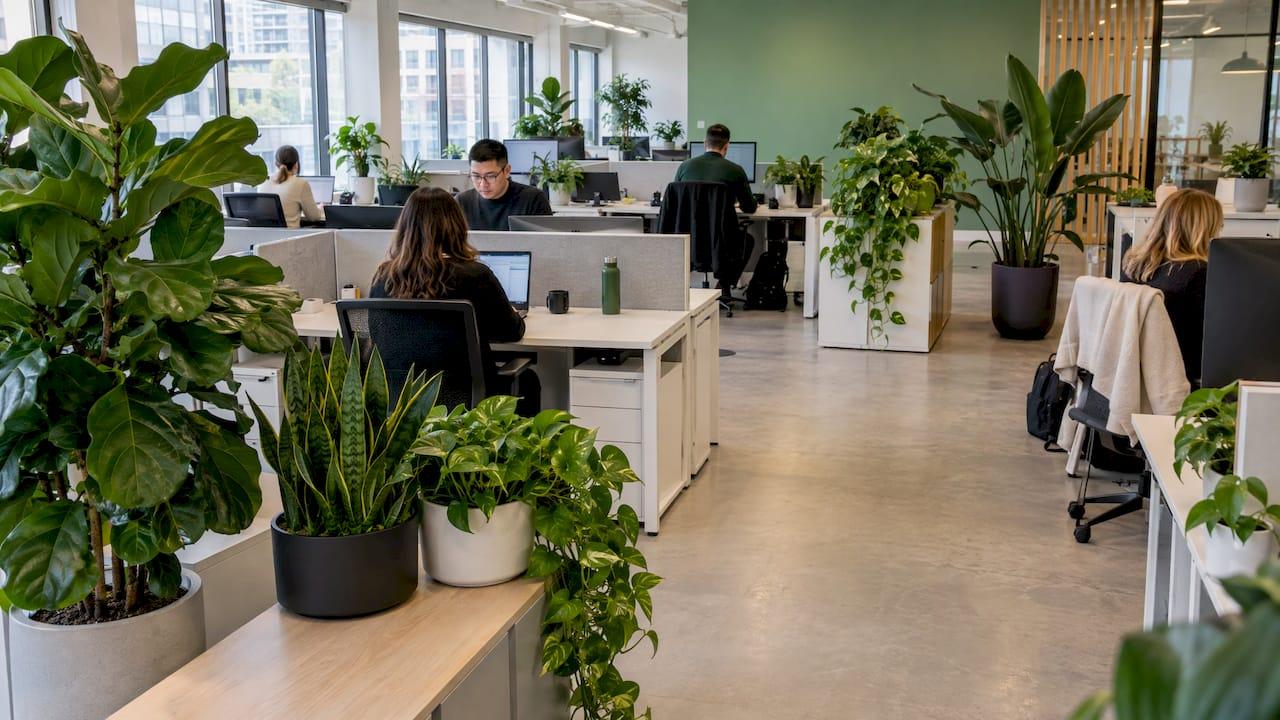
The best open plan office plants are tough, low-light species used in groups, not a lone pot on every desk. Think snake plants, ZZ plants, pothos and peace lilies. Place them to define zones, soften sightlines and frame entrances. Then keep them healthy with a steady care routine. That last part is where most offices struggle.
We are Greenspace Plants, Canada's leading commercial-only indoor plant service, founded in 2014. We design, install and care for plants in offices, hotels, restaurants and retail across Toronto, Vancouver and Calgary. This guide shows how we think about plants in a shared, open space.
Key Takeaways
- Match plants to the light you actually have. Light is the biggest factor in whether a plant lasts.
- Group plants at scale: floor plants, hanging vines, planters and a feature wall do more for the look than scattered desk pots.
- Snake plants, ZZ plants, pothos and peace lilies cope well with typical office lighting.
- Plants help how a space feels. Do not count on them to clean the air in a modern building.
- Shared plants need one clear owner. Without one, they get over-watered, forgotten or moved.
Table of Contents
- Why open plan offices need a plant plan
- Start with light
- Plants that suit an open plan office
- Where to put plants in an open office
- Do plants clean the air?
- Care: where open offices go wrong
- Check before you place
- How Greenspace+ handles it
- FAQ
- Sources
Why open plan offices need a plant plan
An open plan office puts many people in one big room. Desks sit side by side. Sound carries. Everything is visible.
Plants change that. They break up long sightlines. They add colour and texture to a flat, hard-edged room. They make a space feel cared for, which says something about your brand to every client and recruit who walks in.
The design in Montreal's Place Ville Marie is a good example. Sid Lee Architecture's "Biosquare" renovation turned a block of a 60-year-old tower into a bright, plant-filled open workspace. Plants were part of the layout, not an afterthought.
Most offices are not that dramatic. The principle still holds. Plan the greenery like furniture.
Start with light
Light decides which plants live. The Manitoba Master Gardener Association calls it the most important variable when choosing office plants. South-facing windows are brightest. East and west come next. North-facing is dimmest.
In an open plan, the middle of the floor is often the darkest. The University of Arizona Cooperative Extension defines low light as anything more than 8 feet from a window, including room centres and hallways. It also notes that offices provide artificial light for about 10 hours a day, Monday to Friday, and none on weekends.
The University of Maryland Extension gives numbers. Low light is 25 to 100 footcandles. Medium-bright is 100 to 500. High light is 500 to 1,000. A footcandle is a unit of light on a surface. A light meter or phone app can give you a rough reading.

Too much light is also a problem. The same source warns that excess light turns leaves pale and brown, so plants beside summer windows may need distance or a sheer curtain.
Plants under their ideal light do not die overnight. The University of Arizona notes they can survive months to a year while getting leggier and paler. That slow decline is why many offices end up with tired plants.
Want to go deeper on measuring? Our guide on matching plants to lux, PPFD and DLI walks through it. For dim rooms, see our notes on office plants with no sunlight.
Plants that suit an open plan office
These species come up again and again in Canadian and international guidance. They cope with fluorescent lighting and indoor temperature swings.
| Plant | Light | Watering | Good to know |
|---|---|---|---|
| Snake plant | Low to bright | Let soil dry between waterings | Flourishes in dark, windowless offices |
| ZZ plant | Low to moderate | About every two weeks, when nearly dry | Narrow profile, up to 3 ft tall, good beside desks |
| Pothos | Moderate ideal | When soil is dry | Vines up to 8 ft, hang from hooks or storage |
| Peace lily | Low to medium | Weekly | Tolerates fluorescents. Keep away from AC. Toxic to pets |
| Rubber plant | Bright, indirect | Every 7 to 10 days | Fast-growing statement plant |
| Spider plant | Bright or low | About every two weeks | Adaptable |
| Cast iron plant | Low | Light | Prefers artificial light and tolerates thermostat swings |
Watering details for the first six rows come from the University of Manitoba's 2024 office plant guide.
For bigger floor plants, the RHS suggests monstera deliciosa, areca palm and cast iron plant as statement pieces. For desks, it suggests philodendron, peperomia and small succulents.
One warning. Skip "air ferns" sold as no-maintenance plants. AP News reports they are dyed, dried marine animals, not living plants.
For a look-first approach, see our picks of the best indoor plants for office aesthetics.
Where to put plants in an open office
The goal is greenery that adds to the room without blocking people. Here is how we think about each zone.
Entrances and reception
This is your first impression. Use one or two tall, full plants in quality planters. Height gives presence. A rubber plant, areca palm or large ZZ suits the spot.
Zone edges and walkways
A row of planters can mark where one team area ends and another begins. It gives a soft boundary without walls. Keep a clear path. Plants should never block an emergency exit, and cords and outlets should stay clear of watering. That is the Manitoba Master Gardener advice on workplace safety.

Desk clusters
Small plants work well here, but pick compact ones. One shared plant between two desks looks better than a pot on every surface. We cover this in how to integrate plants into desk areas.
Overhead and corners
Hanging pothos uses space nobody else wants. Tall, narrow plants such as snake plants and ZZs fill corners without taking floor area.
Feature walls
A moss wall or green wall gives a big visual lift with no floor footprint. It is a strong choice behind reception or in a collaboration area. Our green walls can anchor a whole room.
Planters matter
The pot is part of the look. Matching planters tie a mixed group together. See our guide to office planter types.
Do plants clean the air?
This comes up a lot, so let's be clear.
Plants have real benefits for how people feel. A 2024 Frontiers in Psychology editorial summarising systematic reviews notes that indoor plants reduce some pollutant concentrations in studies, raise humidity, and are linked with lower diastolic blood pressure.
For air quality in a working office, though, the main levers are ventilation and removing contaminant sources. That is the focus of Health Canada's guidance for office buildings. A University of Technology Sydney field study found that in offices with modern HVAC, plants had little measurable effect on indoor air quality.
So buy plants for the way the space looks and feels. Think colour, calm and a more welcoming room. Treat them as a design and wellbeing choice, alongside good ventilation.
Care: where open offices go wrong
Shared plants often belong to nobody. The Manitoba Master Gardener Association notes that care in common areas is often shared, and that vacations, sick days and hybrid schedules make it easy to forget watering.
The RHS office guidance lists the basics:
- Turn plants a quarter turn each month for even growth.
- Dust leaves at least every other week, since dust slows photosynthesis.
- Remove yellow or browning leaves.
- Mist ferns and orchids, but not cacti or succulents.
- Use self-watering containers when no one person is responsible, to avoid "too many cooks" over-watering.
Place plants away from vents. Plants near heating or air conditioning outlets can be damaged quickly. The RHS also flags the "people factor": staff moving plants around without knowing what they need.
That is a lot of small jobs. It is also why our visits cover more than a watering can. Read what a maintenance visit involves.
Check before you place
A few safety points for shared spaces:
- Allergies. Common workplace allergens include dust and moulds. The Government of Saskatchewan's allergen guidelines say staff should report concerns to their manager, and managers should replace products known to cause reactions. Non-flowering plants are the lower-allergen choice.
- Pets and visitors. Peace lilies are toxic to pets. Keep toxic plants out of reach of children and curious visitors.
- Health and safety. Check with your supervisor or health and safety committee before adding plants.
Our view
Most open plan offices do not fail at choosing plants. They fail at keeping them. A bright photo of a plant wall in week one means little if the plants look tired by month six.
That is why we only do commercial spaces. We design the layout, choose plants for your light, source the planters, install, and then care for it all. We also replace plants that do not thrive, and our plants are guaranteed healthy.
Your space should look good on a Monday morning in February, not only on opening day. When the greenery is handled for you, your team gets the colour and calm, and you get your time back.
Nicole
How Greenspace+ handles it
Greenspace+ is our all-inclusive service. For a fixed monthly fee, you get plant design, installation, regular maintenance and plant replacements. There are no upfront costs and no long-term commitments. Plans start from $299 per month.

We serve 60,000+ plants in 400+ commercial locations. We are WBE Canada certified (woman-owned). We also run national programs for multi-location brands, including in the US. See Greenspace+ for details, or talk to us about your space.
FAQ
What is the best plant for an open plan office?
There is no single best plant. Snake plants and ZZ plants are the most forgiving in low light. Pothos adds trailing greenery, and rubber plants give height in brighter spots. Choose by your light level first.
Can plants grow in an office with no windows?
Some can, for a while. Snake plants, ZZ plants, cast iron plants and peace lilies tolerate low, artificial light. Even these do best with steady light for about 10 hours a day. Grow lights can help in the darkest areas.
How many plants does an open office need?
There is no fixed number. Plan by zone: one or two statement plants at the entrance, groupings at zone edges, and shared plants at desk clusters. A few larger plants look better than many small ones.
Who should look after the plants?
One accountable owner. Shared, informal care leads to over-watering and neglect. Many offices hand this to a service so the plants stay healthy through holidays and hybrid schedules.
Sources
- Office Plant Guide, University of Manitoba (2024)
- How to choose and care for office plants, AP News
- Ode to the Office Plant, Manitoba Master Gardener Association
- Lighting for Indoor Plants, University of Maryland Extension
- Indoor Plant Selection and Care, University of Arizona Cooperative Extension
- Choosing and caring for office plants, RHS
- Sid Lee Architecture's Biosquare, Treehugger
- Frontiers in Psychology editorial (2024)
- Health Canada: improving indoor air quality in office buildings
- Do Potted-Plants Improve the Indoor Environment?, University of Technology Sydney
- Guidelines for Addressing Allergies and Sensitivities, Government of Saskatchewan