
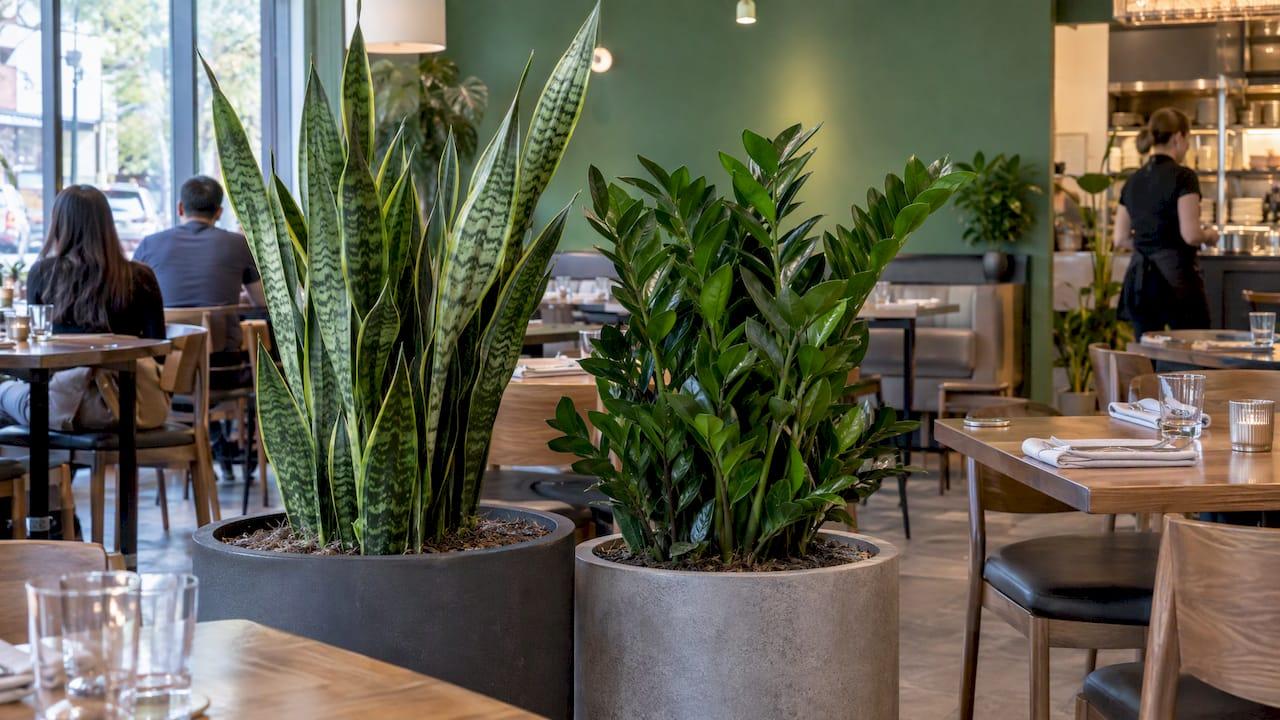
The most pest-resistant indoor plants for a commercial space are snake plants, ZZ plants, pothos, jade, hoya, cacti and succulents. They suffer fewer outbreaks than palms, figs and philodendrons. No plant is bug-proof, though. Placement, watering and regular inspection decide whether a plant stays clean and lush.
We are Greenspace Plants, Canada's leading commercial-only indoor plant service, founded in 2014. We design, install and care for plants in offices, hotels, restaurants and retail across Toronto, Vancouver and Calgary. This guide shows which plants hold up best, why, and how to keep them looking sharp without turning plant care into your job.
Key Takeaways
- Snake plants, ZZ plants, pothos, hoya, jade and succulents are the safest picks for fewer pest problems.
- Fiddle leaf figs, crotons, palms and philodendrons attract spider mites more often. They can still work, with the right care.
- Plants sold as "repellents" do not protect a room. Healthy soil, airflow and early inspection matter more.
- Quarantining new plants for a few weeks stops many problems before they reach your reception area.
- For outdoor patios, native and aromatic flowers such as lavender, cosmos and goldenrod welcome bees. Indoor plants do not need them.
Table of Contents
- What "pest resistant" really means
- The most pest-resistant indoor plants
- Do "bug-repelling" plants work?
- Why pests show up in commercial spaces
- A prevention routine that works
- Choosing plants by space
- Bee-friendly containers for patios and entrances
- The case for a service over guesswork
- Perspective: pest resistance starts with design
- Start with a plan for your space
- FAQ
- Sources
What "pest resistant" really means
A pest-resistant plant is one that insects find less appealing or less able to live on. It is not a plant that repels bugs from the room.
That difference matters when you choose plants for a lobby, a dining room or a showroom. You want a space that looks cared for every day. One sticky leaf or a cloud of fungus gnats around a planter undoes the effect fast.
Common indoor pests in commercial plantings are mealybugs, scales, aphids, thrips, whiteflies, fungus gnats and spider mites. Most of them love the same things: warm air, still air and stressed plants. Offices and restaurants offer all three.
So the goal is two-part. Pick plants that bugs tend to leave alone. Then give them conditions where they stay strong.
The most pest-resistant indoor plants
University extension research gives a clear pattern. According to UMN Extension, succulents, cacti, pothos, sansevieria, hoya and ferns tend to have fewer spider mite problems. Palms, philodendrons and figs tend to have more.
Here is how the best performers compare.
| Plant | Why it holds up | Look it gives a space |
|---|---|---|
| Snake plant (Sansevieria) | Few pests and diseases bother it. Mealybugs and spider mites only occasionally appear. Overwatering is the usual trouble. | Tall, architectural, sculptural lines |
| ZZ plant | Valued in interiorscaping for low-light and drought tolerance and for resistance to diseases and pests | Glossy, deep green, modern |
| Pothos | Among the plants UMN Extension links to fewer spider mite issues | Trailing, soft, ideal for shelves and high planters |
| Hoya | Same UMN Extension group | Waxy leaves, trailing form |
| Jade plant | Often recommended as a houseplant unlikely to attract pests | Compact, sturdy, tidy |
| Air plants | Grow without soil, so soil-borne pests such as gnats are very unlikely | Light, sculptural, great for displays |
Snake plants have a bonus. They contain saponins, natural compounds that deter aphids, mites and mealybugs. In one Popular Science account, fiddle leaf figs and crotons were plagued by spider mites while snake plants nearby stayed clean.
Which plants attract more trouble
Some of the most photogenic plants are also the fussiest. Fiddle leaf figs, crotons, palms and philodendrons are common on mood boards. They do need more attention to stay pest-free.
That does not mean you have to skip them. It means they should be placed where light and airflow suit them, and checked often. Mealybugs, for example, hide where leaf bases meet stems and leave sticky honeydew behind. They are hard to spot until they have spread.

If you love a particular statement plant, plan its care from day one. A mix works well: resilient plants for volume and structure, one or two showpieces where they will get the attention they need.
Do "bug-repelling" plants work?
You will see lists of herbs and flowers that supposedly keep bugs away: lavender, mint, rosemary, basil, marigolds. They are tempting for a restaurant, where fresh herbs look and smell wonderful.
The evidence is more modest. A Clemson Extension review of research found that aromatic plants only repel mosquitoes when leaves are crushed or oils are put on skin. The scent fades in a breeze. Claims that fragrant plants mask other plants from pests have not held up to scientific scrutiny.
The picture is mixed even for single plants. According to The Spruce, mint contains menthol that repels aphids, whiteflies and ants. Rosemary may repel mosquitoes and flies but could attract spider mites and aphids. Basil repels whiteflies but may attract aphids.
A master gardener cited in the same piece makes the key point: repelling plants alone may not prevent an infestation. Good plant hygiene, clean containers and fresh potting soil matter just as much.
So choose herbs for how they look, smell and serve your guests. Do not count on them as pest control.

Why pests show up in commercial spaces
Pests do not appear from nowhere. In a workplace or dining room, the usual causes are simple.
- Overwatering. Wet soil invites fungus gnats and root rot. Even tough snake plants suffer from it.
- Still, warm air. Humid corners with little airflow help pests multiply.
- New plants. A plant brought in from elsewhere can carry eggs in the soil.
- Dust and debris. Dirty leaves and fallen material give pests places to settle.
- Shared planters and soil. Reused soil and unclean containers carry problems from one plant to the next.
In a busy space, no one is watching the details. A plant drops a leaf, someone gives it extra water, and a month later there are gnats around the reception desk.
A prevention routine that works
Here is the routine behind clean, healthy plants. Halton Region Master Gardeners recommend much of it.
- Inspect and isolate new plants. Keep them apart for a few weeks. Pests can emerge from eggs in the soil after arrival. Check under leaves and at the base of stems.
- Water from the bottom and not too often. This keeps the soil surface drier, which discourages gnats and prevents root rot.
- Keep air moving. Good circulation keeps leaves dry and the air less inviting to pests.
- Remove plant debris. Fallen leaves and spent blooms are easy hiding spots.
- Clean tools between plants. Rubbing alcohol does the job.
- Dispose of old soil and clean containers before reuse. A bleach and water wash is the recommended method.
- Wipe or rinse dusty leaves. Regular cleaning of leaves keeps dust and pests down. A damp cloth works.
This is a lot to carry for someone who already runs an office, a hotel lobby or a dining room. It is also where a plant service earns its keep. With Greenspace+, our all-inclusive plan, plant design, installation, regular maintenance and plant replacements are handled for a fixed monthly fee. You get the look without the checklist.
Want to see what a typical visit includes? Our maintenance visit overview walks through it. For a deeper look at pests specifically, see our plan for stopping office plant pests.
Choosing plants by space
Pest resistance is one factor. Light, traffic and style matter too. Here is how we think about common commercial settings.
Reception and lobbies
This is the first impression. Go for tall, sculptural, dependable plants. Snake plants and ZZ plants give height and structure in large planters, and they forgive an off day. Our indoor plant choices page shows options for offices and businesses.
Open-plan offices
Trailing pothos and hoya on shelves and dividers soften hard lines. Pair them with larger resilient plants to anchor each zone. Plants in a team space should feel part of the design, not an afterthought.
Restaurants and hotels
Humidity, heat and food smells make pest control harder here, so resilient foliage plants are a smart base. Add moss walls or green walls for impact. If pets or children are around, check which plants are safe. Our guide to non-toxic office plants lists ASPCA picks.
Retail and showrooms
Plants must look fresh under strong lighting for long hours. Jade plants, succulents and snake plants keep their shape and colour with little fuss. Air plants suit display fixtures.
Bee-friendly containers for patios and entrances
Some readers also ask about bee-friendly container plants and pollinator planters. Those belong outdoors. Indoor plants do not need pollinators, and pollinator flowers do not belong inside.
For a patio, terrace or entrance in Canada, the Canadian Wildlife Federation lists container plants that attract pollinators. They include lavender, catnip, rosemary, thyme, mint, marigold, phlox, zinnia, cosmos, salvia, goldenrod, fuchsia, morning glory and lobelia.
Goldenrod is a standout. The City of Toronto notes that more than 25 goldenrod species are native to Ontario, and over 35 bee species feed on its pollen. It supplies late-season fuel for migrating monarchs and queen bumblebees. Cutting stems back by half in late June or early July keeps container goldenrods compact while they still flower late in summer.
A few practical points for containers:
- Use drainage holes and moisture-retaining soil.
- Choose containers about two-thirds the height of the plant.
- Expect to water daily in the morning during hot, dry weather.
- Plan for winter. Container plants will not survive Canadian cold outdoors, and clay pots can crack in freezing weather.
A Montreal gardening consultant quoted in The Globe and Mail also suggests nasturtium, lavender, dwarf sunflower, cosmos, zinnias and calendula for pollinators, and notes that bees like purple. For a polished patio, we offer outdoor patio planting. You can start from our home page.
The case for a service over guesswork
Choosing a resilient plant is a good first step. Keeping it healthy over years is the harder part. Light changes with the seasons. Staff move desks. Someone waters a plant that did not need it.
With a plant service, you do not have to monitor any of that. Our Greenspace+ plan starts from $299 per month, with no upfront costs and no long-term commitments. Design, installation, regular maintenance and replacements are included, and our plants are guaranteed healthy.
We work only with commercial spaces. We care for 60,000+ plants in 400+ commercial locations, and we are WBE Canada certified (woman-owned). Multi-location brands can use our national programs, including in the US.
Perspective: pest resistance starts with design
Here is what we tell every client. The best pest control is a good plan.
When we design a space, we think about light, airflow and how people move through the room. A plant in the right spot with the right container is far less likely to struggle. Resilient plants like snake plants and ZZ plants are a great foundation. We use them often, and they look beautiful.
We also love a statement plant. A big fiddle leaf fig can make a lobby. We just plan its care from the start, so it stays lush.
That is what a plant service should be. Not just watering. Careful design, regular attention and quick replacement if a plant ever falls short. You should never have to think about it. You should just walk in and feel good about the space.
Nicole
Start with a plan for your space
If you want plants that look great and stay clean, we can help. We design, install and maintain plantings for offices, hotels, restaurants and retail. Greenspace+ covers it all for a fixed monthly fee, starting from $299 per month.

Already have plants and want them cared for? Our plant care maintenance service keeps them healthy. Planning a new look? Start with indoor plant design.
FAQ
Which houseplants are most resistant to pests?
Snake plants, ZZ plants, pothos, hoya, jade plants, cacti and succulents are among the most resistant. University extension sources describe them as having fewer pest problems. Overwatering is the main thing to avoid.
Do indoor plants attract bugs?
Any plant can, since pests thrive in warm, still, humid air and on stressed plants. Overwatered soil attracts fungus gnats, and dust and debris give pests places to hide. Resilient plants, good airflow and regular inspection keep problems low.
What is the toughest indoor plant for an office?
The ZZ plant and the snake plant are two of the toughest. Both handle low light and missed waterings, and both have few pest problems. They suit lobbies, meeting rooms and open-plan offices.
Do herbs like mint and lavender keep bugs away indoors?
Not reliably. Research shows scent from aromatic plants fades quickly and does not protect a room on its own. Enjoy them for their look and fragrance, and rely on good plant care for pest prevention.
What are good bee-friendly plants for patio containers in Canada?
Lavender, cosmos, zinnia, salvia, marigold and native goldenrod are good choices for patio containers. Plan for winter, since container plants usually do not survive outdoors through Canadian cold.
Sources
- Houseplant pests, UMN Extension
- Cultural Guidelines for Commercial Production, University of Florida IFAS
- Snake Plant: A Forgiving, Low-maintenance Houseplant, Penn State Extension
- Growing Insect and Mite-Free Interior Plants
- 5 Best Houseplants That Won't Attract Any Pests, The Spruce
- Do Indoor Houseplants Really Repel Pests?, The Spruce
- Pest-Resistant Houseplants, Martha Stewart
- 3 natural solutions for household pests, Popular Science
- Can Plants Repel Problematic Insects?, Clemson HGIC
- A Guide to Indoor Plant Pests and Diseases, Halton Region Master Gardeners
- Container planting, Canadian Wildlife Federation
- Get to know goldenrod, City of Toronto
- A guide to container gardening in Canada, The Globe and Mail