
Planter irrigation systems, in the commercial plantscaping sense, mean provider-installed pressure-compensated drip or seep emitters run by a controller and backed by ongoing maintenance, not the timer kits sold for home gardens. If you're outfitting an office lobby, restaurant patio, or green wall, the right move is hiring a managed plantscaping service that supplies this hardware plus a documented maintenance program, monthly flushing, seasonal tuning, and a healthy-plant guarantee. Greenspace Plants is one provider built around exactly that model.
TL;DR:
- A proper commercial planter irrigation system should include specific hardware components such as pressure-compensating emitters, micron-rated filters, and zone-specific solenoid valves.
- Maintenance must be scheduled monthly for flushing and emitter inspections, with seasonal adjustments and winterization to prevent waterlogging or drought stress.
- Installation design crucially involves correct emitter placement, drainage planning, and substrate considerations to avoid uneven watering and plant decline.
- Vendors should provide detailed schematics, site surveys, sensor logs, and defined service responsibilities to ensure long-term system health and plant survival.
- Managed service plans, like Greenspace+, offer fixed monthly fees covering design, installation, maintenance, and plant replacement, eliminating upfront costs and reducing operational risk.
Table of Contents
- What to Require From a Commercial Planter Irrigation System
- Emitters, Pumps, and Controllers: What the Options Actually Mean
- Maintenance and Seasonal Care: The Part Vendors Downplay
- Design Rules That Prevent Plant Loss and Planter Damage
- What Planter Irrigation Actually Costs Over Time
- What Providers See Go Wrong (and How Managed Service Fixes It
- Get a Managed Irrigation System Without the Upfront Cost
- Sources
What to Require From a Commercial Planter Irrigation System
Most facility managers get burned not by the equipment itself, but by vague contracts that never spell out who's responsible when an emitter clogs or a plant starts dropping leaves. Before signing anything, put the hardware specs and service obligations in writing.
On the hardware side, your request for proposal should name specific components, not generic categories:
- Mainline and solenoid valves sized for your planter zones, with separate zones for planters that get different light or traffic
- Pressure-compensating emitters rated for the flow your substrate needs, not standard drip tape borrowed from landscaping jobs
- Filtration with a stated micron rating, since undersized filters are the single biggest cause of clogged lines in vertical applications
- Pumps or boosters if you have tall green walls or upper-floor installations where gravity and building pressure alone won't cut it
- Drainage and overflow protection so a stuck valve doesn't flood your lobby floor at 2 a.m.
On the service side, the contract needs to define four things clearly:
- Commissioning, including a full system test before handoff
- Monthly flushing and emitter inspection, not "as needed"
- Seasonal schedule tuning as heating and cooling cycles change your indoor humidity
- Emergency response times and what counts as covered under the plant survival guarantee
Ask every vendor for a site survey report, an irrigation schematic, sensor logs if the system is IoT-enabled, and maintenance records from day one. A provider that hesitates to hand these over is telling you something about how they'll handle problems later.
Emitters, Pumps, and Controllers: What the Options Actually Mean
Vendors love to throw around terms like "smart irrigation" without explaining what's actually running behind the wall. Here's the plain-language version.
Pressure-compensating emitters deliver a consistent flow rate regardless of where they sit in the line, which matters enormously on a green wall where the top row and bottom row see different pressure. Industry guidance puts typical flow rates at 2 to 4 liters per hour per emitter for vertical installations. Micro-sprays work for open planters with broad canopies but waste water on tight vertical plantings. Seep hoses suit long, shallow planter runs, like a row of lobby planters, where individual emitters would be overkill.
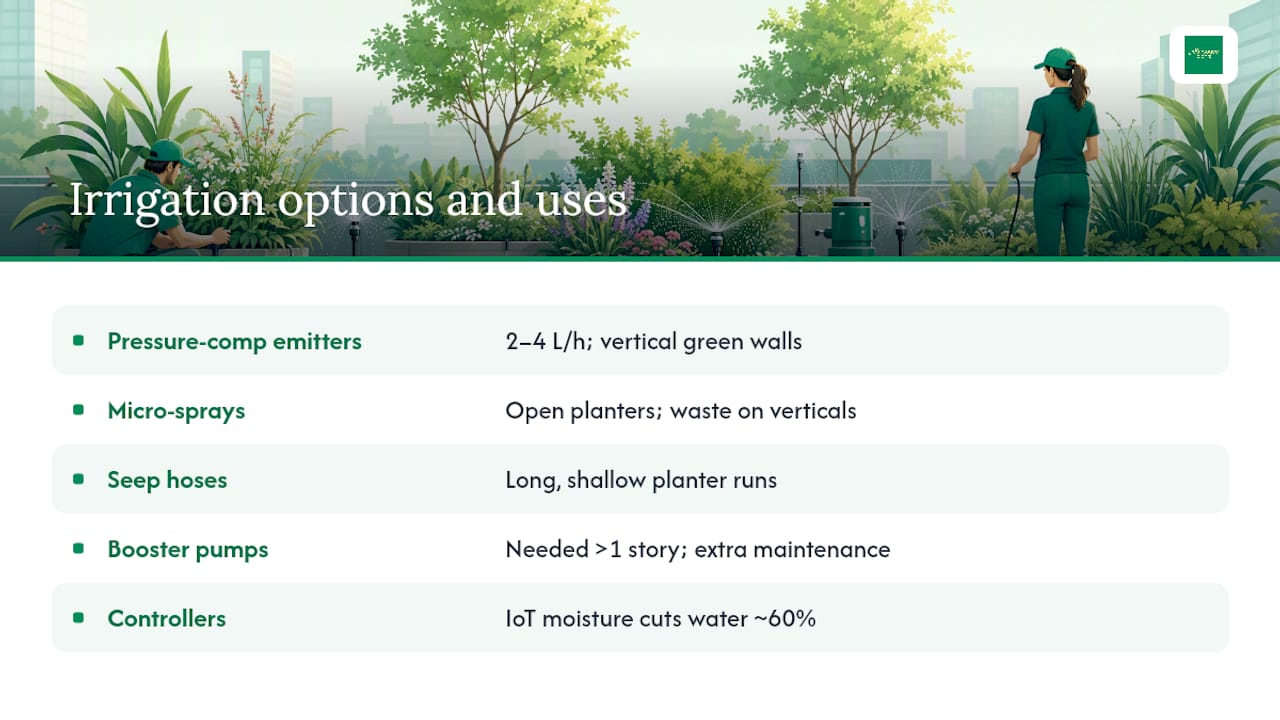
Booster pumps become necessary once you're feeding a wall taller than a single story or fighting building water pressure that's already stretched thin on upper floors. That's an extra maintenance line item, since pumps need their own service checks.
Controllers range from basic timers to moisture-sensor systems to full IoT platforms that log data to the cloud. One experimental green-wall trial found IoT moisture-based control cut water use by roughly 60% compared with fixed timers, though species-specific tuning still requires horticultural judgment, not just software.
Pro Tip: Fertigation, dosing nutrients through the irrigation line, sounds efficient but adds filters, UV sterilization, and dosing pumps to your maintenance load. Only take it on if your provider explicitly covers it in the service plan.
Maintenance and Seasonal Care: The Part Vendors Downplay
More green wall failures trace back to irrigation mistakes than any other cause. Industry sources put the figure at over 60% of green wall failures linked to improper irrigation, usually waterlogging or drought stress from a system nobody's checking.
That statistic is your best argument for a real maintenance contract instead of "set it and forget it." Here's what should happen on a recurring basis:
- Monthly flushing to clear mineral buildup and biofilm before they clog emitters. Guidance recommends filtration with typical micron ratings appropriate to prevent clogging (https://minijungle.org/2026/06/10/indoor-green-wall-irrigation-from-manual-drip-to-smart-fertigation-systems/), with filter checks on the same monthly cycle.
- Seasonal schedule adjustments, since HVAC cycling changes evapotranspiration rates indoors just as much as weather does outdoors. A schedule tuned for August humidity will overwater in February.
- Winterizing outdoor planters and rooftop systems, including draining and blowing out lines before freeze risk arrives. Commercial planter maintenance guidance treats this as a standard seasonal checklist item, not an optional extra.
- Inspection visits covering flow-rate tests, spot checks on individual emitters, substrate moisture readings, and a visual drainage check.
Contracts should also spell out who's responsible for what. Your provider covers the irrigation hardware and horticultural care; you're on the hook for site access and making sure electrical or structural infrastructure is ready before installation. Our maintenance workflow overview breaks down what a properly staffed schedule looks like in practice.
Design Rules That Prevent Plant Loss and Planter Damage
Good irrigation design starts before a single emitter goes in the ground. Placement mistakes are the quiet reason plants decline even when everything else about the system checks out.
Never place an emitter flush against a planter wall. Aim it toward the root zone instead, and use multiple low-flow emitters spread across dense plantings rather than one emitter trying to cover a wide area. This single adjustment prevents more uneven watering than any controller upgrade.
Drainage deserves equal attention:
- Build in low-point drains so standing water has somewhere to go
- Use collection trays under planters that sit on finished flooring
- Route overflow to building drains wherever possible, rather than hoping a tray never overflows
- Leave inspection access so a technician can check drainage without tearing into the planting
Substrate matters, too. Engineered growing mats, hydroponic matrices, and traditional soil mixes each hold and move water differently, which means emitter density has to shift with the material. A green wall on a hydroponic matrix needs a different watering profile than one built on soil-filled cells. Design for service access from day one, so replacing a failed emitter or running a flush doesn't mean disturbing the plantings around it. Our breakdown of common plantscape design mistakes covers several of these placement errors in more detail. Booster pumps and modular access panels, recommended in technical living-wall design guidance, simplify maintenance considerably on larger installations.
What Planter Irrigation Actually Costs Over Time
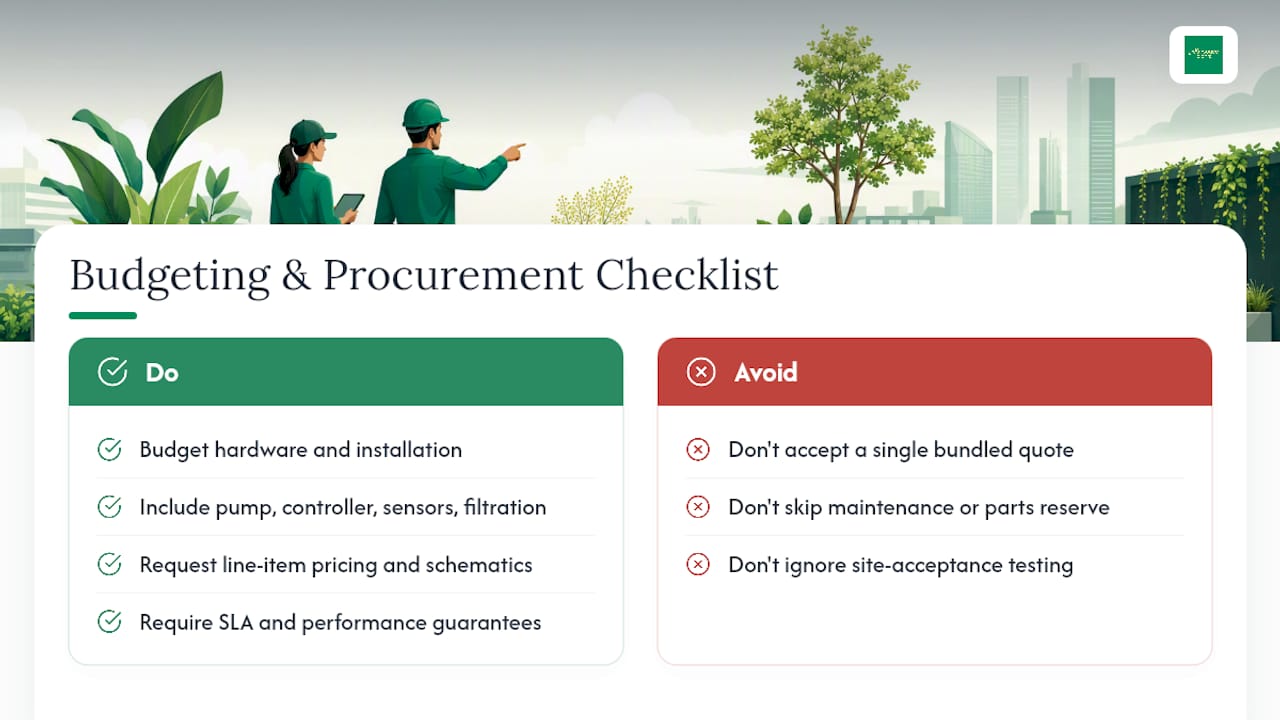
Budget conversations tend to focus only on the upfront hardware, which is how facility teams get blindsided by the ongoing line items. A realistic budget includes hardware and installation, a pump or booster if your site needs one, the controller and any sensors, filtration (and UV sterilization if you're running fertigation), plus monthly maintenance and a reserve for parts and repairs.
Automation earns its keep on the maintenance side more than the install side. Fewer plants die from missed watering, technicians spend less time on manual checks, and sensor-based systems catch leaks or blockages before they become a flooded lobby or a dead green wall. Water savings compound that further, particularly with moisture-sensor control.
When comparing quotes, insist on line-item pricing rather than a single bundled number, request schematics and a written service level agreement, and build performance guarantees into the contract.
Pro Tip: Ask every vendor to schedule site-acceptance testing before final sign-off, a demonstration that every emitter delivers even output and drainage works as designed. It's a cheap step now versus a costly retrofit later.
What Providers See Go Wrong (and How Managed Service Fixes It
The most common failure we see isn't bad equipment. It's the "set-and-forget" mindset: skipped monthly flushes, emitters placed against planter walls, nobody watching seasonal shifts. Greenspace+ builds scheduled flushing, seasonal tuning, and documented schematics into every plan, backed by our plant-health guarantee, so that oversight never falls on your staff.
— Nicole
Get a Managed Irrigation System Without the Upfront Cost
Building and maintaining a planter irrigation system in house means sourcing hardware, hiring or training staff to flush lines monthly, and hoping someone remembers to adjust schedules when the seasons change. Greenspace+ replaces that entire burden with one fixed monthly fee covering design, installation, maintenance, and plant replacements, with no upfront hardware cost and no long-term lock-in.
When Greenspace Plants runs your site survey, you get a full irrigation schematic, a documented maintenance schedule built around your building's HVAC cycles, and a written plant-health guarantee before any equipment goes in. That covers offices, restaurant patios, and green walls alike, whether you're working with an interior designer on a new build or retrofitting an existing space. If you're weighing options for a lobby, patio, or full green plant wall installation, request a site visit and get a written proposal with real numbers before you commit to anything.
Sources
The MiniJungle technical guide covers emitter selection, filtration specs, and fertigation trade-offs for vertical installations. The ScienceDirect study on vertical green-living walls quantifies indoor air and energy benefits tied to species and lighting choices. Urban Pot's commercial planter maintenance checklist lays out seasonal and winterization steps property managers can use to validate a vendor's proposed schedule.
- Indoor Green Wall Irrigation: From Manual Drip to Smart Fertigation Systems - MiniJungle®
- Commercial Planter Maintenance: Seasonal Checklist for Property Managers (Urban Pot)