
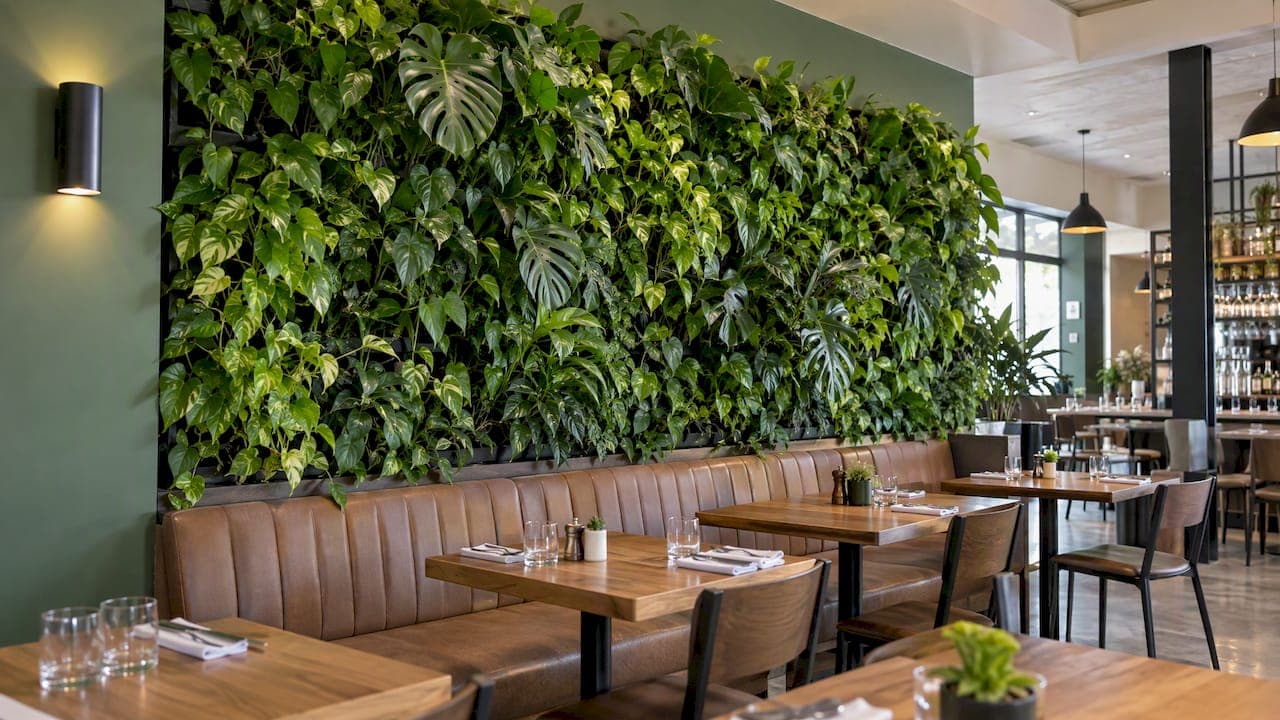
A restaurant green wall is a vertical planting that turns a blank wall into the first thing guests notice. It can be living plants, preserved moss or artificial foliage. Each looks different, costs differently and asks for different care. This guide helps you choose, and shows what to plan for before anything goes on your wall.
We are Greenspace Plants. We are Canada's leading commercial-only indoor plant service, founded in 2014. We design, install and care for plants in offices, hotels, restaurants and retail across Toronto, Vancouver and Calgary. So we have seen what works in a dining room, and what quietly fails.
Key Takeaways
- A green wall shapes how a room feels: it adds texture, softens hard surfaces, and can divide a space without building a wall.
- Living walls look the richest but need steady professional care. Moss and artificial walls ask for much less.
- In Canada, fire rules for interior finishes apply to green walls. Ask about them before you fall in love with a design.
- The wall is only as good as its upkeep. Plan the care before you plan the look.
- A fixed monthly service takes the hassle off your team and keeps the wall looking like day one.
Table of Contents
- What a restaurant green wall actually is
- How a plant wall shapes atmosphere and layout
- Living, moss or artificial: which wall suits your restaurant?
- What to check before you install
- What care a restaurant living wall really needs
- How a typical green wall project unfolds
- Why we think the care plan matters more than the wall
- Cost: what shapes the price of a green wall
- How Greenspace+ keeps your wall looking its best
- Common mistakes we see
- FAQ
- Sources
What a restaurant green wall actually is
A green wall is a vertical system for growing plants. It can stand on its own or attach to an existing wall, as UBC's planting design resource describes it. In a restaurant, that usually means a feature wall behind a banquette, a backdrop for the bar, or a divider between the entrance and the dining room.
People also call it a plant wall or a living wall. The words overlap, but the products do not. There are three main types:
- Living walls. Real plants, rooted in a substrate or hydroponic medium, with built-in irrigation.
- Moss walls. Preserved moss and foliage. No watering, no light needs, and a soft, textured look.
- Artificial walls. Manufactured foliage panels. Consistent year-round, but they are not plants.
We design and install living and moss walls. We will tell you honestly which one fits your room.
How a plant wall shapes atmosphere and layout
Guests do not think about your wall in technical terms. They feel it. The room seems calmer, warmer, a little more expensive. Here is what a good wall does.
It gives the room a focal point
Most dining rooms have one dull stretch of wall. Maybe it is the long side by the washrooms, or the space above booths. Planting it gives the eye somewhere to go. It also gives guests a natural spot for photos, which is free exposure for your brand.
It softens sound
Hard surfaces make restaurants loud. Plant systems can help. One indoor living wall study published in Architectural Science Review built and tested a wall to see whether it reduces reverberation time, including a restaurant-style case. A wall is not a replacement for acoustic treatment. It is a pleasant part of the answer.
A restaurant supply industry overview also lists lower noise, functional dividers and happier customers among the benefits of restaurant plantscaping.
It divides space without closing it
A freestanding planted screen can separate a waiting area from tables. It keeps sightlines open and light moving. It feels softer than glass or timber.

It reflects your brand
A lush, layered wall says fresh, generous, alive. A tight, clean moss wall in a dark tone says modern and calm. Pick the plants and planters for the story you tell on the menu. We go deeper on this in our piece on why living plants turn millennial diners into regulars.
Living, moss or artificial: which wall suits your restaurant?
This is the decision that matters most. Be honest about your light, your staff time and your budget.
| Living wall | Moss wall | Artificial wall | |
|---|---|---|---|
| Look | Richest, layered, changes with growth | Soft, sculptural, uniform | Consistent, can look flat up close |
| Water and light | Needs both, plus irrigation | None | None |
| Weight and install | Heavier, needs structure and drainage planning | Light, simple mounting | Light, simple mounting |
| Upkeep | Ongoing professional care | Occasional care | Dusting and cleaning |
| Air and nature benefits | Plants do the work | Limited | None |
| Best for | Statement walls with good light | Dim rooms, tight budgets, low-touch spaces | Places with no light and no care plan |
Living walls need light, water and suitable temperatures. They also need continuous horticultural care. Artificial walls mount without plumbing or drainage and need no irrigation. That is the trade: more life, more responsibility.
A quick way to decide
Ask yourself three questions.
- Does the wall get real light? Windows or strong, long-hours lighting point to living. A windowless corner points to moss.
- Who will look after it? If the answer is "whoever has a minute", choose moss, or choose a care program.
- How close will guests sit? Close-up tables reward real plants and real texture.
Our green plant walls page shows the options we offer. Our design portfolio shows what they look like in real rooms.
What to check before you install
A wall is part of the building. Treat it that way. Three things to settle early.
Structure, weight and water
Green system planning should consider weight loading, drainage and discharge points, irrigation and the existing structure, as UBC's planting design resource notes. In a restaurant, add one more: keep water well away from food prep, power and guest paths. A leak behind a banquette is a bad night.
Fire code
In Canada, flame-spread limits are applied through the National Building Code mainly to interior finishes. Those are materials that form part of the building interior and are directly exposed. The standard test method the code references is CAN/ULC-S102. Your local authority and fire officials make the final call on your space.
We have written two guides on this. Read our breakdown of green wall fire code in Canada and the guide to living wall fire safety, tests and maintenance. Bring your designer and contractor into the conversation early. It is much cheaper than redoing a wall.
Plant choice
Plants for a green system must handle tough conditions. They should also avoid high toxicity, irritation, poisonous or thorny traits, which UBC's guidance flags. In a restaurant, think about guests leaning against the wall, kids at the next table and staff brushing past with trays. Our guide to living wall plants matched to system and exposure goes deeper.
What care a restaurant living wall really needs
This is where most walls win or lose. A living wall is not a decoration you install once. It is a small garden on a vertical surface.
Research on indoor living walls in Canada describes ongoing care as routine horticultural work. That includes irrigation system checks, pruning, fertilization and pest management. The same research notes operators must monitor lighting, replace failed plants and keep an updated log. That keeps the installation healthy and stops it from becoming a hygiene or maintenance liability.
In plain terms, a visit should cover:
- Irrigation check. Are lines, pumps and drip points working? Is every plant getting water?
- Pruning and shaping. Plants lean toward light. We trim and rotate so the wall stays even.
- Feeding. Vertical plants have little soil, so nutrients matter.
- Pest management. Catch small problems early, before guests see them.
- Plant replacement. Swap out anything struggling, so the wall never looks patchy.
- Clean-up. Fallen leaves, dust and drips are gone before service.
The same research points to a system life expectancy of 15 to 25 years when components are repaired as needed. A wall can be a long-term feature of your room, if someone looks after it.
Want to know what a visit looks like? Read what to expect during a maintenance visit.
Restaurant-specific wrinkles
- Service hours. We schedule visits so guests never see a ladder.
- Kitchen air. Grease and heat travel. Keep living walls away from open cooking.
- Evening light. Dim dining rooms are lovely, but plants still need light. Walls in low light may need supplemental lighting or a moss option.
- Cleanliness. Debris near food is a no. Regular care keeps it tidy.
For the wider picture of plants in a restaurant, see our guide to restaurant interior plants that last.
How a typical green wall project unfolds
We are not sharing a client story here. This is the path most projects follow, so you know what to expect.
1. Walk the space
We look at the wall, the light, the layout, the nearby seating and the building's rules. We ask about your brand, your menu and your guests.
2. Design
We propose the wall type, plant mix, planters and placement. You see how it will look and how it will feel. Indoor plant design is where we spend the most care.
3. Install
We plan the install around your schedule. Closed days and early mornings are common. Structure, irrigation and safety checks come first. Plants go in last.
4. Settle in
New plants adjust to a new room. We watch the wall closely in the first weeks and tweak as needed.
5. Keep it beautiful
Regular visits keep the wall full and healthy. Plants that fail are replaced. The wall looks as good in year two as it did on opening day.
Why we think the care plan matters more than the wall
We have a plain view on this. A wall is easy to admire on the day it goes in. It is harder to admire a year later if no one is looking after it. Most disappointing green walls were not badly designed. They were left alone.
It is also the main reason owners come to us. They want the look without becoming a plant person. Busy teams should spend their time on food and guests, not on irrigation lines.
So we do not sell a wall and walk away. We design it, install it, care for it and replace plants that struggle. That is the whole idea behind Greenspace+. We serve 60,000+ plants in 400+ commercial locations, and we work only in commercial spaces. We are WBE Canada certified (woman-owned) too.
— Nicole
Cost: what shapes the price of a green wall
We do not publish a price for walls, because no two are the same. Here is what moves the number.
- Size. More surface means more plants, more irrigation and more labour.
- Type. Living walls cost more to install and to keep than moss or artificial ones. Artificial walls have very low ongoing costs, but they give you no living benefits.
- Site work. Structure, drainage and water access can add work, especially in older buildings.
- Fire requirements. Your building may need specific materials or documentation.
- Care. Ongoing visits, plant replacement and parts.
A good quote shows all of these. Ask for the care cost next to the install cost. A cheap wall with no care budget is an expensive wall later.
How Greenspace+ keeps your wall looking its best
If you want the plants without the project management, Greenspace+ is our all-inclusive service. For a fixed monthly fee, you get design, installation, regular maintenance and plant replacements. There are no upfront costs and no long-term commitments. Plans start from $299 per month.

We guarantee healthy plants. If one struggles, we replace it. Prefer to own your plants? We also offer a purchase with care afterward, and care for plants you already have. See the options compared, or start with our plant care and maintenance service.
Running more than one restaurant? We run national programs for multi-location brands, including in the US. Learn about the National Account Plant Program.

For more on how plants support hospitality spaces, read our guide to plant design for hospitality. Curious why one plant is not enough? See why biophilic design needs more than a single plant.
Common mistakes we see
- Choosing for the photo, not the room. A wall that looks great on a mood board may not suit a dim corner.
- Skipping the fire conversation. Check the rules before you order.
- No care plan. The most common problem by far.
- Wrong plants. Some are thorny, irritating or fussy. Not ideal near guests.
- Forgetting the details. Lighting, planters and edges matter. A great wall can look cheap with a poor frame.
FAQ
Is a living wall or an artificial wall better for a restaurant?
It depends on light, budget and care. Living walls look richer and bring real plants into the room, but they need regular professional care. Artificial walls are low effort, but they do not bring the living benefits. If the wall gets good light and you want a standout feature, we usually suggest living. If not, moss is a strong middle ground.
How often does a restaurant living wall need care?
It needs a consistent program. Irrigation checks, pruning, feeding and pest management are routine tasks, and failed plants need replacing. Visit frequency depends on the size, the light and the plants. We set a schedule for your wall and keep to it.
Do green walls need to meet fire code in Canada?
Often, yes. The National Building Code applies flame-spread limits mainly to interior finishes, and your local authority sets the final requirements for your space. Raise it with your designer and your building officials before you commit. Our fire code guide has more detail.
Can a green wall help with noise?
It can help a little. Studies of indoor living walls have tested their effect on reverberation, and plants add soft, absorbing texture to hard rooms. Treat it as one tool alongside proper acoustic treatment, not a replacement.
Do you only work in Toronto, Vancouver and Calgary?
Our day-to-day service is in those three cities. For multi-location brands, we also run national programs, including in the US. Tell us where you are and we will say what is possible.
Sources
- Green Walls, Façades, and Roofs, Plants in the Landscape (UBC)
- Indoor Living Walls in Canadian Dwellings (McGill, 2020)
- Flame Spread (Canadian Wood Council)
- Architectural Science Review: indoor living wall acoustic study
- Plantscaping 101 for Restaurants: Part 2 (Wasserstrom)