
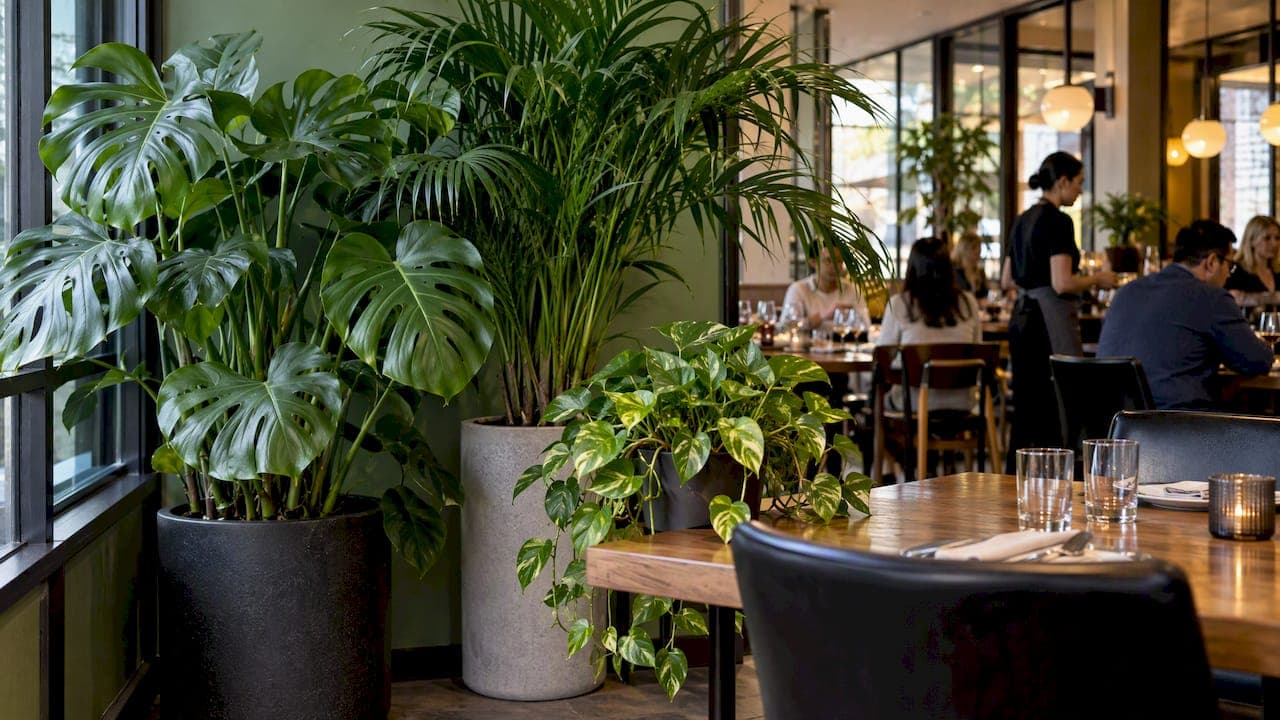
The best shade patio plants for containers in Canada are hostas, ferns, hellebores, coleus, begonias, astilbe and trailing creeping Jenny. Add a tall "thriller" and a sturdy, wide planter, and a dim corner becomes the part of your patio people want to sit in.
We're Greenspace Plants. Since 2014 we've designed, installed and cared for plants in offices, hotels, restaurants and retail across Toronto, Vancouver and Calgary. Shade is one of the most common patio challenges we see. It's also one of the easiest to solve with the right plant list.
Key takeaways
- Shade is not one thing. Full shade, part shade and bright indirect light call for different plants, so watch your patio for a few days before you buy.
- Foliage does the heavy lifting in shade. Hostas, ferns, hakonechloa and brunnera give you colour and texture without relying on flowers.
- Wind is the second test. Wide-based planters, clustered pots and woodland-edge plants cope far better than tall, narrow pots.
- In Canada, pick pots that survive freezing and thawing, and make them at least 35 cm wide and deep.
- For a restaurant, hotel or office patio, a managed program saves you the watering, swapping and seasonal change-outs.
Table of Contents
- Start by reading the shade
- The best plants for shaded patio containers
- Tall shade plants that stay easy to live with
- Native plants for part shade
- Shade plus wind: choosing plants and planters
- Looking after shaded plants in wind
- Our point of view
- Let us handle the patio
- FAQ
- Sources
Start by reading the shade
Before you pick a single plant, look at the light. Most patio shade falls into three groups:
- Full shade: little or no direct sun, only bright sky or reflected light.
- Part shade: about three to six hours of direct sun, often morning or late day.
- Dappled or bright indirect shade: light that filters through a tree, pergola or building edge.
Sidra Sheikh, writing in Canoe, points out that the real movement of light and shadow on your patio matters more than which way it faces. Watching how the light moves across your space is the best free planning tool you have. Check it at morning, noon and late afternoon.
One more point. Michigan State University Extension notes that even shade containers still need some bright, indirect light if you want blooms. A spot with no light at all won't flower, whatever you plant. In a deep, dark corner, lean on foliage.
This matters for a commercial patio too. A restaurant terrace between two buildings might be bright at lunch and dim by dinner. Plan for the light your guests actually see.
The best plants for shaded patio containers
The Master Gardeners of British Columbia list a reliable group for full-shade containers: hakonechloa, creeping Jenny, hosta, ferns, fuchsia, hellebore, coleus, begonia, impatiens and astilbe. It's a good, tested starting point for Canadian conditions.
Here's how we'd use them on a design-led patio.
| Plant | Role in the pot | What it gives your space |
|---|---|---|
| Hosta | Filler, large leaves | Bold, calm texture in greens, blues and variegated tones |
| Ferns | Filler or backdrop | Soft, airy movement |
| Hakonechloa | Spiller or edge | Flowing, golden-green grass look |
| Creeping Jenny | Spiller | Bright chartreuse trailing over the rim |
| Coleus | Thriller or filler | Strong colour in leaf patterns |
| Begonia and impatiens | Seasonal colour | Flowers in lower light |
| Fuchsia | Hanging or tall accent | Pendant blooms |
| Hellebore | Early-season structure | Evergreen leaves and spring flowers |
| Astilbe | Thriller | Feathery plumes above the foliage |
Build a pot like a designer
Michigan State University Extension suggests a "thriller, filler, spiller" approach, with an added "chiller" for calm. It's a simple framework for living art in shady containers. In practice:
- Put one tall, eye-catching plant in the centre or back.
- Surround it with mounded, leafy fillers.
- Let one trailing plant spill over the edge.
- Keep the palette tight: two or three leaf colours, not seven.
That last step is where most patios go wrong. A restrained palette looks intentional and reads as "on brand".
Add a luminous touch
Shade can feel heavy. Garden Design suggests 'Jack Frost' heartleaf brunnera for its silvery foliage, which seems to glow in low light. Pale, variegated or silver leaves bounce light around a dark corner far better than deep green alone.
The same source notes that Japanese maple or bamboo can work as standalone specimen plants in large shade containers. They're strong choices when you want one sculptural statement rather than a mixed bowl.
Shrubs and evergreens for year-round shape
If your patio is used through winter, or seen from inside, evergreen structure matters. The Master Gardeners of British Columbia, as cited by Lune Gardens, note that evergreen shrubs such as Taunton yew suit shaded balconies. GARDENWORKS lists azaleas, hydrangeas and viburnum among shade-loving shrubs. Check the hardiness zone of any shrub against your city before you buy, since a pot exposes roots to colder air than open ground does.
Tall shade plants that stay easy to live with
A tall plant gives a patio presence. It hides a bare wall, frames a doorway and sets a rhythm along a row of planters.
Michigan State University Extension lists astilbe, foxglove and coleus as thrillers for shady containers. Each does it differently:
- Astilbe: feathery flower plumes and fern-like leaves. Reliable, and it likes steady moisture.
- Foxglove: vertical spires, a classic cottage look. Best where it's sheltered.
- Coleus: tall, colourful leaves. It's an annual in Canada, so plan to replace it each year.
For a larger pot, Japanese maple or bamboo give height with a more architectural feel. Whatever you choose, check how big it will get and how often it needs trimming. "Low maintenance" depends on how well a plant suits its spot, not just on the plant.
Native plants for part shade
If your patio gets some sun, native plants are worth a look. For part-shade containers in the Greater Toronto Area, Blooming Boulevards lists wild columbine, wild strawberry, Pennsylvania sedge, woodland sunflower in larger pots, and wild ginger for deeper, consistently moist containers.
WWF Canada suggests looking at local natural areas to see which native species suit your region's conditions. It's good advice if you want a patio that feels rooted in its place.
One for the shade-loving collector: Coast Farms notes that Arisaema (Jack-in-the-pulpit) needs rich, moist, well-draining soil and a sheltered spot away from wind. It's striking, but it does not want an exposed corner.
Shade plus wind: choosing plants and planters
Shaded patios between buildings often act as wind tunnels. Air funnels through narrow gaps. High-rise terraces get it worse.
Plants that cope with wind
Blooming Boulevards recommends native species from prairie, meadow, shoreline and open woodland-edge habitats because they tolerate mechanical wind stress. For urban high-rise gardens, the group's guidance leans toward woodland-edge species. Those plants are used to some shade and some moving air, which is exactly your situation.
A few practical rules of thumb we follow:
- Choose plants with flexible stems and compact habits over brittle, top-heavy ones.
- Group big-leaved plants like hostas in sheltered spots, since large leaves can tatter.
- Keep tall, narrow plants close to a wall, not in the open.
If you're in Calgary, where wind and dry air are a constant, see our guide to drought tolerant patio plants for Calgary.
What a wind-resistant planter looks like
The same Blooming Boulevards guide gives a clear checklist for stability. Choose wider-based planters. Cluster containers together. Place taller plants near walls. Add discreet weight low in the pot.
Size matters as well. WWF Canada recommends containers at least 35 centimetres wide and deep so plants have enough soil and root space. For year-round Canadian use, it advises durable pots that withstand freezing and thawing cycles. A thin, cheap pot will crack in its first winter.
For guests, looks count as much as stability. A wide, low planter in a good finish can feel more premium than a tall, tippy one. If you're weighing materials and finishes, our guides to office planter types and custom planter costs go deeper.
Looking after shaded plants in wind
Shade doesn't mean low water. Wind pulls moisture from soil quickly. Blooming Boulevards advises watering early in the morning or late in the evening and checking containers daily during heatwaves. It also suggests plant dollies under large containers, so you can move them ahead of a storm.
A simple weekly routine:
- Check soil moisture with a finger, two to three centimetres down.
- Water deeply until it drains, then empty any saucer.
- Remove spent leaves and flowers.
- Turn pots a quarter turn so growth stays even.
- Look under leaves for pests.
- Check that weights and clusters are still stable.
Shaded foliage stays damp longer, so slugs and fungal problems show up more than in full sun. Spot them early and they're easy to deal with.
For a fuller schedule, see our patio planter maintenance guide. Running a restaurant? Our notes on outdoor dining area plant setup and restaurant patio plant installation cover how plants work around tables, service paths and heaters.
Our point of view
We do this every day, and the same mistakes come up on commercial patios.
First, people buy for the tag, not the spot. A plant labelled "shade" may still want morning sun. Match the plant to the light you measured.
Second, people underbuy on pot size. A small planter dries out fast in wind and tips in a gust. Go wider and heavier than you think you need.
Third, a patio is a seen space. Guests judge your brand by it before they walk in. Tired plants, cracked pots and mismatched sizes say "nobody's looking after this". Healthy, layered greenery says the opposite.

That's why we only work with commercial spaces. Since 2014 we've grown into Canada's leading commercial-only indoor plant service, caring for 60,000+ plants in 400+ commercial locations. We're WBE Canada certified, which means we're a woman-owned business. We also run national programs for multi-location brands, including in the US.
Our advice: pick fewer plants, choose a good pot, and make sure someone looks after it every week. The plants are the easy part. Consistency is what makes a space look good in month eight.
— Nicole
Let us handle the patio
If you'd rather not manage watering, swaps and seasonal change-outs yourself, we can design, install and care for your outdoor space. Our patio plantscapes are built around your light, your wind and your brand, and we handle planter sourcing, from standard to custom.

For indoor spaces, Greenspace+ is our all-inclusive service. It covers design, installation, regular care and plant replacements for a fixed monthly fee, from $299 per month, with no upfront costs or long-term commitments. Outdoor patio work is quoted by project, so get in touch and tell us about your space. If you manage several locations, our national account program keeps them looking consistent.
FAQ
What grows really well in shade on a patio?
Foliage plants do best. Hostas, ferns, hakonechloa, creeping Jenny and hellebore handle shade well, and coleus, begonias and impatiens add colour. The Master Gardeners of British Columbia list these for shaded containers. Start with two or three of them, not all at once.
Can plants grow in full shade with no sun?
Foliage plants can, but flowers are harder. Michigan State University Extension says shade containers still need bright, indirect light to bloom. In a very dark corner, choose plants for their leaves and expect few flowers.
What are low-maintenance tall plants for shaded containers?
Astilbe and foxglove give height with little fuss if they have steady moisture. Coleus is tall and colourful, though you'll replace it yearly in Canada. For a larger pot, Japanese maple or bamboo make a strong single feature.
Which planters resist wind best?
Wide-based, weighted planters. Cluster them, put tall plants near a wall, and add discreet weight low in the pot, as Blooming Boulevards advises. Make sure the pot is frost-durable too.
Do I need different plants for a shaded patio in Toronto?
The same principles apply, but choose plants hardy for your zone and consider native options. Blooming Boulevards lists native part-shade choices for the GTA, including wild columbine and Pennsylvania sedge. If your patio is tall and exposed, favour woodland-edge species.
Sources
- Creating Native Plant Container and Raised Bed Gardens, Blooming Boulevards
- How to create wildlife habitat on your balcony, patio or porch, WWF Canada
- Plants for a shaded balcony, Master Gardeners of BC
- Container gardening in a shady area, Michigan State University Extension
- Best Shade Plants for Pots and Shade Container Ideas, Garden Design
- How to start a container garden in Canada, Canoe
- How to Plant Arisaema in Canada, Coast Farms
- Container Gardening on Your Balcony, Lune Gardens
- Shade Gardening Guide, GARDENWORKS