
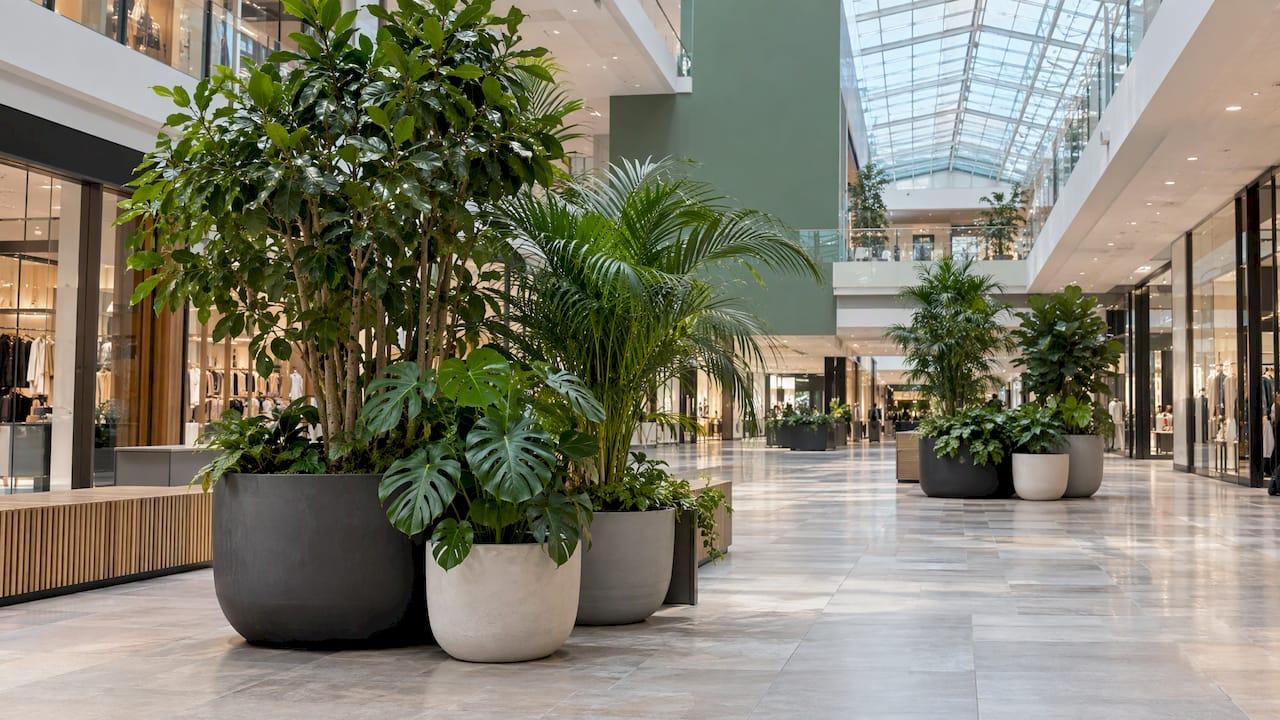
The best shopping mall plants are tough, tropical foliage plants matched to the light, warmth and humidity of each spot, placed where they add to the space without blocking people. Then someone has to keep them healthy, week after week. That last part is where most commercial plantings fail.
We are Greenspace Plants, Canada's leading commercial-only indoor plant service, founded in 2014. We design, install and care for plants in offices, hotels, restaurants and retail across Toronto, Vancouver and Calgary. This guide is for design-conscious managers, workplace experience leads, interior designers, and property and hospitality teams who want a mall, atrium or retail corridor that looks and feels alive.
Key Takeaways
- Choose plants for the building's real conditions: light first, then warmth, humidity and available space.
- Place plants to invite people in. Keep them off circulation routes, away from exits, and out of windowless corners.
- Large, bold plants suit big volumes. Small plants get lost and too many plants crowd a space.
- A planting only stays beautiful with a care routine behind it. Plan the maintenance when you plan the design.
- A full-service plan removes the upkeep from your team. Greenspace+ starts from $299 per month.
Table of Contents
- Why a mall is a different job from an office
- Start with light
- Warmth, humidity and the plants that cope
- Scale: big spaces need bold plants
- Placement that invites people in
- What care really involves
- Do plants improve air in commercial buildings?
- Why a managed plant program beats a one-off purchase
- Our perspective
- See what it could look like in your space
- FAQ
- Sources
Why a mall is a different job from an office
A mall is not a quiet floor of desks. It has long sight lines, big glass roofs, heavy foot traffic and a mix of tenants with different needs. Plants here are part of the architecture. They soften hard surfaces, mark gathering spots and shape how shoppers move.
That changes the brief. A plant in a mall has to look good from far away and up close. It has to survive passing carts, strollers and crowds. It also has to cope with the building's climate, which can swing from sunny atrium to dim corridor within a few metres.
The same logic applies to a hotel lobby, a restaurant entrance, or a retail showroom. The scale differs. The principles do not.
Start with light
Light decides almost everything. Clemson's horticulture extension calls light the most important environmental factor when choosing indoor plants. It also explains that light is often measured in foot-candles, and that plants are grouped as low, medium, high or very high light.
That gives you a simple way to sort a mall. Map each zone by how much light it gets, then match plants to the zone, not the other way around.
Read the building, not the brochure
Windows are a good starting point. According to the Manitoba Master Gardener Association, south-, east- and west-facing windows generally give brighter light than north-facing ones. Trees, neighbouring buildings, overhangs and window coverings can all cut that light further.
The same article suggests measuring light with a meter or phone app at different times of day. Do it in winter too. A skylight that feels generous in July can feel thin in January.
If a zone turns out too dark, the fix may be the fixtures, not the plants. Reviewing your commercial lighting upgrades can show where better lighting would open up more planting spots. Clemson's extension notes that artificial light can supplement or replace natural light, and that longer exposure can make up for weaker light, ideally run on an electric timer.
We go deeper on this in our piece on how lighting shapes plant selection.
A quick light map
| Zone in a mall | Typical light | What to plant for |
|---|---|---|
| Skylit atrium or food court | Bright, sometimes direct | Large, sturdy statement plants that handle high light |
| Entrances and window-lined concourses | Bright but variable | Plants that cope with changing light and cold at the glass in winter |
| Mid-mall corridors | Medium | Adaptable foliage plants in planters at seating areas |
| Interior corridors and corners | Low | Low-light foliage, with supplemental lighting where needed |
This is a planning frame, not a spec. Every building has its own quirks, which is why a site walk matters.
Warmth, humidity and the plants that cope
Most popular interior plants come from the tropics. They like it warm and steady.
Philodendron is a good example. The University of Connecticut's fact sheet describes it as a well-known foliage plant used in interior plantings in offices, lobbies and shopping malls. It does well when kept warm (a 65°F minimum, about 18°C), moderately moist and out of direct sun.
Notice what that says. Even a plant famous for mall use depends on conditions. "Suitable for malls" really means "suitable when the spot matches its needs."
Humidity is the quiet variable
UT Extension notes that many tropical indoor plants do best with more than 50% relative humidity. Indoor rooms often sit at medium (40 to 50%) or low (under 20%) humidity instead.
Low humidity also increases water loss through transpiration. So watering may need to change when the air is dry. In a Canadian winter, with heating running, that matters.
This is one reason a set schedule can fail. A plant that needs water every week in October may need a different rhythm in February. Care has to follow the plant, not the calendar.
Matching plant to spot
Landscape Ontario's interior landscaping guide says success depends on a planning and design process that makes sure the plants fit the proposed conditions. We agree. Our approach starts with the space: its light, traffic and look, and then the plant list.
If you want a starting point, our indoor plant choices for offices and businesses page shows what we work with. Our guide to indoor plants for high-traffic areas covers busy zones in more detail.
Scale: big spaces need bold plants
A mall has height. Plants that look right in a boardroom look lost under a double-height ceiling.
An indoor plantscaping guide from a horticultural training provider puts it plainly: large plants usually don't suit small spaces, tiny plants can look wrong in large ones, and too many plants can overwhelm a room.
So think in layers:
- Anchors. A few large statement plants that set the scale.
- Mid-layer. Planters at seating areas and corners, to carry the eye along.
- Accents. Smaller plants where people pause, such as a counter or a kiosk.
Fewer, better-sized plants usually beat many small ones. Our articles on scaling greenery in large commercial spaces and large statement plant examples show how this plays out.
Planters matter as much as plants. We source standard, premium, luxury and custom planters, so the container can match a mall's finishes and a tenant's brand.
Placement that invites people in
Good placement makes people want to stay. Bad placement gets in their way, and gets the plants damaged.
The same plantscaping guide says placement should blend function and look. It should avoid blocking access routes, and should leave room for seating beside plants where people may gather. It also says to keep plants from blocking corridors, entrances, exits and window light.

An architects' guide to interior plantscaping for biophilic design adds a warning. It advises against placing plants in line with foot traffic, near outdoor exits, or in windowless corners, because of long-term damage.
Placement checklist
- Keep a clear path. Plants frame a route. They never narrow it.
- Put planters beside benches and gathering spots.
- Keep plants back from exit doors, where drafts and cold hit.
- Don't tuck plants into dark corners without a light plan.
- Keep window light open for the plants that need it.
- Give each plant room so air can move around it.
The Manitoba Master Gardener article also advises keeping plants away from cold glass in winter and away from drafts. Mall entrances are full of both.
A green wall or moss wall is another option when floor space is tight or traffic is heavy. It brings plants up to eye level without using the walkway. We design and install both. See our green walls page.
What care really involves
Here is the part most buyers underestimate. Planting is a day. Care is years.
Landscape Ontario lists what a maintenance program can cover: watering, pruning, grooming, fertilizing, soil dressing, pest and disease control, transplanting, relocation, container washing and after-hours service. It adds that contract terms decide what is included and what costs extra.
That last point deserves a close read. Ask what is in the monthly fee and what is billed on top.
The routine on a busy site
Mall plants collect dust from crowds, air handling and construction. The Manitoba Master Gardener article recommends wiping dust off leaves every few months so plants can keep photosynthesizing. It also recommends giving plants enough space for air circulation.
Large indoor gardens can go further with monitoring. Calgary's Devonian Gardens used soil sensors to track water content, soil temperature and salinity across many planter beds and species. The lesson is useful at any scale: healthy plants come from paying attention to conditions, not guessing.
We built our service around that kind of attention. Our technicians are plant clinicians, and a visit is more than a watering can. You can read what happens in a Greenspace maintenance visit.
Do plants improve air in commercial buildings?
People often ask. The research is encouraging, and worth stating carefully.
A 2017 study in newly built public office buildings reported that major indoor air pollutants fell after plants were introduced for three months. Some allergic rhinoconjunctivitis symptoms and work-related stress indexes also decreased in the plant group.
Laboratory work from the University of Technology Sydney, summarized by Professor Margaret Burchett, found that potted plants reduced airborne VOCs to negligible levels (under 100 ppb) in test chambers. Reductions reached up to 75% when total VOCs rose above about 100 ppb.
Those are results from offices and test chambers, not from malls. Still, they point the same way as what shoppers and tenants feel: a planted space seems fresher and calmer. That experience is the real prize for a mall, a hotel lobby or a restaurant.
Why a managed plant program beats a one-off purchase
Most plant failures in commercial spaces have the same story. The install looks great. Then nobody owns the watering, the pruning or the replacement of a tired plant. Six months later the space looks neglected, and that reflects on the brand.
A managed program fixes that. The plants arrive designed for your space. The care is scheduled. A failing plant gets replaced, so the look stays consistent.
That is the idea behind Greenspace+. For a fixed monthly fee, you get plant design, installation, regular maintenance and plant replacements. There are no upfront costs and no long-term commitments. Plans start from $299 per month. Your team doesn't need to think about plants again.
If you already own plants or prefer to buy outright, we also offer a buyout with plant care, or plant care only. Our comparison page sets them out.

Working with designers
Malls and hospitality projects often involve an interior designer. We collaborate with designers on plant selection, planters and placement, so the greenery supports the concept rather than fighting it. Learn more on our indoor plant design page.
Our perspective
We have spent years walking into spaces that were meant to feel welcoming and found plants that were tired, leggy or in the wrong spot.
It is almost never the plant's fault. The light was wrong, or the placement fought the traffic, or nobody had the job of looking after it.
That is why we only do commercial work. We design, install and care for plants in offices, hotels, restaurants and retail across Toronto, Vancouver and Calgary. We look after 60,000+ plants in 400+ commercial locations. We are WBE Canada certified (woman-owned), and we run national programs for multi-location brands, including in the US.
Our view is simple. Plants should make a space look and feel better, and your team should never have to think about them. When the design, the planters and the care come from one team for one monthly fee, the green stays green.
Nicole
See what it could look like in your space
If you manage a mall, a lobby, a restaurant or a retail floor, we can start with the room itself. We look at your light, your traffic and your brand, then design a planting around them.
Greenspace+ covers design, installation, care and replacements for one fixed monthly fee, from $299 per month. Start with Greenspace+, or see our work in the client look-book.

Multi-location brand? Our national account plant program brings one standard to every site.
FAQ
Which indoor plant is good for a shop?
Pick plants for the shop's light first. Philodendron is a classic choice for lobbies, offices and malls when it stays warm, moderately moist and out of direct sun. Larger statement plants suit bigger retail spaces, and smaller plants suit counters and shelves. We help retail clients choose plants and planters that fit their brand.
How many plants does a shopping mall need?
Fewer, well-sized plants usually look better than many small ones. Too many plants can overwhelm a space, and tiny plants can look wrong in a large one. We suggest a few large anchors, mid-size planters at seating, and small accents where people pause.
Can plants go near mall entrances?
Yes, but choose the spot carefully. Entrances bring cold drafts and fast changes in light, and plants should never block the way in or out. Keep plants away from cold glass and exit doors in winter, and give them room for air to move.
Do mall plants need regular care?
Yes. Watering, pruning, dusting, fertilizing and pest checks all matter, and needs shift with the season as humidity drops in winter. With Greenspace+, maintenance and plant replacements are part of the fixed monthly fee.
Sources
- Philodendron, University of Connecticut Home and Garden Education Center
- Indoor Plants: Cleaning, Fertilizing, Containers and Light Requirements, Clemson HGIC
- Selecting Indoor Plants for the Home or Office, UT Extension
- Interior landscaping user guide, Landscape Ontario
- Ode to the Office Plant, Manitoba Master Gardener Association
- Indoor Plantscaping e-book sample, Chapter 1
- An Architect's Guide to Interior Plantscaping for Biophilic Design
- LoRa Technology: Smart Agriculture for Indoor Botanical Gardens, City of Calgary
- Impact of Indoor Plants on Indoor Air Quality, Journal of Environmental Health and Sustainable Development
- Potted-plants reduce indoor air pollution, Burchett, UTS