
Showroom plant styling means hiring a plantscaping provider to design, install, and maintain living plants that support your merchandise instead of hiding it. The fastest path to a workable proposal is simple: gather your floor plans and photos, note your access hours, and request an on-site assessment. Greenspace Plants offers this as a full-service option through Greenspace+, covering design, installation, and ongoing care under one plan.
TL;DR:
- Proper site assessment with scaled floor plans, photos, and environmental data prevents mismatched proposals and ensures plant survival.
- Plant placement should support display visibility and match ceiling heights and finishes; composition matters more than quantity.
- Maintenance contracts need clear terms on visit frequency, replacement protocols, pest management, and response times to avoid unresolved issues.
- Cost varies widely based on plant size, planter type, installation complexity, and service frequency; itemized quotes are essential for fair comparison.
- Full-service programs centralize accountability, reducing risks related to environmental changes and logistical surprises after installation.
Table of Contents
- What Design Principles Make Showroom Plants Work?
- What Should You Prepare Before Requesting Proposals?
- How Do You Evaluate Plant and Planter Selections?
- What Belongs on the Installation-Day Checklist?
- Which Maintenance Model and Contract Terms Actually Protect You?
- How Should You Budget for a Showroom Plant Project?
- Why Full-Service Programs Reduce Showroom Risk
- How Greenspace Plants Fits Into Your Showroom Project
- Sources
- FAQ
What Design Principles Make Showroom Plants Work?
A showroom is not an office lobby. Every plant either supports the product story or competes with it, and the difference usually comes down to composition, not quantity. Retail research on biophilic design backs this up directly: the visual quality and arrangement of natural elements determine whether customers respond positively, not the raw number of plants you install.
We think about showroom greenery in three zones, each with a different job:
- Reception and focal points: statement specimens that greet visitors and set tone without blocking signage.
- Product-adjacent placement: smaller, controlled plants that frame merchandise without obscuring price tags, labels, or sightlines to exits.
- Back-of-house and transition areas: where scale and species can flex more freely since customer eyes rarely linger there.
Plant scale should match your ceiling height and fixture lines. A six-foot fiddle-leaf fig looks intentional under a 14-foot ceiling and awkward crammed against an 8-foot drop ceiling. Planter finishes matter just as much. Matte black, brushed metal, or raw concrete containers read differently against a luxury auto showroom than they would in a furniture gallery, and mismatched finishes make greenery look like an afterthought rather than part of the brand experience. Deliberately composed biophilic settings can even lift perceived customer value and loyalty, which is a strong argument for treating plant placement as a design decision, not decoration bolted on at the end.
What Should You Prepare Before Requesting Proposals?
Vendors can only quote accurately when you hand them the right inputs. Practitioner guidance on commercial plantscaping consistently points to environmental assessment as the step that predicts whether an installation succeeds or struggles. Before you request bids, assemble this:
- Scaled floor plans showing walls, fixtures, and traffic paths.
- Photos of every elevation, including window exposures and any HVAC vents or returns near planned plant zones.
- Ceiling heights at each zone you want styled.
- Operating hours, plus delivery, freight elevator, and loading dock dimensions.
- After-hours access rules, since many installations happen outside retail hours to avoid disrupting customers.
- Landlord or property-management constraints, including any required insurance certificates or contractor badging.
Skipping this step is the single biggest reason proposals come back mismatched. A designer who does not know your HVAC return locations cannot predict which species will thrive near a cold-air stream, and a vendor who does not know your loading dock width might quote an installation timeline that simply will not work on delivery day.
How Do You Evaluate Plant and Planter Selections?

Any plant list a vendor sends you should map directly to the light and climate conditions you measured, not to generic labels. "Low light tolerant" means very little without knowing your actual foot candles, HVAC cycling, and proximity to exterior doors. Ask for species names tied to specific zones, and push back if a proposal reads like a catalog copy-paste. Our guide on how lighting shapes plant selection walks through the measurements that should inform any serious plant list.
A few criteria separate a durable showroom install from one that declines within months:
- Touch-prone areas need tougher species. Anywhere customers or staff brush past regularly calls for rigid-leaved, forgiving plants rather than delicate tropicals. Our breakdown of plants for high-traffic areas covers which species hold up.
- Planter specs should be spelled out, not implied: drainage method, liner material, filled weight, and finish. Ask explicitly who owns maintenance of any built-in irrigation trays.
- Modular or mastered planters give you flexibility for seasonal resets, product launches, or trade show setups without a full re-install.
Pro Tip: Ask any vendor for a written light reading, not a visual guess, before they finalize plant selections. A meter reading taken on a cloudy morning can look nothing like the same corner on a sunny afternoon, and that gap is where plant failures start.
What Belongs on the Installation-Day Checklist?
Installation day is where good planning either pays off or falls apart. Floor protection, elevator scheduling, and packaging removal need to be settled before the delivery truck arrives, not negotiated on-site. Early collaboration between your plantscaping provider and any interior designer or general contractor on the project, ideally during the design-development stage, prevents the kind of last-minute conflicts where a planter and a lighting fixture end up fighting for the same six inches of floor space. Providers with design collaboration experience tend to catch these clashes before they become change orders; their participation in a designer trade program ensures smoother coordination and better outcomes.
A tight handover packet keeps everyone accountable afterward:
- Floor protection down before any plant or planter enters the space.
- Delivery and freight elevator windows confirmed in writing, with packaging hauled away same day.
- A handover document listing plant locations, watering notes, access protocols, and an escalation contact for problems.
- Living walls and moss installations flagged separately. These carry their own technical scope, irrigation systems, and maintenance plans, and should never be lumped into a standard potted-plant contract.
Which Maintenance Model and Contract Terms Actually Protect You?
Four maintenance models cover most commercial arrangements: Plant-as-a-Service programs, standalone vendor maintenance contracts, in-house staff care, and hybrid setups that mix a vendor for specialized zones with internal watering for the rest. A Plant-as-a-Service model, where design, installation, maintenance, and replacements roll into one recurring fee, tends to fit busy showroom managers best because it removes the coordination burden of managing multiple vendors or training staff on plant care.
Whichever model you choose, your contract should spell out these elements explicitly:
- Visit cadence, matched to species and conditions rather than a blanket weekly or biweekly schedule for every zone.
- Replacement terms, stating exactly what gets replaced, at what size or spec, and within what window.
- Pest management protocol, including how issues get reported and treated.
- Reporting format, so you know what condition your plants were in at each visit.
- Response times for urgent issues, separate from routine visits.
A reasonable SLA benchmark for showroom accounts runs 48 to 72 hours for urgent response and a 7 to 14 day window for replacements, with high-visibility zones held to the faster end of that range. Exclusions matter just as much as guarantees: contracts should clearly separate what's covered from client-caused damage, construction disruption, or unauthorized relocation of a plant to a spot the designer never assessed. A vague "healthy plant guarantee" without those boundaries protects nobody.
How Should You Budget for a Showroom Plant Project?
There is no defensible flat per-plant or per-square-foot rate that applies across showrooms, because cost is driven by variables that shift project to project. Anyone quoting a single universal number is guessing.
The real cost drivers are:
- Plant quantity and mature size at install.
- Planter type, especially custom or luxury finishes versus standard containers.
- Installation complexity, including access limitations and after-hours labor.
- Living or moss walls, which carry separate design and irrigation costs.
- Travel and logistics for your specific location.
- Service frequency once the maintenance contract begins.
Most showrooms choose between three purchasing paths: an all-inclusive recurring plan that bundles design, installation, and care into one monthly fee; a one-time purchase with optional paid maintenance added later; or a care-only arrangement for showrooms that already own their plants and planters. Request itemized proposals broken out by plant specs, planter specs, visit cadence, and replacement terms. That is the only way to compare two vendor quotes fairly, since a lower headline number often hides a thinner maintenance schedule or a narrower replacement guarantee.
Why Full-Service Programs Reduce Showroom Risk
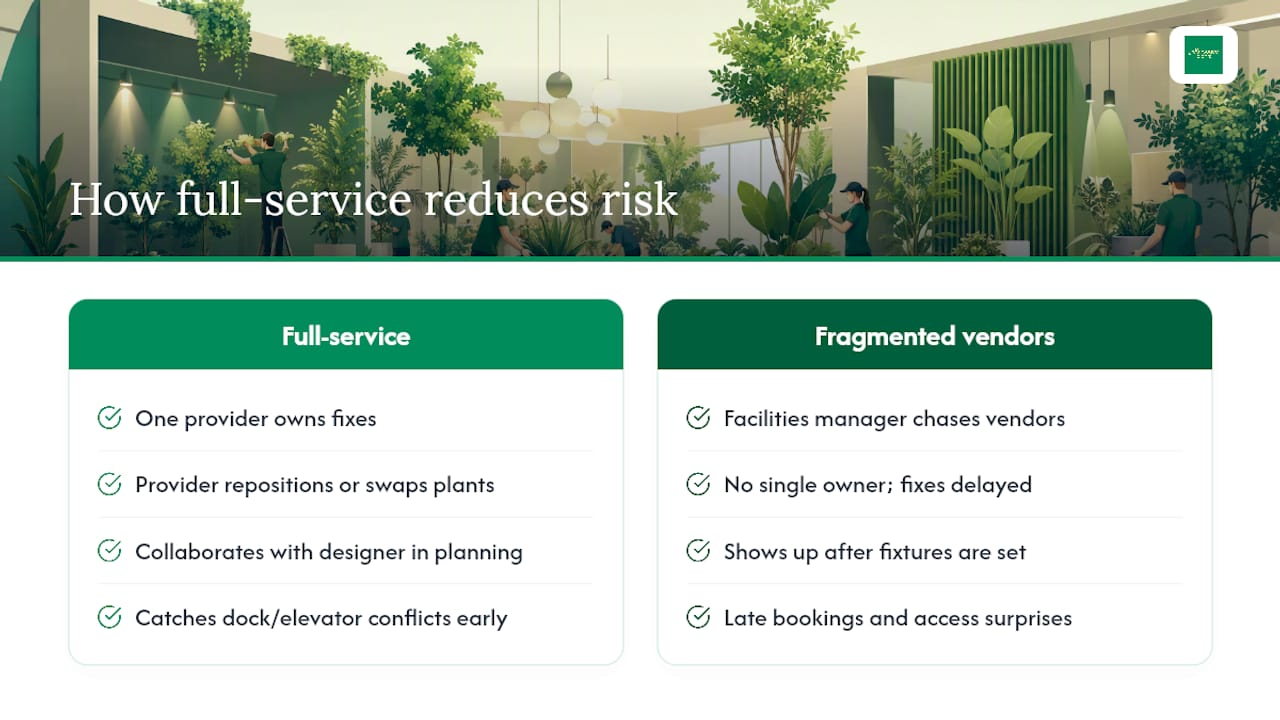
Most plant failures we see trace back to environmental changes after installation, not neglect. A blind gets installed, an HVAC vent gets redirected, a display wall goes up six inches from where the designer expected. A full-service program centralizes accountability so one provider owns the fix, whether that means repositioning a plant, swapping species, or adjusting the care plan, instead of a facilities manager chasing three separate vendors.
The other recurring pitfall is access surprises: a loading dock closes early, a freight elevator needs booking two weeks out. Providers who collaborate directly with your interior designer during planning, rather than showing up after fixtures are set, catch planter-and-fixture conflicts before they become expensive change orders.
— Nicole
How Greenspace Plants Fits Into Your Showroom Project
Greenspace Plants is the alternative to piecing together a designer, an installer, and a separate maintenance vendor for your showroom, since Greenspace+ bundles all three into one plan with no upfront cost and no long-term commitment.
That structure matters most for showroom managers who do not have spare hours to manage multiple contracts or chase replacement warranties across vendors. Design, installation, ongoing maintenance, and plant replacements all sit under one agreement, so if a species struggles after an HVAC change or a display gets rearranged, one team handles the fix rather than three phone calls.
If you're ready to move forward, start by sharing your floor plans and elevation photos and requesting an on-site assessment. From there, ask for an itemized proposal covering plant and planter specs, visit cadence, and replacement terms so you can evaluate it against anything else you're considering. You can review interior plant service options or browse completed showroom installations to see how the process plays out in real spaces, and reach out through Greenspaceplants to get a scoped quote started.
Sources
- Effects of indoor plants on office workers: a field study in multiple Dutch organizations (Frontiers, 2023)
- Retail biophilic design study (ScienceDirect)
- Biophilic atmospheres and customer loyalty (MDPI, 2023)
- Commercial plant maintenance models (Interiorscape guide)
FAQ
What Is Showroom Plant Styling, Exactly?
It's contracted commercial plantscaping for showrooms, covering design, installation, and ongoing maintenance rather than one-off decorating. It differs from residential plant styling because sightlines, product visibility, and traffic patterns drive every placement decision.
How Much Does Showroom Plant Styling Cost?
Cost depends on plant quantity, planter type, installation complexity, and service frequency, so there is no single flat rate. Greenspace Plants offers Greenspace+, an all-inclusive plan starting at $299 per month with no upfront cost, while custom design, installation, and maintenance services are quoted individually based on project scope.
How Often Should a Showroom's Plants Be Serviced?
Visit cadence should match species, light, and traffic rather than following one fixed schedule everywhere. Many commercial contracts run weekly or biweekly visits, with high-visibility zones held to faster inspection and replacement timelines than back-of-house areas.
What Should a Replacement Guarantee Actually Cover?
A useful guarantee specifies the exact size and species being replaced, the replacement timeline, and clear exclusions like client-caused damage or unauthorized relocation. Vague guarantees without those details tend to create disputes rather than prevent them.
Do Living Walls Need a Separate Maintenance Plan?
Yes. Moss walls and living green walls carry their own irrigation systems, technical scope, and replacement terms, so they should never be bundled into a standard potted-plant contract. Ask any provider, including those offering green plant walls, for maintenance terms specific to that installation type.