
Sustainable plant sourcing for commercial interiors means selecting indoor plants and supply chains that minimize environmental impact, verify ethical provenance, and optimize both lifecycle costs and occupant health. If you're an office manager or business owner preparing an RFP or evaluating a plant service provider, the single most important action you can take right now is to request a written provenance statement before any contract is signed.
Start here — your immediate checklist:
- Ask your supplier for source certificates naming the grower, lot number, and propagation method for every plant species.
- Request a sample maintenance schedule with defined KPIs (replacement timelines, visit frequency, survival rate targets).
- Confirm in writing that all growing media is peat-free, with permitted alternatives listed.
- Require a replacement guarantee covering plants that fail within a defined period post-installation.
Table of Contents
- Why sustainable plant sourcing matters for your commercial project
- Core principles to specify in your design brief and RFP
- How to evaluate vendors and run a sustainable procurement process
- How to fold sourcing requirements into design, schedule, and maintenance
- Sample contract language for sustainable sourcing and provenance
- Key Takeaways
- What the sourcing conversation is really about
- Greenspace Plants brings this sourcing standard to your office
- Useful sources and further reading
Why sustainable plant sourcing matters for your commercial project
The business case goes well beyond aesthetics. Plants sourced from responsible, local nurseries tend to be better acclimated to indoor conditions, which means fewer replacements, lower maintenance labor, and a longer-lived installation. Plantscaping supports wellness goals including reduced stress and improved air quality — benefits that depend on plants actually thriving, not just surviving their first month.
There are real legal and reputational risks attached to poorly documented supply chains. Plants sold as "wild-collected" may have been illegally harvested from protected habitats, exposing your organization to reputational damage if the sourcing story surfaces. Ethical sourcing requires transparent supply chains; businesses that cannot trace each plant to a responsible origin are vulnerable to exactly this kind of risk.
Resource costs are equally concrete. Peat-based growing media releases stored carbon from sensitive wetlands, and long-distance shipping adds measurable emissions to your project's footprint. Both are avoidable with the right specifications.
Certification signal: The SITES framework (Sustainable Sites Initiative) is the primary U.S. rating system for sustainable landscapes, covering corporate campuses and interior projects alike. Referencing SITES in your RFP signals to vendors that you expect a documented, verifiable approach to plant selection and management.
- Health: Well-sourced, acclimated plants perform better indoors, supporting air quality and occupant satisfaction.
- Ethics: Provenance documentation protects you from association with illegal collection or poaching.
- Cost: Local nursery stock and warranty-backed plants reduce lifecycle replacement and labor costs.
- Carbon: Minimizing plant transport distance lowers your project's carbon footprint and improves plant survival rates.
Core principles to specify in your design brief and RFP
Getting these principles into your specification document before vendors bid is what separates a sustainable outcome from a greenwashed one.
Native and climate-adapted species. Ecological landscape design centers native plants because they support local ecosystems and reduce reliance on chemical fertilizers and excessive water. For indoor commercial projects, "adapted" means species proven to thrive in your building's light and humidity conditions, ideally sourced from regional genetics.
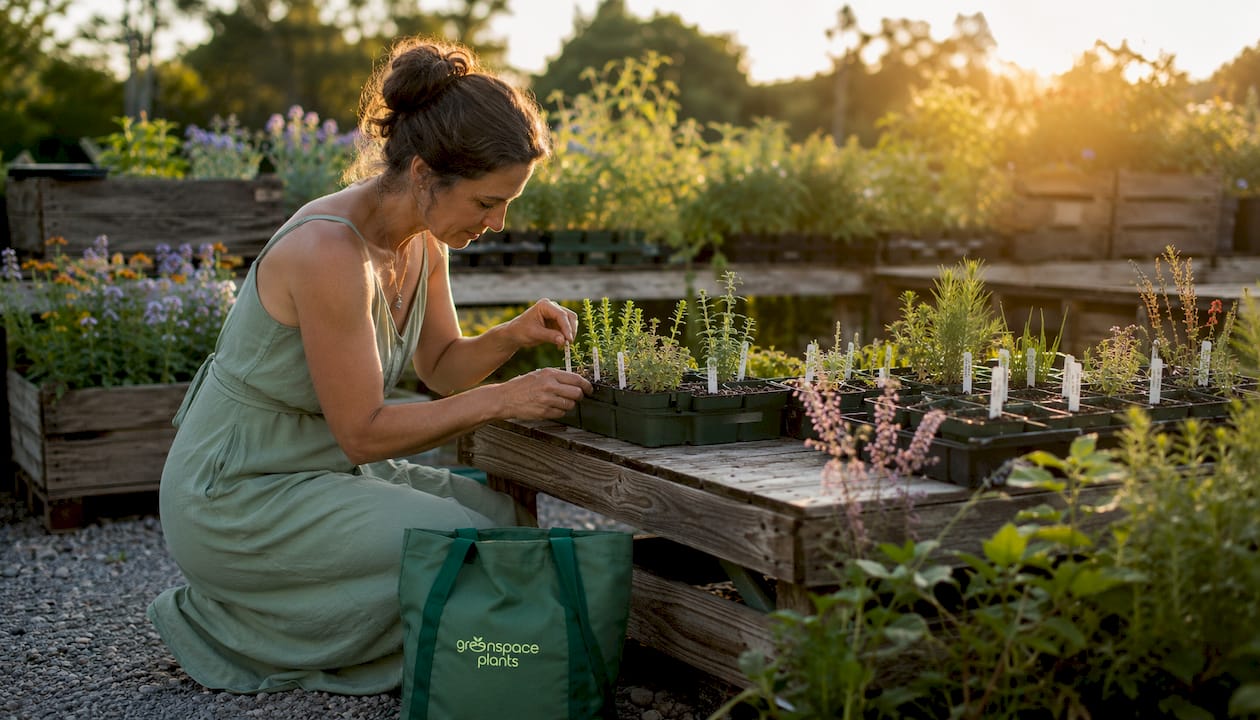
Propagation ethics. Require documentation that all stock is nursery-grown through seed propagation, asexual division, or tissue culture. Tissue culture produces many identical, pest-free plants from sterile samples, removing pressure on wild populations entirely. No wild-collection, period.
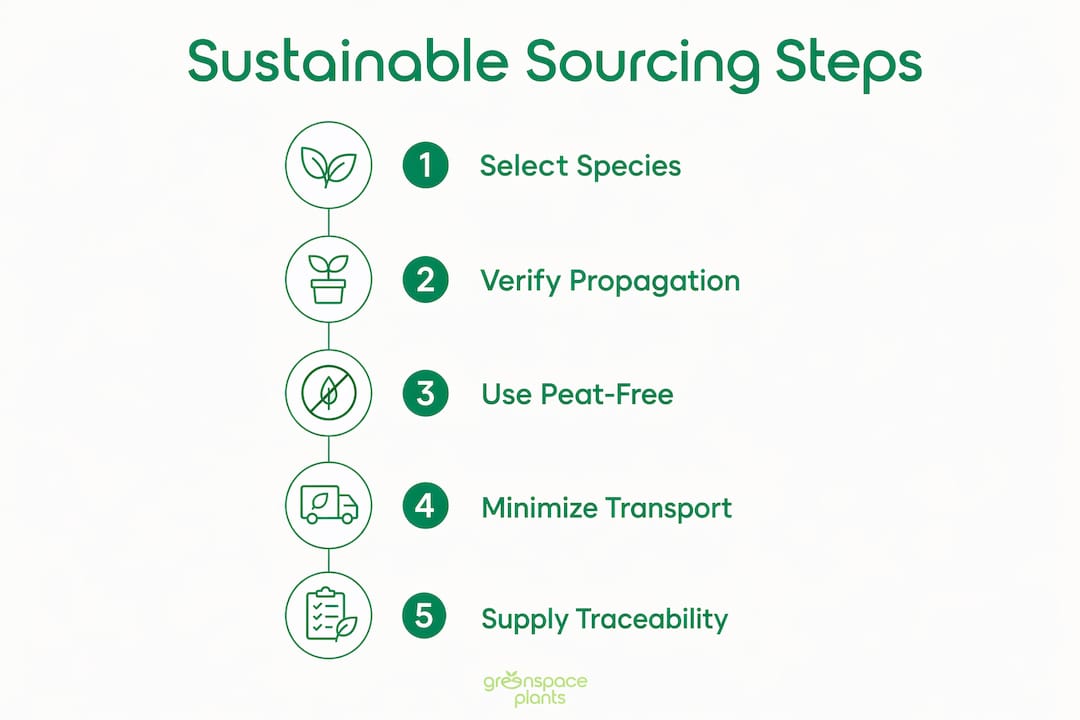
Peat-free growing media. Peat moss is harvested from sensitive wetlands and releases stored carbon. Specify peat-free alternatives such as compost mixes, coconut coir, or locally sourced wood-based byproducts, and require documentation confirming media composition.
Minimize plant miles. Plant miles refers to the distance a plant travels from nursery to your site. Shorter distances mean lower emissions and better-acclimated stock. Prioritize regional nurseries whenever possible.
Supply-chain traceability. Every delivery batch should arrive with a provenance statement: grower name, lot number, propagation method, and transport chain records.
Lifecycle planning. Specify replacement guarantees, planned phasing, and a management-over-maintenance model that favors adapted plant communities over high-turnover single specimens.
Pro Tip: When visiting or auditing a nursery, ask to see the propagation tags on the growing benches. Legitimate nurseries label each batch with propagation date and method. If a supplier cannot show you batch records or deflects the question, treat that as a red flag for wild-collected or undocumented stock.
How to evaluate vendors and run a sustainable procurement process
A structured evaluation prevents you from accepting vague sustainability claims at face value.
Step 1: Pre-qualification documents to request
Before inviting vendors to bid, require: nursery provenance statements, propagation records for each species, phytosanitary certificates where applicable, and a sample maintenance schedule with defined KPIs.
Step 2: Conduct structured interviews
Ask every vendor the same questions so you can score responses consistently:
- Where is each plant species grown, and can you provide the grower's name and lot numbers?
- What propagation method was used — seed, division, or tissue culture?
- Is all growing media peat-free? What alternatives do you use?
- What is your replacement guarantee, and what triggers it?
- How do you reduce carbon emissions in your delivery logistics?
Step 3: Score responses across five categories
- Provenance and supply-chain transparency
- Propagation ethics (nursery-grown, tissue culture, no wild collection)
- Media sustainability (peat-free confirmation and documentation)
- Local sourcing and plant miles minimization
- Warranty and maintenance model quality
Step 4: Check references for long-term plant health
Ask for portfolio examples or case studies showing plant health at 12 and 24 months post-installation. A vendor confident in their sourcing and maintenance model will share this readily.
Red flags to reject a supplier outright:
- No provenance documentation or refusal to name the grower
- Plants described as "wild-collected" or "field-harvested" without certification
- Inability to confirm peat-free media
- No replacement guarantee or vague warranty language
Ethical sourcing requires you to be prepared to audit propagation claims, not just accept them.
How to fold sourcing requirements into design, schedule, and maintenance
Timing matters. Native and nursery-propagated stock often has longer lead times than commodity greenhouse plants, so sourcing specifications need to enter the project timeline at the design phase, not after installation is scheduled.
| Role | Responsibilities | Verification Step |
|---|---|---|
| Designer / Specifier | Select species, write sourcing specs into design brief | Confirm provenance requirements are in the RFP |
| Procurement Lead | Issue RFP, score vendors, execute contract | Collect and file provenance statements pre-delivery |
| Facilities Manager | Oversee installation, track replacements | Log KPIs: survival rate, visit frequency, replacements |
| Supplier | Deliver documented stock, maintain per schedule | Provide batch records and maintenance reports |
Budget guidance: nursery-propagated, locally sourced stock typically costs more upfront than commodity imports. That premium is offset by lower replacement frequency, reduced chemical inputs, and fewer emergency service calls. A management-over-maintenance approach uses plant selection and design to lower long-term resource use, which means your steady-state maintenance cost drops over time. Plan for a higher initial procurement line item and a declining maintenance cost curve across years one through three.
For installation best practices including pre-install acclimation staging, the plant installation guidance from Greenspace Plants covers the sequencing in detail. A commercial landscape renovation plan follows similar phasing logic for exterior-to-interior transition projects.
Sample contract language for sustainable sourcing and provenance
These clauses are practical starting points. Run them by your legal counsel or procurement team before including them in a binding agreement.
- Provenance traceability clause: "Supplier shall provide, with each delivery batch, a written provenance statement including grower name, nursery address, lot number, and propagation method for each species delivered. Records shall be retained and made available for audit upon request."
- Wild-collection ban: "No plant material shall be sourced from wild collection. All stock must be nursery-propagated via seed, vegetative division, or tissue culture. Noncompliant stock will be rejected and replaced within [X] business days at no cost to the client."
- Peat-free media clause: "All growing media used in delivered plants shall be peat-free. Permitted alternatives include compost mixes, coconut coir, and locally sourced wood-based byproducts. Supplier shall provide media composition documentation upon request."
- Warranty and replacement clause: "Supplier guarantees a [X]% plant survival rate at [90/180] days post-installation. Plants falling below this threshold shall be replaced within [X] business days. Client retains audit rights to provenance documentation for all replacement stock."
Pro Tip: Build an audit-rights clause into every agreement. The right to request batch records at any point during the contract term is what gives provenance requirements real teeth. Without it, a supplier can swap to cheaper, undocumented stock after the initial delivery.
Key Takeaways
Sustainable plant sourcing for commercial interiors requires provenance documentation, nursery-propagated stock, peat-free media, and a management-over-maintenance model to deliver lasting health and cost benefits.
| Point | Details |
|---|---|
| Demand provenance documentation | Require grower name, lot number, and propagation method for every delivery batch. |
| Prefer local, nursery-propagated stock | Regional sourcing reduces plant miles, lowers emissions, and improves acclimation and survival rates. |
| Specify peat-free growing media | Ban peat in contracts; list permitted alternatives such as coconut coir and compost mixes. |
| Use management-over-maintenance | Select adapted species and design plant communities to reduce long-term labor and chemical inputs. |
| Greenspace Plants | Offers design, installation, maintenance, and guaranteed replacements under one fixed monthly fee with no upfront costs. |
What the sourcing conversation is really about
There's a tendency in commercial interiors to treat plant sourcing as a procurement checkbox — get the greenery in, make it look good, move on. That framing misses the point almost entirely.
The suppliers who can hand you a provenance statement without hesitation are the same ones whose plants survive year two. The ones who deflect the question are usually sourcing from commodity wholesalers with no traceability, which means you're absorbing the replacement cost and the reputational risk. Provenance documentation isn't bureaucracy. It's the fastest signal of whether a vendor actually knows where their plants come from.
The other thing most guides understate: the management-over-maintenance shift is a genuine financial argument, not just an environmental one. Adapted, well-sourced plants need fewer interventions. That means fewer technician visits, less chemical use, and a maintenance contract that gets less expensive over time rather than more. The upfront sourcing premium pays for itself, usually within the first year of steady-state operation.
Greenspace Plants brings this sourcing standard to your office
Sourcing sustainably is exactly the kind of requirement that sounds straightforward until you're actually managing vendor responses, chasing provenance records, and tracking replacements. Greenspace Plants handles all of it under one roof.
The Greenspace+ program covers indoor plant design, installation, regular maintenance, and guaranteed plant replacements for a fixed monthly fee, with no upfront costs and no long-term commitment required. You can request a sustainability statement from Greenspace Plants directly, including propagation documentation and media composition details, as part of any initial consultation. Pricing is transparent and lifecycle costs are discussed upfront, so you're never surprised by replacement fees or add-on charges.
Greenspace Plants currently serves commercial spaces across Toronto, Vancouver, and Calgary. To see real installations and assess plant health over time, browse the client portfolio or reach out to request a consultation and sustainability documentation package.
Useful sources and further reading
These are the primary references behind this guide. Keep them on file alongside your provenance statements and maintenance KPIs.
- SITES (Sustainable Sites Initiative) — The U.S. framework for certifying sustainable landscape planning, design, and management. Reference SITES when a project targets landscape sustainability certification.
- NYBG: How to source houseplants ethically and sustainably — Covers plant miles, peat-free media, and provenance verification in practical terms.
- Chesapeake Conservation Landscaping Council (CCLC) — Eight essential elements of conservation landscaping, including phased implementation and native plant communities.
- Lady Bird Johnson Wildflower Center — The authoritative U.S. database for native plant identification and regional suitability by zip code.
- Native Plant Trust — Research and propagation resources for verifying native species and nursery-grown stock in the northeastern U.S.
- ASLA: Applying Ecological Design — Practitioner guidance on native plant communities and reducing chemical and water inputs in designed spaces.
- National Wildlife Federation: Ecological Landscape Design — Principles for layered, native plant design that supports biodiversity and reduces maintenance intensity.