
Portable HEPA air purifiers are the reliable, measurable way to cut indoor particle pollution, and nothing about that changed in 2026. Plants can remove certain VOCs in sealed lab chambers or engineered biofilters, but that effect doesn't scale to a real living room or open-plan office. We still love plants at Greenspace Plants for what they're genuinely good at: mood, humidity, and making a space feel alive. For particle removal, though, a properly sized purifier does the job faster, and a hybrid approach covers both bases.
TL;DR:
- HEPA air purifiers reduce indoor particle levels within hours and are more effective than plants for eliminating PM2.5 and PM10 pollutants.
- A purifier's rated flow (CADR) must match the room size and be correctly placed for optimal performance, while plants cannot realistically match that scale or speed.
- Lab studies show selected plants can significantly reduce VOCs in sealed conditions, but real-world air exchange and emission sources limit their effectiveness.
- For VOC removal, activated carbon filters improve performance, but plants' VOC absorption benefits are mainly limited to controlled, low-exchange environments.
- Proper source control and ventilation generally outperform any device or plant-based solution, with purifiers serving as the primary tool for particle pollution and plants providing psychological and humidity benefits.
Table of Contents
- Air Purifiers vs Plants: Speed and Scale of Pollutant Removal
- What the Research Actually Shows About Plants and Air Quality
- How to Actually Improve Your Indoor Air Right Now
- The Case for Keeping Plants Anyway
- How Professional Plantscaping Manages These Trade-Offs
- Editorial Take: Stop Treating This as a Competition
- A Simpler Way to Get the Plant Benefits Without the Upkeep
- Sources
- FAQ
Air Purifiers vs Plants: Speed and Scale of Pollutant Removal
The gap between how fast a purifier works and how fast a plant "works" is not close. A randomized crossover trial run in three multifamily buildings in Toronto found that constant operation of portable air cleaners cut weekly average PM2.5 concentrations by 66% (with a confidence range of 59% to 72%). Running the same units on auto mode, which cycles based on sensor readings rather than staying on full-time, still delivered a significant reduction. That's real-world data from occupied homes, not a lab.
Plants can't match that pace. A comparative study testing HEPA purifiers against potted plants for particulate removal found that plants took considerably longer to bring PM2.5 and PM10 down to safe levels — typically multiple times longer than purifiers. In raw numbers, purifiers reached target levels within about a day; plants needed multiple days in comparable conditions in the same controlled setup. Almost three full days versus less than one.
VOCs tell a slightly different story, but not the one plant marketing usually implies. Under sealed, controlled conditions, certain species perform impressively. Phytoremediation trials on ornamental potted plants found that Cordyline fruticosa dropped VOC concentration from an average of 2.92 ppm down to 0.36 ppm, an 87.5% reduction for some compounds. That's a genuinely strong result. The catch is the setting: a closed chamber with no air exchange, no new pollutant sources, and one plant working against a fixed volume of contaminated air. Your kitchen, your open-concept office, or your kid's bedroom does not behave like that.
Here's how the two approaches actually compare on the metrics that matter for a real space:
- Speed of particle removal: Purifiers reduce PM2.5 and PM10 within hours; plants need days under equivalent lab conditions.
- Target pollutant type: Purifiers with HEPA filters excel at particles; activated carbon add-ons handle some gases and odors. Plants show measurable VOC uptake only in sealed, low-exchange environments.
- Scale required: One correctly sized purifier serves an entire room. Matching that with plants would require a density no home or office could realistically hold.
- Mechanism: Purifiers rely on mechanical filtration rated by CADR, or Clean Air Delivery Rate. Plants rely on leaf-surface absorption and soil microbial activity, both far slower processes.
- Operational demand: A purifier runs on electricity and needs filter swaps. A plant needs water, light, and periodic care, with no measurable draw on your utility bill.
None of this makes plants useless. It just means they're solving a different problem than the one most people buy them to solve.
What the Research Actually Shows About Plants and Air Quality
Most of the "plants clean the air" claims trace back to a single 1989 NASA chamber study, and it's worth understanding what that study actually tested. NASA sealed individual plant species inside airtight chambers and measured how much benzene, trichloroethylene, and formaldehyde each one absorbed over time. The results were legitimate for comparing plant species against each other. They were never designed to model an office, a bedroom, or a house with doors opening, HVAC systems running, and new VOCs constantly being released from furniture, cleaning products, and cooking.
That distinction matters because a 2019 meta-analysis out of Drexel University put the NASA-style findings to a real-world test. The Drexel review pulled together decades of plant air-cleaning studies and calculated what it would actually take to replicate natural ventilation's pollutant removal using houseplants alone. The number: somewhere between 10 and 1,000 plants per square meter, depending on the study and pollutant. Extrapolated to an average 1,500 square foot home, that works out to roughly 680 plants. Nobody is fitting 680 plants into a house and living there.
The core numbers, at a glance:
- NASA 1989: chamber-based, single-species comparisons, no air exchange, not generalizable to whole rooms.
- Drexel 2019: 10 to 1,000 plants per square meter needed to match ventilation's removal rate; roughly 680 plants for a 1,500 ft² home.
- Phytoremediation trials: up to 87.5% VOC reduction for select species, but only under sealed, engineered conditions.
- Toronto 2026 trial: 66% average PM2.5 reduction from constant purifier operation in actual occupied apartments.
The gap between lab and living room comes down to three variables: air exchange rate, how continuously pollutants are being emitted, and how well air actually mixes through a room. A Phys.org analysis of houseplant air-cleaning claims makes the point plainly: sealed-chamber experiments are valid for ranking species against each other, but they omit the exact conditions that define a real room, which is precisely why the results don't transfer.
Species do differ, though, and that's worth knowing if you're leaning toward plants for other reasons. Cordyline, pothos, and spider plants have shown some of the stronger VOC uptake numbers in lab trials. Engineered systems called plant biofilters push this further by mechanically forcing air through root systems and growing substrate, using fans to force contact between air and plant matter that a windowsill pothos never gets. Those setups can achieve meaningful reductions in a targeted space like a small lab room. A houseplant sitting quietly on a shelf is not running that system, and the American Lung Association's own review of the claim is blunt about it: plants don't measurably clean indoor air in typical homes, and their real value lies elsewhere.
How to Actually Improve Your Indoor Air Right Now
If particle pollution is your concern, whether from wildfire smoke, pet dander, cooking, or general urban PM2.5, a properly sized HEPA purifier is the tool that will move the needle, and it will do it in hours rather than days.
Sizing and placement matter more than brand. Every purifier is rated by CADR, its Clean Air Delivery Rate, and that number needs to match your room's actual volume, not just its square footage. EPA guidance is clear that HEPA filters remove the vast majority of airborne particles, but only when the unit is sized correctly and unobstructed. A purifier tucked behind a couch or crammed into a corner behind furniture is fighting reduced airflow before it even starts. Professionals sizing a unit account for what's called effective mixing volume, meaning the air a unit actually reaches once furniture and partitions are factored in, not just the room's raw dimensions.
If your goal is consistent air quality rather than occasional bursts, constant low-speed operation tends to outperform auto mode.
For VOCs specifically, look for a unit with an activated carbon stage layered onto the HEPA filter. HEPA alone won't touch gases; carbon captures some of what HEPA misses, though it has its own saturation limits and needs regular replacement.
When to prioritize which fix:
- Wildfire smoke or high outdoor PM days: a HEPA purifier, running constantly, is the fastest fix.
- Allergies or asthma triggers: HEPA filtration plus regular vacuuming with a sealed HEPA vacuum.
- New furniture, fresh paint, or off-gassing materials: ventilation and source control first, purifier with carbon filtration second.
- General office wellbeing goals: plants as a complement, purifiers as the primary particle control.
Health Canada's guidance puts ventilation and source control ahead of any device, and that order makes sense: opening a window or fixing the source of a pollutant costs nothing and often does more good than any filter. Purifiers are the supplement, not the substitute, for that first step. A partner guide on improving occupant health through better air management walks through this same layered approach in more detail.
Pro Tip: Replace HEPA filters on the schedule your manufacturer lists, usually every 6 to 12 months, and check it sooner if you have pets or live somewhere with heavy seasonal pollen. A clogged filter quietly stops working long before it looks dirty.
Plants still have a role here, just not the one people assume. Keep them for humidity balance and the psychological lift they bring to a room, and let a purifier handle particle removal. Watch watering carefully: overwatered soil is one of the more common causes of mold growth and fungus gnats indoors, which can undercut the very air quality you're trying to improve.
The Case for Keeping Plants Anyway
None of the particle-removal data means plants belong in the trash. Their strongest, best-documented benefits just live outside the air-cleaning conversation entirely.
Workplace and ergonomics research consistently ties indoor greenery to lower reported stress, higher perceived air quality, and measurable productivity gains, even when actual particle counts don't move. The Old Farmer's Almanac's rundown of houseplants and mental health covers several of these studies, and the pattern holds across office and home settings alike: people feel better in rooms with plants, whether or not the air itself changed. That perception has real value in a workplace, where mood and focus directly affect output. A deeper look at office greenery's link to productivity breaks down the mechanisms behind that effect.
Plants also do something purifiers can't: they add humidity through transpiration, which in dry climates or heated offices during winter can make a space feel noticeably more comfortable. In already low-pollution environments, some evidence suggests plant leaves help settle fine dust onto surfaces rather than leaving it airborne, though that's a minor effect compared to filtration.
The risks are real but manageable:
- Overwatering is the single biggest cause of mold and root rot in indoor plants.
- Standing water in saucers attracts fungus gnats and can become a breeding ground for mold spores.
- Certain flowering plants can trigger allergies in sensitive individuals.
- Poor drainage or the wrong potting mix compounds every one of the above.
Professional maintenance is what closes that gap. A trained plant care schedule catches overwatering before it becomes mold, which is exactly why the risk profile changes so much between a self-managed office plant and one on a maintained program.
How Professional Plantscaping Manages These Trade-Offs
Trained plant technicians catch the problems before they start: the right potting substrate for drainage, a watering schedule matched to each species and its light exposure, and placement that avoids the humidity pockets where mold tends to form. That's the difference between a healthy office plant and a moldy one sitting in the same spot.
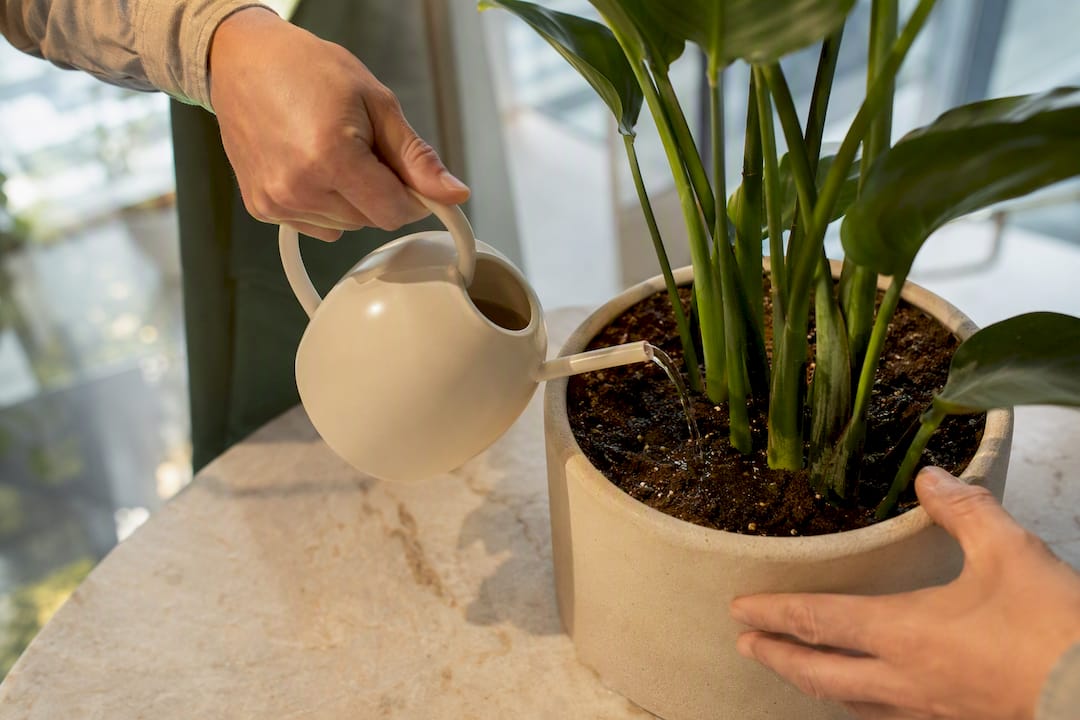
In practice, offices that combine both approaches tend to get the best of each: a HEPA purifier running in the main work area for particle control, and a curated mix of low-maintenance greenery near reception or break rooms for the wellbeing lift. Neither tool has to justify the other's existence. A closer look at how plants factor into commercial indoor air standards shows how that balance plays out across different commercial layouts.
For anyone who'd rather not manage watering schedules, drainage checks, and pest inspections in-house, that's the specific gap a managed program fills:
- Design and installation matched to a space's light and layout.
- Scheduled maintenance that catches overwatering before it becomes mold.
- Guaranteed plant replacement if something declines despite proper care.
- No guesswork over which species tolerates low office light versus which one needs a window.
Editorial Take: Stop Treating This as a Competition
The framing of "air purifiers vs plants" is where most advice goes wrong. It sets up a contest between two tools that were never built to solve the same problem, and readers end up either overbuying plants they think will replace a purifier or underbuying purifiers because a blog post told them a peace lily would handle it.
The Drexel review and the Toronto trial, read together, settle the practical question pretty cleanly. If particle reduction is the goal, a correctly sized HEPA purifier, run consistently rather than on auto mode, is the tool with measurable, repeatable results in real homes. Plants don't compete on that axis, and pretending otherwise sets people up to under-address genuine air quality problems, wildfire smoke season being the clearest example.
Where conventional advice actually falls short is in acting like plants need to justify their real estate through air cleaning at all. They don't. The wellbeing and productivity case for greenery stands on its own, no exaggerated purification claims required. Prioritize a purifier for particles, keep plants for how a room feels, and stop asking one to do the other's job.
— Nicole
A Simpler Way to Get the Plant Benefits Without the Upkeep
Greenspace Plants exists for the office managers and business owners who want the wellbeing lift of real greenery without becoming an amateur horticulturist on top of everything else on their plate. We offer a program that handles plant design, installation, ongoing maintenance, and replacement for a fixed monthly fee, with no upfront cost and no long-term contract locking you in.
To be clear about where plants fit: Greenspace+ is not a replacement for mechanical filtration. If particulate reduction is your priority, a properly sized HEPA purifier still does that job faster and more measurably than any plant arrangement. What our service delivers is everything plants are actually proven to do well, humidity balance, stress reduction, a space that feels alive, minus the risk of overwatering, mold, or a dying fern in the lobby. Our healthy plant guarantee means if something declines, we replace it, no questions asked.
If you're weighing greenery for an office, restaurant, or retail space, take a look at our interior plant services or browse the client look-book for real installations across different commercial layouts, then reach out for a quote tailored to your space.
Sources
- Potted plants do not improve air quality (Drexel University, 2019)
- Comparative evaluation of air phytoremediation potential of four ornamental potted plants for ecofriendly biofilter applications (PMC)
- What is a HEPA filter? (EPA)
- Choosing a portable air purifier (Health Canada, 2024)
FAQ
Are air-purifying plants better than air purifiers?
No. Controlled comparisons show plants take 1.67 to 3.55 times longer than purifiers to reduce PM2.5 to safe levels, and purifiers are the measurably faster option in real rooms.
What are the downsides of using an air purifier?
Purifiers cost money to run, require regular filter replacement (typically every 6 to 12 months), and only clean the air within their effective range, meaning poor placement or undersized units underperform.
What plant purifies the air the most?
In controlled lab trials, Cordyline fruticosa showed some of the strongest VOC reductions, up to 87.5% for certain compounds, along with pothos and spider plants, though none replicate that result in an open room.
Where should you not put an air purifier?
Avoid corners, behind furniture, or against walls that block airflow. Placement in the room's open, central area, away from obstructions, is what allows the unit to reach its rated CADR performance.
Can I just use plants instead of an air purifier for wildfire smoke?
No. Wildfire smoke is a fast-moving particulate event, and only a HEPA purifier delivers the rapid PM2.5 reduction needed; plants have no meaningful effect at that scale or speed.