
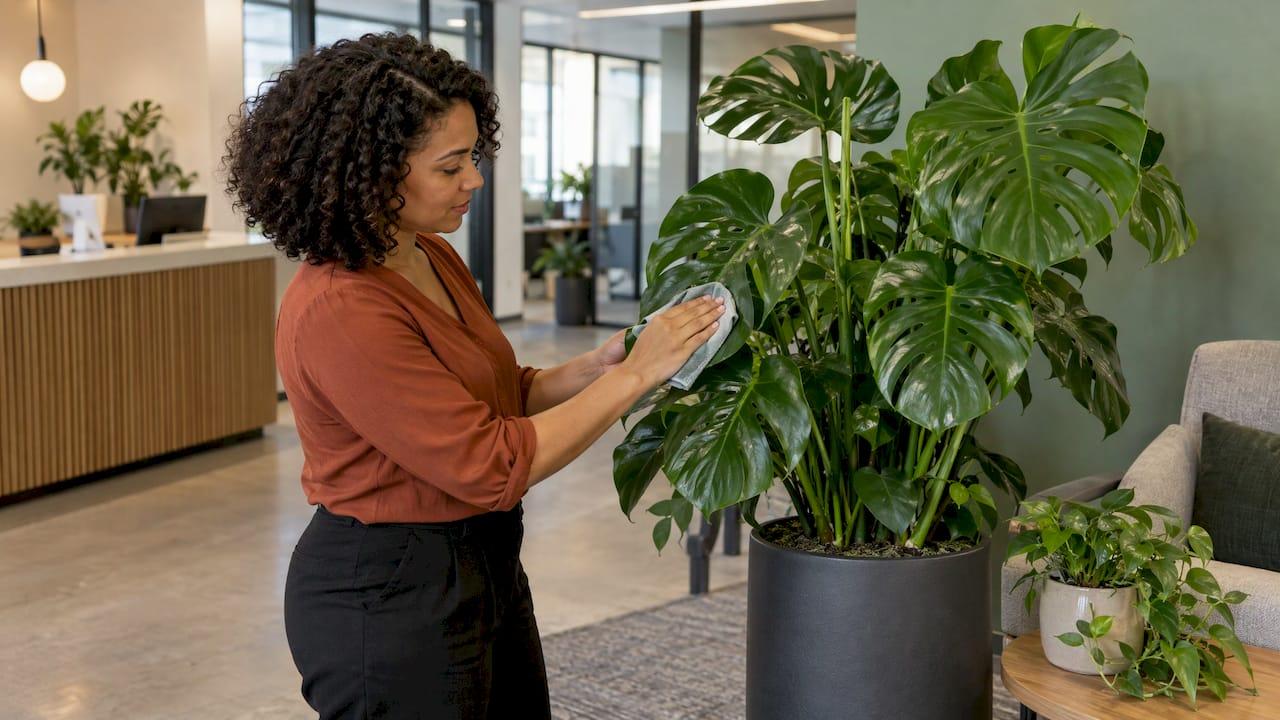
Clean plants look better. Dusty leaves look tired, and guests notice. The method is simple: support each leaf, wipe it with a damp cloth and lukewarm water, and repeat on a steady schedule.
The hard part in a commercial space is the volume. A lobby, a dining room or a floor of desks can hold dozens of plants, some of them tall. We are Greenspace Plants, Canada's leading commercial-only indoor plant service, founded in 2014. We design, install and care for plants in offices, hotels, restaurants and retail across Toronto, Vancouver and Calgary. Below is how leaf cleaning is done properly, and where it goes wrong.
Key Takeaways
- Use a soft, damp cloth and lukewarm water. Plain water cleans dust from most leaves with little risk of damage.
- Match the method to the leaf: wipe large smooth leaves, rinse small ones, and brush hairy ones dry.
- Skip leaf-shine sprays, homemade oil mixtures and harsh detergents. They leave residue or harm the leaf surface.
- Cleaning helps you spot pests early, which matters most in warm, dry buildings in winter.
- With a large collection, the cleaning is easier when someone else owns the routine. Greenspace+ includes regular maintenance for a fixed monthly fee.
Table of Contents
- Why clean leaves matter in a commercial space
- The basic method, step by step
- Match the method to the leaf
- What to avoid
- Cleaning is also your early warning system
- Does cleaning plants clean the air?
- How often should you clean?
- Moving patio plants back inside
- When the plants are too many to wipe yourself
- Our view on clean plants
- FAQ
- Sources
Why clean leaves matter in a commercial space
Plants are part of your look. A glossy, green rubber tree in reception says something about your brand. A grey, dull one says something else.
There is a plant-health reason too. Dust sits on leaves and can block light. Iowa State Extension notes that cleaning houseplants improves their appearance, stimulates growth and may help control insects and mites. It also says that in nearly all cases, a cloth with clear water cleans dust with no risk of damage.
That is the good news. You do not need special products. You need a gentle hand and a routine.
The basic method, step by step
This works for most smooth-leaved plants: rubber trees, fiddle-leaf figs, philodendrons, snake plants.
- Pick your moment. Toronto Master Gardeners suggests cleaning early in the day so leaves can dry. In a restaurant, that means before service. In an office, before people arrive.
- Use lukewarm water. Most houseplants are tropical. Consumer Reports quotes a New York Botanical Garden professor who explains that tap-cold water is not something these plants meet in nature, and that cold water suits fungal spores. Warm water also lifts dirt better. Never use hot water.
- Support the leaf. Hold it in one palm. Wipe with the other hand. This keeps you from bending or tearing it.
- Wipe both sides. Dust and pests both gather on undersides.
- Rinse the cloth often. A dirty cloth just moves grime around. It can also carry pests from one plant to the next, so use a fresh cloth when you see signs of insects.
- Let it dry. Keep the plant out of harsh direct sun while the leaves are wet.
A microfibre cloth works well. A soft sponge works too. Skip anything abrasive.
Match the method to the leaf
Not every plant takes a wipe. Some need a rinse. Some need a brush.
| Leaf type | Examples | Best method |
|---|---|---|
| Large, smooth | Rubber tree, fiddle-leaf fig, monstera | Wipe with a moist cloth, supporting each leaf |
| Small or narrow | Ferns, small-leaved trailers | Rinse gently with a sprayer or in a shower |
| Hairy or fuzzy | African violets | Clean with a soft brush or toothbrush, kept dry |
The table follows Toronto Master Gardeners' guidance on cleaning houseplants. The same group says plants with needles or hairy leaves should be dusted with a soft brush rather than washed or sprayed.
If you rinse a plant
Small plants can go in a sink or shower. Use lukewarm water and a gentle flow. Let the pot drain fully before it goes back into its decorative planter. Standing water in a cachepot is how roots start to rot.

For large floor plants in a lobby, rinsing is rarely practical. Wiping is cleaner and safer for your floors.
What to avoid
Most damage comes from trying too hard. Here is what to leave out.
- Leaf shine. Jane Perrone, a well-known houseplant writer, advises against these products because they are sticky and attract more dust.
- Household detergents. Iowa State warns they can damage the waxy leaf coating, causing discolouration and browning. If a leaf is very grimy, a mild dish-soap solution is the most that university suggests, followed by a thorough rinse.
- Cloths sprayed with chemicals. Toronto Master Gardeners says never to use them.
- Vigorous rubbing. Gentle pressure is enough.
- Hot or very cold water. Both stress the plant.
Here is the practical point for a busy workspace. It is easy to grab a spray bottle from the cleaning cupboard. Please don't. Plain lukewarm water is the safer choice.
Cleaning is also your early warning system
When you wipe every leaf, you see every leaf. That is when you catch trouble.
Look for fine webbing, pale speckles, cottony white clusters or a sticky film. A sticky coating can be honeydew, a residue left by insects such as aphids, scale or mealybugs. Check stems, new growth and the undersides of leaves.
Why does it matter indoors? Salisbury Greenhouse in Alberta explains that outdoors, natural predators keep insects in check. Inside a warm building, pests can multiply rapidly with no natural checks and spread to nearby plants.
If you find pests:
- Move the plant away from others.
- Wipe or rinse the leaves, paying attention to the undersides.
- Use only a product registered for indoor use in Canada, and follow the label exactly.
The University of Saskatchewan notes that pests most often arrive on other plants or in potting soil. Its guide also covers a basic insecticidal soap recipe and says treatment must be repeated every few days because it kills adults only.
If you manage a larger collection, our guide to an integrated pest management plan for office plants walks through a week-long approach. You can also read about pest-resistant plants for offices and restaurants if you are choosing what to put in.
Does cleaning plants clean the air?
A fair question, especially if you want better indoor air quality.
Canadians spend a great deal of time inside. A literature review for the Canadian Ornamental Horticulture Alliance notes that, per Health Canada, Canadians spend up to 90% of their time indoors. The same review reports that indoor plants help remove particulate matter such as dust, pollen and smoke.
Leaves that are kept clean can keep doing their job and look their best. That is the simple link between a tidy plant and a pleasant room. For more on what plants do for the air, see our piece on the best plants for reducing carbon dioxide indoors.
How often should you clean?
There is no single rule. Look at the leaves. When dust is visible, it is time.
Plants near vents, doors, kitchens and busy walkways collect dust faster. Dining rooms add a light film of airborne grease and moisture. Quiet corners stay clean longer.
A steady rhythm beats a big clean-up once a year. A quick wipe of the plants guests see first, every few weeks, keeps the whole space looking cared for. For how visit schedules fit different spaces, see how often office plant service is right.
Watering matters as much as dusting. A clean plant in soggy soil still struggles. Our 30-second check for watering problems is a quick way to see where a plant stands.
Moving patio plants back inside
Restaurants and hotels with summer patios face a seasonal job. When plants come in for winter, they need a check first.
The Toronto Sun's City Gardener column advises soaking the plant in lukewarm water, inspecting leaves, stems and soil, then washing leaves and stems with water and a soft cloth. It suggests bringing potted plants in at least overnight once night temperatures fall below about 10°C, then easing them in gradually.
Halton Region Master Gardeners describe a soap bath and rinse routine for plants coming indoors. They used a plant-safe insecticidal soap sold in Canada and rinsed thoroughly before repotting.
Washing, inspecting, moving and re-potting dozens of planters is a lot of work. It is also the kind of work that is easy to leave until a guest asks why the fig has spots.

When the plants are too many to wipe yourself
Wiping one pothos is a five-minute task. Wiping 80 plants across a floor, a dining room and a patio is a different job. It needs time, a ladder, the right cloths, a plan for each leaf type and an eye for pests.
Most office managers and restaurant owners have better things to do. That is fair.
That is why we built regular care into one plan. Greenspace+ is our all-inclusive service. It covers plant design, installation, regular maintenance and plant replacements for a fixed monthly fee. There are no upfront costs and no long-term commitments. It starts from $299 per month.
Your plants stay healthy, your space stays on brand, and you do not carry the routine. We guarantee healthy plants.
We care for more than 60,000 plants in over 400 commercial locations. We are WBE Canada certified (woman-owned). For multi-location brands, we run national programs, including in the US.

If you only need the care side, see our plant care maintenance service. If you are starting from scratch, indoor plant design is where we begin.
Our view on clean plants
We started this company on a simple idea. Plants in a commercial space should look as good in month twelve as they did on install day.
Clean leaves are a big part of that. They are one of the first things a visitor reads without knowing it. A glossy leaf says someone cares. A dusty one says nobody has looked in a while.
We think of plant care as more than a watering can. It is looking closely at every plant, every visit, and catching small things before they become visible ones.
That is why we take the routine off your plate. You should be able to walk through your lobby, your dining room or your showroom and simply enjoy it. No ladder, no spray bottle, no guesswork.
If you want a space that looks and feels alive, and you want it handled, we would be glad to talk.
Nicole
FAQ
Can I use soap to clean indoor plant leaves?
Plain water is the first choice. If leaves are very grimy, Iowa State Extension says a mild dish-soap solution can be used for extra cleaning. Rinse it off thoroughly afterward. Test one leaf first if the plant is delicate.
How do I clean plants with fuzzy or hairy leaves?
Keep them dry. Use a soft brush, such as a clean paintbrush or soft toothbrush, to lift dust gently. Washing or spraying these leaves can leave moisture trapped in the hairs.
What water temperature is best for cleaning plants?
Use lukewarm water. Most houseplants are tropical, and cold tap water is not what they would meet naturally. Never use hot water on plants.
Why are my plant's leaves sticky?
A sticky film is often honeydew left by insects such as aphids, scale or mealybugs. Check stems, new growth and leaf undersides, and move the plant away from others. Use only a product registered in Canada for indoor use on that plant, and follow its label.
Sources
- Beginner's Guide to Growing Houseplants, Toronto Master Gardeners
- February: Clean Your Houseplants, Toronto Master Gardeners
- Dust on houseplant foliage, Iowa State University Extension
- How to Clean Houseplants, Consumer Reports
- Leaf shine and cleaning leaves, Jane Perrone
- Bring Tropical Plants Indoors for Winter, Salisbury Greenhouse
- Common pests in your indoor garden, University of Saskatchewan
- Benefits of indoor plants literature review, Canadian Ornamental Horticulture Alliance
- The City Gardener: Bringing your houseplants inside for winter, Toronto Sun
- Bringing Plants Indoors Without Bringing in Problems, Halton Region Master Gardeners