
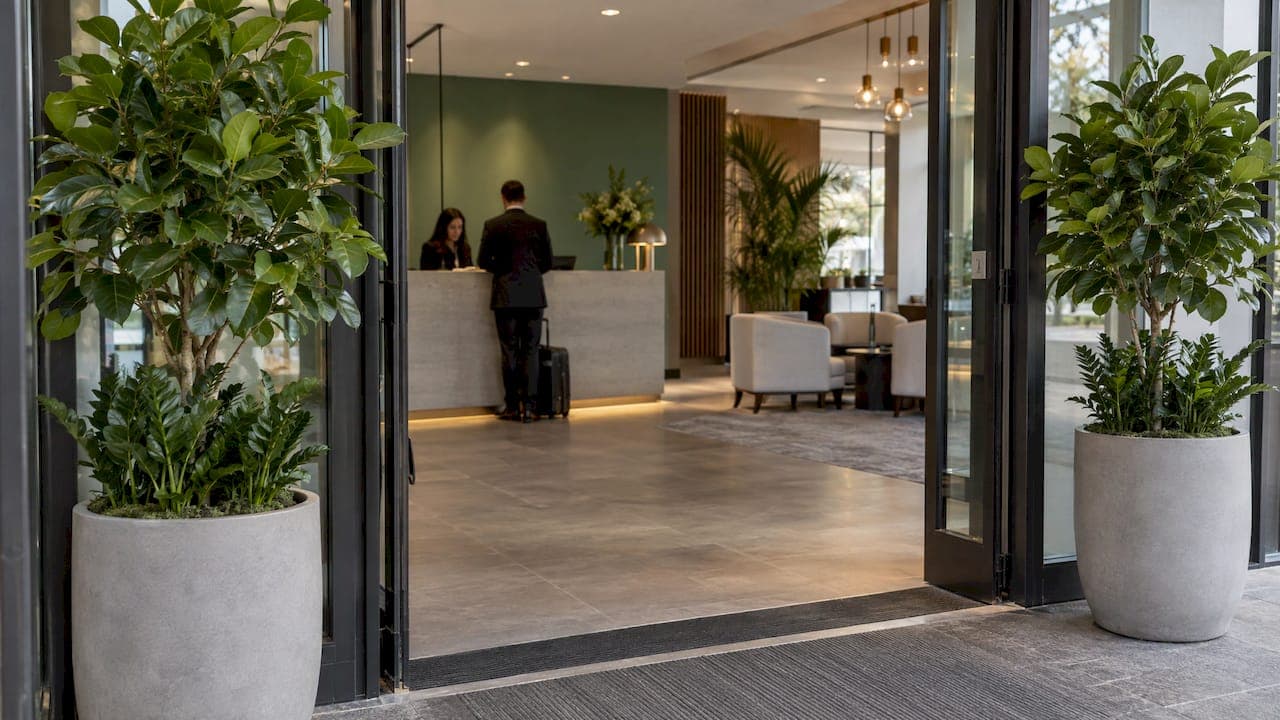
The best evergreen planters pair one tall, structured plant with a few fine-textured fillers and something that spills over the edge. Put them in the largest pot you can find, shelter them from wind, and they will look good in January as well as July.
We design, install and care for plants in offices, hotels, restaurants and retail across Toronto, Vancouver and Calgary. Entrances are where people first judge a space, so we spend a lot of time on them. This guide covers the plants, the combinations and the winter care that make an entrance look intentional all year.
Key Takeaways
- Start with a tall evergreen focal point, then add texture with grasses, heuchera or ivy, and a trailing plant for the edge.
- Choose the biggest frost-resistant pot you can. Bigger pots insulate roots better and survive winter more often.
- Container plants face colder roots than plants in the ground, so pick varieties hardy for a colder zone than yours.
- Freeze-thaw cycles and drying wind do the damage. Shelter, steady moisture and no de-icing salt prevent most losses.
- Commercial entrances can hand all of this off. Plant choice, planters and seasonal care can be one service.
Table of Contents
- Why evergreens earn the front spot
- Evergreen container plants that work in Canada
- Planter ideas by look and feel
- How to combine plants so the pot never looks flat
- Choosing the planter itself
- Getting evergreen planters through a Canadian winter
- Our point of view
- Let us handle the planters
- FAQ
- Sources
Why evergreens earn the front spot
Annuals look great for six weeks. Then frost arrives and the pot looks tired.
Evergreens hold their shape and colour through the months when little else does. Brian Minter, the B.C. horticulturist, suggests building fall and winter containers from evergreen perennials, grasses and compact broadleaved evergreens instead of late-flowering annuals, because they stay fresh through fall and winter.
For a hotel lobby, restaurant patio or retail storefront, that matters. A planter that looks the same in November as in June tells guests the place is cared for. It also means you are not swapping plants every season.
Evergreen container plants that work in Canada
Not every evergreen suits a pot. Roots in a container get colder than roots in the ground, so hardiness matters more than you would expect.
Here are reliable options, with the hardiness details their sources give.
| Plant | Role in the pot | What to know |
|---|---|---|
| Dwarf mugo pine | Mounded focal plant | Hardy to zones 3 to 7, according to Houzz |
| Japanese pieris | Shade-friendly shrub | Hardy to zones 5 to 8 per the same Houzz list |
| False cypress (Chamaecyparis) | Soft, textured conifer | Recommended for containers by the Toronto Master Gardeners |
| Dwarf Alberta spruce | Neat cone shape | Slow growing, so it keeps its form for years |
| Creeping juniper | Spiller | Varieties 'Pancake' and 'Mother Lode' are hardy to Zone 3 |
| Evergreen carex ('Evergold', 'Everillo') | Graceful grassy filler | Colourful foliage that holds through the cold months |
| Boxwood | Clipped structure | Dense, formal, easy to shape |
A few notes on choosing.
Check your zone, then go one colder. Dinter Nursery offers a rule of thumb that container plants lose about 10 degrees Celsius of hardiness compared with plants in the ground. So a plant rated for your zone in a bed may not survive the same winter in a pot. Toronto sits in Zone 6. Calgary is colder. Vancouver is milder. Pick accordingly.
Go dwarf. Dwarf evergreens are made for pots. They stay in scale with the planter and need less pruning. Almanac.com notes they work well singly or in artful combinations.
Match the light. Evergreens in containers should get some winter sun, but most should not spend the cold months in full sun, says the Missouri Botanical Garden. Shady north-facing entrances need different plants than sunny south-facing patios. We cover those in our guide to shade patio plants for Canadian containers.
Planter ideas by look and feel
Think of it as picking a mood first and plants second. Here are five looks we like.
1. The formal pair
Two identical planters flank a door. Each holds a single upright evergreen, such as a columnar boxwood or a dwarf Alberta spruce.
It is crisp and symmetrical. It suits law offices, boutique hotels and fine dining.
Brian Minter points to columnar choices like upright euonymus 'Greenspire', cypress 'Fernspray Gold' or boxwood 'Graham Blandy' as focal points.
2. The golden accent
Gold foliage lifts a dark entrance. Use a golden-edged upright euonymus in the centre. Surround it with evergreen heucheras in deep colours.
Minter notes that the contrast between the two can be quite striking. It works well in the grey months, when a doorway needs some warmth.
3. The soft and spilling mix
Place a mounded conifer in the middle. Add arching evergreen grasses around it. Let a creeping juniper or ivy fall over the rim.
This one feels relaxed and natural. It suits restaurant patios and café fronts, where you want guests to linger.
4. The shade-garden pot
For a sheltered, shadier spot, Minter suggests Pieris japonica, especially variegated types like 'Flaming Silver'. They carry flowers and bring red or bronze new growth.
This suits building entrances tucked under overhangs or between towers.
5. The winter greens arrangement
Push the planter into the holidays with cut boughs. West Coast Gardens suggests mixing at least three kinds of greenery for texture, and building the arrangement about double the height and double the width of the pot.
Cedar, pine, fir and juniper all work. Add birch branches or red dogwood stems for height. It is a short-term look, but it turns a plain planter into a seasonal feature. If you want holiday greenery handled for you, see our Christmas plants in Toronto and Vancouver pages.
How to combine plants so the pot never looks flat
The classic formula is height, fill and spill. It works for evergreens too.
Height. One upright plant sets the scale. Columnar conifers, upright euonymus or a tall grass all work. For tall evergreens in a mixed pot, the Good Earth Garden Center lists yews, boxwoods, junipers, arborvitaes and Alberta spruce.
Fill. Add mid-height plants with a different leaf shape. If your focal plant has fine needles, use broad leaves like heuchera. If it has broad glossy leaves, use fine grasses.
Spill. Soften the rim with a trailing plant. Amsterdam Garden Centre suggests Golden Creeping Jenny, Ajuga 'Black Scallop' and variegated English ivy for this job.

Play with contrast
Contrast is what makes a planter look designed.
- Dark against light. Pair dark-leaved plants like boxwood with silvery or golden foliage like blue fescue or variegated euonymus.
- Structure against softness. Set a clipped shrub beside a fine grass or fern.
- Upright against trailing. Layer a conifer behind low mounds or trailing vines.
These pairings are drawn from a guide to evergreen planter combinations that also recommends balancing structured shrubs with fine-textured grasses to avoid a flat look.
Keep the palette small. Three to five plant types is plenty. More than that and the pot starts to look busy.
Choosing the planter itself
The pot is half the design. It is also half the survival plan.
Size. Go big. The Toronto Master Gardeners advise using the largest possible freeze-thaw-resistant container because more soil means better insulation. The Missouri Botanical Garden agrees that larger pots usually overwinter evergreens more successfully. If you are unsure how to scale a pot to a plant, this guide to choosing the right pot size walks through it.
Material. Choose something rated for freeze-thaw. Thin glazed ceramic and some terracotta can crack when water inside the walls freezes. Heavy fibreglass, thick concrete and good-quality composite hold up better.
Drainage. Every pot needs holes. Raise it slightly off the ground so water can leave and ice does not lock the base.
Colour. Dark pots absorb heat. That can help roots in cool weather but stress them in summer sun. We looked at this in detail in our post on planter colour psychology.
Style. Match the planter to the brand. A sleek charcoal fibreglass planter says modern office. A weathered stone finish says heritage hotel. At Greenspace we source standard, premium, luxury and custom planters, so the container fits the space rather than the other way round.

Getting evergreen planters through a Canadian winter
Most winter losses come from three things: freeze-thaw swings, drying wind and dry roots.
The Toronto Master Gardeners name the freeze-thaw cycle as the main problem when overwintering perennials in containers. Here is how to get ahead of it.
- Plant early. Aim to finish winter combination pots by the end of November, so roots can establish before the ground gets too cold, as the Good Earth Garden Center recommends.
- Pick the right spot. CBC Life notes that a location protected from drying winter winds is critical for container shrubs. Against a wall or in a corner is better than an open walkway.
- Water until the soil ball freezes. The Toronto Master Gardeners say to keep watering evergreens until the soil ball freezes hard. Evergreens keep losing moisture through their needles all winter.
- Keep moisture steady. The Missouri Botanical Garden calls correct soil moisture over winter critical. Not soaked, not bone dry.
- Insulate. Wrap the sides of the pot, or cluster pots together against a wall, to buffer temperature swings.
- Skip the salt. De-icing salt near planters harms roots. Keep it off the pots and the soil.
Feeding
Evergreens are not heavy feeders, but they do need regular food. The Missouri Botanical Garden notes that if you feed at every other watering with a weak solution, use only one-fifth of the label's monthly amount. Follow the product label for your fertilizer.
Spring and summer
Evergreen planters are not winter-only. In spring, refresh the soil surface, trim any winter damage and check drainage. In summer, check moisture under any mulch, because pots dry quickly. Our guide to patio planter maintenance lists the daily and seasonal checks we run. In Calgary, where dry conditions rule, drought-tolerant patio plants are worth a look.
Our point of view
Most people who call us about planters do not have a plant problem. They have an entrance problem. The space does not feel finished, or it looked great in June and sad by November.
We think the answer is a plan, not a shopping trip. Choose a mood that fits your brand. Pick plants that suit the light and the zone. Choose a planter built for freeze-thaw. Then make sure someone looks after it.
That last part is where most planters fail. Greenspace Plants has been Canada's leading commercial-only indoor plant service since 2014, and we are WBE Canada certified (woman-owned). We care for 60,000+ plants in 400+ commercial locations, and we know the difference a steady, hands-on routine makes. Plants that are watered, checked and replaced on schedule look better. Period.
If you manage a space where first impressions matter, you should not have to think about moisture levels in January. That is our job.
Nicole
Let us handle the planters
If you would rather have an entrance that looks good without the upkeep, that is what we do. Our all-inclusive Greenspace+ service covers plant design, installation, regular maintenance and plant replacements for a fixed monthly fee, starting from $299 per month, with no upfront costs and no long-term commitments. We stand behind our plants with a healthy plant guarantee.

For patios and entrances, see our outdoor patio plant services or start with Greenspace+. Prefer to see our work first? Browse the client look-book. We also run national programs for multi-location brands, including in the US, through our National Account Plant Program.
FAQ
What is the best dwarf evergreen for pots?
Dwarf Alberta spruce is a popular pick for its clean shape and slow growth, which keeps it tidy in a container for years. Dwarf mugo pine and false cypress are also good choices. Match the plant to your zone and remember that pots are colder than the ground.
Can evergreens stay in the same container all year?
Yes. Evergreen shrubs can live in good-sized containers for years, as the Houzz list of cold-hardy container evergreens notes. Use a large, frost-resistant pot, and refresh the soil surface each spring.
Do I need to water evergreen planters in winter?
Yes, until the soil ball freezes hard. Evergreens keep losing moisture through their foliage in cold, windy weather. Water on days when the soil is not frozen, and keep the pot sheltered from drying winds.
What can I plant around an evergreen for colour?
Try evergreen heucheras, carex grasses, ajuga, creeping Jenny or variegated ivy. Golden or silver foliage stands out against dark conifers and boxwood. Pansies add flowers in cooler weather, if you want a short-term burst.
Sources
- Container Gardening: A Toronto Master Gardeners Guide
- Top Cold-Hardy Evergreens for Container Gardens, Houzz
- In the Garden: Fall containers, baskets for your porch
- Minter: Put some colour in your garden container
- Dwarf Evergreens: Best Small Evergreen Trees for Containers, Almanac.com
- Growing Evergreens in Containers, Missouri Botanical Garden
- The plant picks that will keep your front porch looking fresh year-round, CBC Life
- The Best Plants for Container Gardens, Dinter Nursery
- How To Create A Winter Evergreens Planter, West Coast Gardens
- Elements of a Cool-Season Planter, Amsterdam Garden Centre
- 12 Stunning Evergreen Planters to Beautify Your Space