
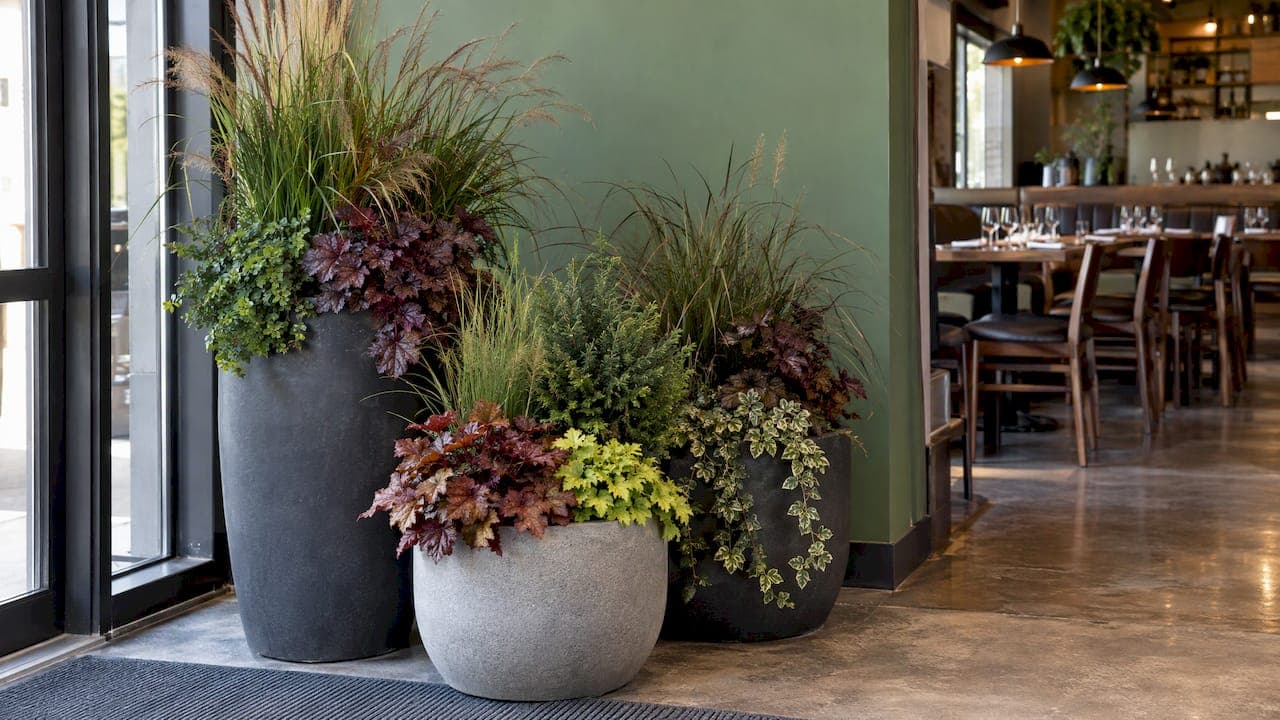
The best fall patio planting uses large containers, a clear design formula, and plants hardy enough to handle your local frost. Mix cool-season colour with evergreen structure. Then the patio still looks intentional in January, not just in October.
We design, install and care for plants in offices, hotels, restaurants and retail across Toronto, Vancouver and Calgary. Patios are where plants work the hardest, because weather tests every choice. This guide shows what we would plant, how to arrange it, and how to care for it as temperatures drop.
Key Takeaways
- Use big containers, at least 18 to 20 inches across, so the soil buffers temperature swings and the display looks substantial.
- Follow a thriller, filler, spiller layout. One tall plant, a mass of fillers, and something trailing over the rim.
- Mix cool-season colour (kale, pansies, asters) with evergreen structure (grasses, conifers, boxwood) so the planter lasts past the first hard frost.
- Potted plants are less cold-hardy than the same plants in the ground. Choose plants rated at least one zone hardier than your location, or plan protection.
- Fall is also the moment to decide who looks after the patio through winter, so it never looks neglected.
Table of Contents
- Why fall is a patio's second chance
- Know your zone before you shop
- Plants that work for fall patio containers
- Design your container so it looks finished
- Soil, drainage and planting steps
- Care as the temperature drops
- Planning a patio that works all year
- Our perspective
- Let us handle your patio
- FAQ
- Sources
Why fall is a patio's second chance
Summer annuals fade. Petunias go leggy. Guests still sit outside on mild evenings, and the front entrance is the first thing people see.
Fall planting fixes that. Cool nights bring out deep colour in foliage. Cool-season plants root easily in cool soil. A well-planted container can carry a restaurant patio or a hotel entrance from harvest season right through to the holidays.
Timing matters by region. In much of Canada, the strongest planting window is early to mid fall, before the ground and pots freeze. If you are reading this in November, hardy greens, conifers and grasses are still good choices in milder areas such as coastal British Columbia. Colder regions should favour evergreens and sturdy structure over tender flowers.
Know your zone before you shop
Canada's climate varies enormously, and so does what survives in a pot. The Vancouver Sun notes that hardiness in the Vancouver area ranges from roughly zone 6a or 6b in the eastern Valley to zones 7 or 8 in Vancouver, South Surrey and much of Vancouver Island. Calgary and Toronto sit in very different territory.
The same article adds a rule that surprises many people. Plants lose about one zone of hardiness when they move from the ground into a container. Roots above ground face more cold than roots in soil.
For winter containers, Freshet News advises plants hardy to at least zone 6, with insulating fabric or a sheltered spot in extreme cold. In practice, pick plants rated a zone or two hardier than your area if you want them to stay outside all winter.

Plants that work for fall patio containers
Think in two groups. Seasonal colour gives the pop. Evergreen structure gives the staying power.
Seasonal colour for fall
These are the plants that make a patio feel full and current:
- Ornamental kale and cabbage. Cool-season annuals that put on a strong show in fall, with ruffled foliage in purple, cream and green.
- Winter pansies and violas. Small flowers that keep going in cool weather and soften the edges of a pot.
- Asters. Late-season flowers that suit sunny spots. The Ottawa Citizen lists asters, ornamental kale, purple fountain grass, caladium and coleus among fall planter choices.
- Purple fountain grass. Adds height and movement. It needs sun and regular watering for the best colour, per the same source.
- Sunflowers, zinnias and begonias. The Ottawa Citizen reports they can keep flowering into frost when fed and watered through summer, depending on soil and sun exposure.
For shade, the Ottawa Citizen suggests Japanese anemones, and variegated hostas for foliage interest. We cover more options in our guide to shade patio plants that thrive in Canadian containers.
Evergreen structure that lasts
This is what keeps a patio looking designed after the flowers go. Freshet News recommends evergreen perennials, ornamental grasses and compact broad-leaved evergreens when you want interest beyond autumn. Their list includes pieris, euphorbias, Heuchera, evergreen Carex and Lonicera.
For tall, narrow focal plants, Freshet News names yews, 'Graham Blandy' boxwood, Japanese holly 'Sky Pencil' and Blue Arrow junipers as winter-capable choices. Upright euonymus and 'Fernspray Gold' cypress also work as columnar anchors.
BC Living points to Nandina domestica as a plant that offers year-round interest in containers. It suits milder coastal climates best.

If you want a deeper look at choosing plants for lasting structure, this evergreen landscape design guide is a helpful companion.
Quick picks by purpose
| Goal | Good choices | Notes |
|---|---|---|
| Bold colour now | Ornamental kale, asters, pansies | Best in cool weather. Replace when they decline. |
| Height and drama | Purple fountain grass, upright euonymus, boxwood 'Graham Blandy' | Fountain grass needs sun and water. Evergreens last all winter. |
| Soft edges | Violas, Heuchera, ivy-like trailers, evergreen Carex | Spill over the rim and hide the pot's edge. |
| Winter interest | Conifers, yews, junipers, pieris | Choose plants hardy to at least zone 6 as a baseline. |
| Shade | Hostas, Japanese anemones, Heuchera | Foliage does most of the work. |
Design your container so it looks finished
A patio planter should look like part of the space, not an afterthought. A few simple rules do most of the work.
Use thriller, filler, spiller
The Chicago Botanic Garden recommends the thriller, filler, spiller arrangement: a tall plant in the centre or back, fillers around it, and a trailing plant over the edge. It keeps height, mass and softness distinct, so nothing competes.
A fall version might look like this:
- Thriller: purple fountain grass or an upright evergreen.
- Filler: ornamental kale, asters or Heuchera.
- Spiller: violas, trailing ivy or evergreen Carex.
Go bigger than you think
Size is the quiet difference between a planter that looks premium and one that looks like a garden centre afterthought. Freshet News recommends containers at least 18 to 20 inches in diameter, so the soil volume buffers both heat and cold and creates a substantial display. Their other piece suggests 18 to 24 inches (45 to 60 cm) for larger plant combinations.
Group pots in odd numbers at different heights. For an entrance, a staggered trio of small, medium and large pots reads as deliberate.
Keep the palette restrained
More plants do not mean a better design. A simple recipe of one strong grass, one flowering focal point and one trailing or textural plant often looks more refined than a crowded mix. Think about bloom, foliage, texture, movement and form together, not just one flower colour.
Tie the palette to your brand. Deep burgundy and charcoal foliage suit a moody bar. Silvery greens and white flowers suit a spa or boutique hotel. Warm golds and rusts suit a casual bistro.
Pot colour matters too. Dark pots absorb heat. Our piece on planter colour psychology and root heat explains how the finish affects both look and plant health.
Soil, drainage and planting steps
Winter root problems usually come from wet soil, not just cold. BC Living advises a free-draining, aerated and fertile growing medium and warns against garden soil low in organic matter. Freshet News recommends a very free-draining mix to limit winter root problems, and a porous perennial or tree soil mix for fall displays.
Here is the process we follow:
- Clear the container. Remove spent summer plants and any diseased material.
- Check drainage. Holes must be open. Raise pots slightly so water never sits underneath.
- Refresh the mix. Use a free-draining potting mix with added organic matter.
- Place the thriller first. Then add fillers, then spillers.
- Plant at the same depth the plants grew in their nursery pots.
- Water in thoroughly. The Chicago Botanic Garden suggests watering new transplants to the bottom of the root zone.
- Finish the surface. A layer of mulch or moss keeps soil tidy and slightly insulated.
Care as the temperature drops
Fall containers need less water than summer ones, but they still need attention. Check the soil weekly, or more often in wind or sun. The Chicago Botanic Garden also suggests deadheading pansies to keep them blooming.
Frost is the main event. Some guidance by temperature:
- Tender plants: The Vancouver Sun recommends bringing tropicals such as hibiscus and mandevilla indoors before temperatures fall below 10°C.
- Hardy containers: The same article says they may need insulating cloth below approximately −8 to −10°C.
- Cool-season flowers: The Chicago Botanic Garden suggests protecting plants when night temperatures reach the low 40s Fahrenheit, around 5°C.
For containers staying outside, options include moving them against a wall, grouping them tightly, wrapping pots in insulating fabric, or using frost blankets on cold nights. Our guide to patio planter maintenance covers daily checks and seasonal care in more detail.
In Calgary, dry air and wind add stress. Our post on drought-tolerant patio plants for Calgary is a good starting point there.
Planning a patio that works all year
The smartest approach treats the patio as four seasons, not one. Plant structure once, then swap the seasonal layer.
- Structure: evergreens, conifers and hardy grasses stay in the pot year-round.
- Fall layer: kale, asters, pansies and grasses tucked around the base.
- Winter layer: branches, cones and evergreen boughs for the holidays.
- Spring layer: bulbs and early annuals, planted around the same structure.
BC Living notes that containers can grow bulbs, annuals, perennials, climbers and herbs from spring through winter. That is the flexibility you want. It means one investment in good pots and evergreen anchors, then low-cost seasonal swaps.
For restaurants, the layout of tables, walkways and heaters matters as much as plant choice. Our guide to outdoor dining area plant setup walks through placement, and our restaurant patio plant installation guide covers the install side.
Our perspective
Most patio plantings fail for one reason. Nobody owns them after install day.
A great fall planter looks fantastic for two weeks. Then the kale needs replacing, a frost hits, or a pot dries out on a windy Tuesday. The space starts to look tired, and guests notice before staff do.
That is why we do not treat plants as décor you buy once. We treat them as a living part of your brand. Greenspace Plants is Canada's leading commercial-only indoor plant service, founded in 2014. We care for 60,000+ plants in 400+ commercial locations, and we are WBE Canada certified (woman-owned).
Our approach is simple. We design it so it fits your space and your look. We install it. We care for it. If a plant struggles, we handle it, and our healthy plant guarantee backs that up. You get a patio that looks intentional in every season, without adding another task to your list.
If you want a patio that looks like you meant it, start with the container and the care plan together.
Nicole
Let us handle your patio
If you manage a restaurant, hotel, retail space or building, you probably do not have time to source hardy plants, swap seasonal colour and watch the forecast for frost. We do that for a living.
Our outdoor patio plant services cover design, planter sourcing, installation and ongoing care for commercial patios. We work with standard, premium, luxury or custom planters, so the look matches your brand.

For indoor spaces, our all-inclusive Greenspace+ plan starts from $299 per month. It includes design, installation, regular maintenance and plant replacements, with no upfront costs or long-term commitments. If you run several locations, including in the US, we also offer a national account plant program. Patio projects are quoted to the space, so get in touch and tell us what you have in mind.
FAQ
What are the best plants for fall patio containers in Canada?
Ornamental kale and cabbage, pansies, violas, asters and ornamental grasses are reliable choices for colour. Add evergreen structure such as boxwood, yew, juniper, Heuchera or evergreen Carex so the container lasts into winter. Always match plants to your hardiness zone.
When should I plant fall containers?
Early to mid fall is ideal, while soil is still cool but not frozen. Cool-season plants root well in that window. In colder regions, later planting should lean on hardy evergreens and grasses rather than tender flowers.
How big should the pots be?
Aim for at least 18 to 20 inches in diameter. Larger soil volume buffers temperature swings and gives you room for a thriller, filler and spiller combination. Bigger pots also look more substantial on a commercial patio.
Can fall containers stay outside all winter?
Yes, if the plants are hardy enough and the pots are protected. Containers lose roughly one zone of hardiness compared with plants in the ground, so choose plants hardy to at least zone 6 as a baseline and go hardier in colder regions. Wrap pots or shelter them against a wall when temperatures fall well below freezing.
Can Greenspace Plants manage seasonal patio changes for us?
Yes. We design, install and care for commercial patio plantings, including seasonal refreshes. Contact us with your location and the look you want, and we will recommend a plan.
Sources
- In the Garden: Fall containers, baskets for your porch (Freshet News)
- In the Garden: Make some seasonal magic on your patio (Freshet News)
- Prepping your patio for fall (Ottawa Citizen)
- The City Gardener: How to give your fall garden a lift (Ottawa Citizen)
- Here's how to prepare your plants for winter (Vancouver Sun)
- Fall-scaping with Containers (Chicago Botanic Garden)
- Discover the Joy of Container Gardening (BC Living)
- Evergreen Landscape Design: A Practical Guide to Year-Round Structure (GreenCurate)