
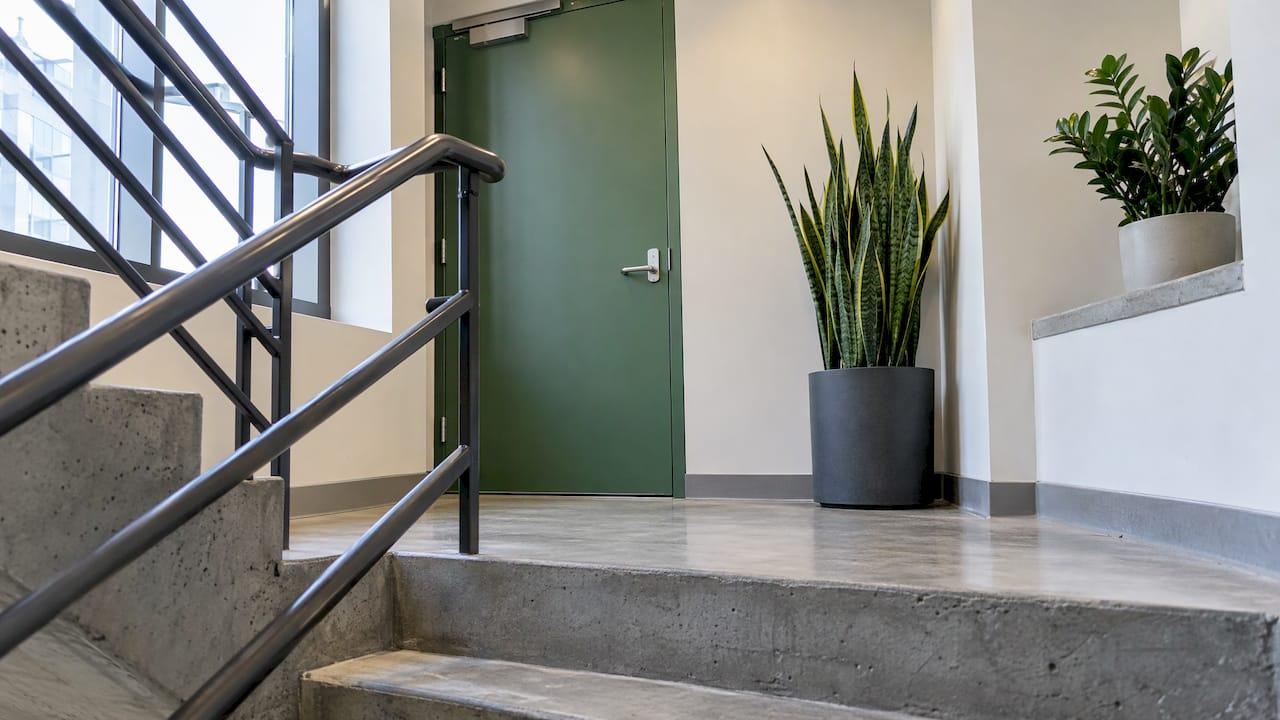
The best stairwell plants are tough, low-light foliage plants. Think pothos, snake plant and ZZ plant. They go on landings, wall shelves and wall mounts, never on the walking surface. A stairwell is one of the hardest spots in a building for a plant. We design, install and care for plants in offices, hotels, restaurants and retail across Toronto, Vancouver and Calgary. A stairwell done well looks calm and intentional. Done badly, it looks tired.
This guide covers what to plant, where it goes, and how to keep it safe and healthy. It is written for people who care how a space looks and feels.
Key Takeaways
- Stairwells are often the worst low-light spots in a building, so choose plants for tough conditions, not for looks alone.
- Put plants on landings, wall shelves or wall mounts. Keep steps, handrails and exits clear.
- Check your lease or building rules first. Many buildings restrict items in stairwells and common areas.
- Plants in stairwells are hard to reach, so a regular care visit matters more here than almost anywhere else.
- A fixed monthly service takes design, installation, care and replacements off your list.
Table of Contents
- Why stairwells are hard on plants
- Start with the light
- The best plants for a stairwell
- Pet and visitor safety
- Where plants go: keep the path clear
- Trailing plants: use them with care
- How a stairwell plant should be cared for
- A quick plan for your stairwell
- What this means for different spaces
- What we do about it
- Our view on stairwells
- FAQ
- Sources
Why stairwells are hard on plants
Most people see a stairwell as an empty wall with a bit of space. A plant sees it differently.
The University of Saskatchewan's gardening team notes that stairwells and hallways are often the worst low-light spots for houseplants, and only a few plants tolerate them. That is the first thing to accept. A lush fern that looks great in a photo may fade in six weeks on a dim landing.
Three things work against plants in a stairwell:
- Low light. Many stairwells have no windows, or one small window on a landing.
- Temperature swings. Stairwells near a front door or between floors can be cooler and draftier than the rest of the space. The same USask guide advises keeping houseplants away from doorways and frequently opened windows, where cold drafts can harm them.
- Awkward access. If a plant is hard to reach, it gets watered late, turned never and checked rarely.
Good design starts with these limits. Then it chooses plants and positions that work with them.
Start with the light
Light decides everything. Before you pick a single plant, find out how much you have.
The Manitoba Master Gardener Association says light is the most important variable when choosing office plants. South-facing windows give the brightest natural light, then east and west, and north-facing the least. Obstructions, window size and blinds also change what reaches the plant. They suggest a light meter or a phone app to measure light at different times of day.
For a stairwell, do a simple walk-through:
- Visit in the morning, at midday and in the evening.
- Note whether the light comes from a window, from overhead fixtures or from nowhere at all.
- Check whether the light is on all day or only when someone is using the stairs.
If the stairwell relies on motion-sensor lighting or has no daylight, the plants need help. Our guides on how lighting shapes plant selection and on matching plants to office light levels explain the numbers in plain terms. If you want to know when supplemental lighting makes sense, read grow lights versus sunlight.
The best plants for a stairwell
The answer is the same for most commercial stairwells: choose forgiving plants with a clean, architectural look.
The USask guide points out that sansevieria (snake plant) prefers plenty of natural light but tolerates low levels of artificial light. That tolerance is why it shows up so often in dim corners.
Here is how we would think about the usual shortlist.
Snake plant (sansevieria)
Upright, sculptural and slow-growing. It suits a corner where a stair meets a landing. Its tall leaves add height without spreading into the walkway. In a modern lobby stairwell, a row of matching snake plants in one planter style looks sharp and deliberate.
ZZ plant
Glossy, dark green and tidy. It works well in a floor planter on a wide landing. It does not drop leaves or sprawl, so it keeps a clean silhouette.
Pothos
The classic trailing plant. It works from a wall-mounted shelf or a raised planter, with the vines guided along a wall. It softens hard edges. It also adapts to a range of light conditions.
Heartleaf philodendron
Similar in habit to pothos, with a slightly more refined leaf shape. Good for a repeated look up a long stairwell.
Cast iron plant
Broad, dark leaves and a reputation for putting up with neglect. It suits deeper, darker landings where few plants will cope.
For more low-light ideas, see our post on office plants that cope with no sunlight.
What to skip
Plants that want strong light, such as flowering plants, do not belong in a dim stairwell. The Toronto Master Gardeners explain that flowering plants generally need southern or western exposure, while many foliage plants thrive in eastern or northern windows with plenty of light but little direct sun. A stairwell is foliage territory.
Delicate trailing plants that dislike cold, such as string of pearls, also do better away from doors and exterior walls. Save them for a bright, sheltered spot elsewhere in the building.
Pet and visitor safety
If your stairwell is used by guests, children or visiting dogs, choose with care. The Manitoba Master Gardener guide advises avoiding toxic plants within reach of young visitors. Hotels, restaurants and family-friendly retail should think about this early.
Our guides on pet-safe office plants and nontoxic office plants list what to choose and what to avoid. Tell your plant provider at the design stage if the space welcomes pets or children.
Where plants go: keep the path clear
This is where stairwell plants succeed or fail. A beautiful plant in the wrong place is a hazard.
The rule: nothing on the walking surface
Stairs are a route for people, and in an emergency they are an exit route. Plants never go on steps, in the middle of a landing or anywhere that narrows the path.
The Canadian Centre for Occupational Health and Safety's sample inspection checklist asks whether stairs, stairwells and landings are clear and unobstructed, and whether emergency exits, doors, landings and steps are well marked and unblocked. A plant that fails that test fails the building.
Check your building's rules
Many leases and tenant manuals set their own limits. One Mississauga tenant manual states that tenants must not obstruct or place anything in lobbies, corridors, stairwells or other common areas except for access and exit, and that unauthorised obstructions may be removed at the tenant's expense.
That is one building, but the principle applies widely. Before you plan a stairwell installation:
- Read your lease and tenant manual.
- Ask your property manager about common-area rules.
- Confirm any fire code or building requirements for stairwells.
In the workplace, the Manitoba Master Gardener guide also notes that permission from a supervisor or the health and safety committee may be needed before plants are brought in.
Good positions
When the stairwell is yours to style, these positions work:
- Wide landings. One or two upright plants in stable, weighted planters, set against the wall and clear of the door swing.
- Wall-mounted shelves. Trailing plants at or above shoulder height, set back from the handrail.
- Wall-mounted planters or a green wall. These add presence without using any floor space. See our green plant walls.
- Corners. Where a flight of stairs turns, a tall plant fills the dead space.
Positions to avoid
- On steps or risers where feet, bags and cleaning equipment pass.
- Anywhere that blocks a handrail, a door or an exit sign.
- Long vines that hang into the walkway where someone could catch a hand or foot.
- Heavy planters balanced on narrow ledges.
Use stable, weighted planters with drainage. Think about what happens when a planter gets bumped by a person carrying boxes. If it can tip, it is in the wrong place.
Trailing plants: use them with care
Trailing plants are the natural fit for stairs. They add movement and soften straight lines. The USask horticultural team notes that climbers and vines can make a tight corner feel less sharp or a high ceiling feel less tall.
That is a design tool. In a tall, narrow stairwell, a pothos on a high shelf draws the eye up and breaks the long wall.

The key is control. Guide the vines along the wall instead of letting them drop. Trim them back before they reach handrail height. A plant that looks wild in a home looks careless in a hotel lobby.
How a stairwell plant should be cared for
Care is where most stairwell plants fail. Nobody walks past with a watering can. The plant sits in a dim corner and gets forgotten.
The basics are simple. The Manitoba Master Gardener guide advises watering when the first inch of potting mix is dry, preferably with water that has sat overnight to reach room temperature. It also advises turning plants 90 degrees weekly to balance light exposure. It adds that plants in warmer, brighter spaces generally need more water than those in cooler, dimmer ones, and that season and humidity change demand.
In a stairwell, that means:
- Water less often than you think. Low light means slower growth and less water use.
- Rotate. Plants lean toward the light. Turning them keeps them even.
- Watch the seasons. Winter heating dries the air in Canadian buildings. Summer cooling changes it again.
- Check drainage. Water sitting in a cachepot with no way out rots roots.
- Dust the leaves. Dust blocks what little light there is.
This is the part most offices underestimate. A stairwell plant that is hard to reach is a plant that nobody tends. That is why we build care into every installation. Our plant care maintenance covers the regular visits. You can see what a visit includes in More Than Just a Watering Can.
A quick plan for your stairwell
If you are planning a stairwell yourself, here is the order that works.
- Read the rules. Lease, tenant manual and fire code first.
- Measure the light. Morning, midday and evening.
- Decide the look. One plant type repeated, or a mix? Sculptural or soft?
- Pick the positions. Landings, shelves, wall mounts. Nothing on steps.
- Choose the planters. Stable, weighted, with drainage, in a finish that suits your brand.
- Plan the care. Who waters, who rotates, who replaces a plant that declines?
Steps three, four and five are design work, and they decide how the space feels. Planter choice shapes the look as much as the plant does. We source standard, premium, luxury and custom planters, and our indoor plant design service is built around the space and the brand. You can browse finished spaces in our design photos.
Step six is the one that decides whether the stairwell still looks good in a year.
What this means for different spaces
Offices. A stairwell between floors is often the first impression of your culture. Greenery signals care. It makes a utilitarian space feel like part of the workplace experience.
Restaurants and hotels. Guests use stairs to reach dining rooms, rooms and lounges. A planted landing sets the mood before they reach the door. Pet and child safety matter more here.
Retail and showrooms. Stairs to a mezzanine or lower level can feel like an afterthought. Plants make them part of the experience.
Property managers. Shared stairwells call for consistency across a building. They also call for strict adherence to common-area rules. A single provider handling design, installation and care keeps it uniform.
Interior designers. A stairwell planting is a design element like any other. We work with designers on plant selection, planter sourcing and installation.
What we do about it
We are Canada's leading commercial-only indoor plant service, founded in 2014. We care for 60,000+ plants in 400+ commercial locations, and we are WBE Canada certified (woman-owned). We also run national programs for multi-location brands, including in the US.
For stairwells, the all-inclusive Greenspace+ service is the simplest route. For a fixed monthly fee, from $299 per month, you get plant design, installation, regular maintenance and plant replacements. There are no upfront costs and no long-term commitments. Our healthy plant guarantee means a plant that struggles in a tough spot is not your problem.

If you would rather own the plants, we also offer a one-time purchase with optional ongoing care. See how Greenspace+ works, or compare the buyout and care-only options. For a wider range of plants and styles, browse our indoor plant choices.
Our view on stairwells
Stairwells are the most overlooked spaces in a commercial building. They are also the places people pass through every day, often alone, often between meetings or between courses. They deserve better than a blank wall.
We design them around three ideas. First, the plant has to suit the light. We would rather use a tough, handsome plant that thrives than a fussy one that sulks. Second, the path stays clear. Planting is there to support the space, never to get in the way of the people using it. Third, the care is part of the design. A stairwell planting that looks good on installation day and tired by spring is a bad design.
That is why we put design, installation, care and replacement together in one service. You should not have to think about whether the pothos on the third-floor landing got watered. You should just walk past it and feel the space is looked after.
If you are planning a stairwell, a lobby or any space where plants are hard to place, we would be glad to talk it through.
Nicole
FAQ
What are the best plants for stairs in a low-light stairwell?
Snake plant, ZZ plant, cast iron plant, pothos and heartleaf philodendron are the usual choices. Snake plant, for one, tolerates low levels of artificial light. Measure the light first, and add supplemental lighting if the stairwell has no daylight.
Can I put plants on the stairs themselves?
No. Keep steps, handrails and exits clear. Use landings, wall shelves or wall mounts instead. Check your lease and building rules too, as some buildings restrict anything placed in stairwells and common areas.
Which trailing plants work best in a stairwell?
Pothos and heartleaf philodendron are the most reliable. Mount them on a shelf or wall bracket, and guide the vines along the wall so they do not hang into the walkway. Trim them back regularly.
How often should stairwell plants be watered?
Water when the first inch of the potting mix is dry, and adjust for the season and the light. Plants in dim, cool spaces need less water than those in bright, warm ones, according to the Manitoba Master Gardener Association. A regular care visit takes the guesswork out.
Are stairwell plants safe around pets and children?
They can be, if you choose non-toxic plants and place them out of reach. Tell us about pets and young visitors at the design stage, and we will plan around them. Our nontoxic plant guide is a good place to start.
Sources
- Designing with houseplants, Gardening at USask
- Ode to the Office Plant, Manitoba Master Gardener Association
- Beginner's Guide to Growing Houseplants, Toronto Master Gardeners
- Inspection Checklist: Sample Checklist for Outdoor Areas, CCOHS
- Tenant Manual 2026, Mississauga Executive Centre