
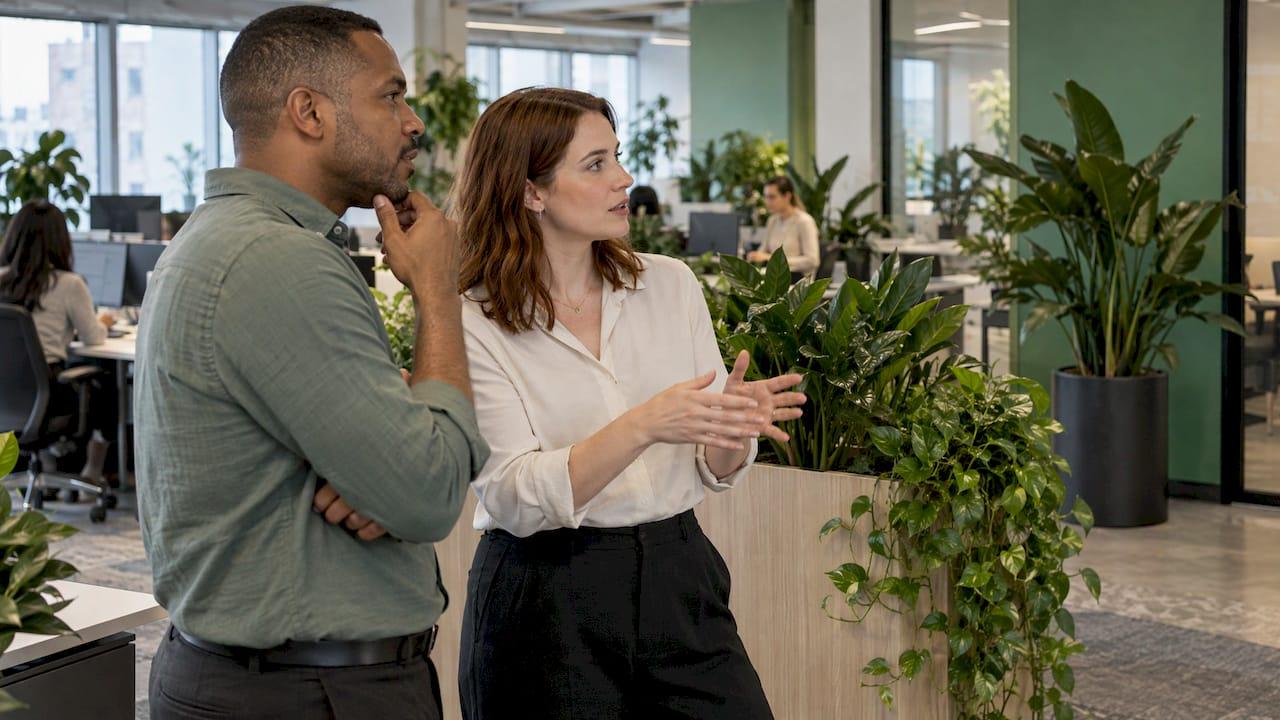
LEED rates how a building performs for the environment. WELL rates how a space performs for the people inside it. LEED looks at energy, water and materials. WELL looks at air, light, comfort and mind. Many projects pursue both.
We are Greenspace Plants, Canada's leading commercial-only indoor plant service, founded in 2014. We are not certifiers. But we design, install and care for plants in certified and certification-minded spaces, so we know where greenery fits in each system. This guide is for office managers, workplace experience leads, interior designers, and property and hospitality teams.
Key Takeaways
- LEED is about environmental performance. WELL is about occupant health and experience. Fitwel is a lighter health-focused option.
- Both are voluntary. Both use points and tiers. Both need renewal every three years.
- WELL requires on-site performance testing. LEED relies mainly on documentation of design and construction.
- Plants are not a shortcut to either rating. They do count in WELL's nature features and in some LEED v5 site credits.
- If your priority is how a space looks and feels, WELL speaks to that most directly.
Table of Contents
- WELL vs LEED in plain terms
- What each one measures
- Cost and timeline in Canada
- Fitwel, BOMA BEST and other comparisons
- Can you pursue both?
- Where office plants fit
- How to choose between WELL, LEED and Fitwel
- Perspective
- Plants for your WELL or LEED project
- FAQ
- Sources
WELL vs LEED in plain terms
The simplest split: LEED supports goals tied to carbon, efficiency and resource use, while WELL addresses indoor environmental quality and occupant experience. LEED v5 adds more weight on decarbonization, quality of life and ecological restoration. WELL stays focused on health outcomes backed by documentation and verification.
They are not rivals in the way people assume. LEED includes an indoor environmental quality category. WELL goes much deeper on that same ground.
Who runs them matters too. WELL is administered by the International WELL Building Institute, and LEED in Canada by the Canadian Green Building Council. WELL launched in 2014. Fitwel arrived in 2016 and is now delivered by the Center for Active Design.
| LEED | WELL | Fitwel | |
|---|---|---|---|
| Focus | Environmental performance of the building | Occupant health and comfort | Occupant health, simple to implement |
| Administered by | CAGBC in Canada (USGBC) | IWBI | Center for Active Design |
| Tiers | Certified, Silver, Gold, Platinum | Bronze, Silver, Gold, Platinum | 1, 2 or 3 stars |
| Verification | Documentation review | Documentation plus on-site testing | Digital submission with double-blind review |
| Prerequisites | Yes, in several categories | Yes, in each concept | None |
What each one measures
LEED
LEED projects earn points across categories. In the version summarized by gb&d Magazine, the maximum is 110 points, with 40 for standard certification, 50 for Silver, 60 for Gold and 80 for Platinum. Energy and Atmosphere carries the most points. Sustainable Sites comes next.

Categories include location, sustainable sites, water, energy, materials and indoor environmental quality. Several categories have prerequisites every project must meet.
In Canada, CAGBC supports the market with certification, verification, education and training. LEED covers new construction, interior fit-outs, operations and maintenance, and core and shell.
WELL
WELL organizes its features by concept. The WELL v2 criteria include air, water, nourishment, light, fitness, thermal comfort, sound and mind. Each has required preconditions and optional optimizations.
The tier thresholds mirror LEED. Forty points earns Bronze, 50 Silver, 60 Gold and 80 Platinum.
The big difference is testing. WELL requires on-site performance verification before certification is awarded. Someone measures the air, light and sound in your actual space.
That is why design-led teams like it. The standard asks how the room feels to a person sitting in it.
Fitwel
Fitwel was built to be easier. It has no prerequisites, so teams choose the strategies that suit them. It suits existing buildings and portfolios.
A comparison from architecture firm Marx & Kubo puts Fitwel at 12 to 16 weeks and WELL at about seven months. Fitwel is the lighter lift. WELL is the more thorough one.
Cost and timeline in Canada
Fees change, so treat these as signposts and confirm on each program's page.
- LEED: BDC reported that a new commercial building up to 2,500 m² paid a $7,250 certification fee, and an existing building of that size $4,350. Recertification comes every three years.
- WELL: IWBI's published pricing shows registration fees from $1,500 to $10,000 and program fees that scale with floor area. For a project of 50,000 sq ft or less, registration is $2,500 and the program fee $22,500. Those fees include coaching and a documentation review round.
- Fitwel: a flat $1,000 USD per asset for building certification, plus a $500 USD registration fee per project.
These are program fees only. Consultants, testing and design changes are separate.
Fitwel, BOMA BEST and other comparisons
People often ask how the rest of the field lines up. Here is a short, practical read.
Fitwel vs WELL. Choose Fitwel for speed, low cost and portfolios. Choose WELL for new builds, higher budgets and deeper, tested results.
Fitwel vs LEED. They answer different questions. Fitwel looks at health strategies. LEED looks at building sustainability. A building can hold both.
BOMA BEST vs LEED or WELL. BOMA BEST is a Canadian program for existing buildings, focused on operations. It sits closer to LEED's operations track than to WELL's occupant lens. Ask your property team which one the building already holds.
ASHRAE vs WELL. ASHRAE publishes technical standards, such as ventilation requirements. It is not a certification. WELL and LEED lean on standards like these, and your engineers will know which apply.
None of these locks you out of another. As gb&d notes, neither certification restricts a building from holding other certifications.
Can you pursue both?
Yes. LEED and WELL complement each other, and their overlap is small enough that each is worth earning. The USGBC and IWBI have published a crosswalk, updated for LEED v5, that helps teams pursuing both.
A sensible order for most office projects:
- Decide the goal. Lower carbon and operating cost points to LEED. Better daily experience points to WELL.
- Check what the building already holds. A tenant fit-out can often ride on the base building's work.
- Map overlaps early, especially air, light and materials.
- Bring design and plant partners in at concept stage, not after the furniture lands.
Both are voluntary. But they are often written into owner requirements, funding criteria or ESG goals. Check your lease and your brand's commitments first.
The building envelope and systems are one side of occupant wellness. Interior design choices shape the employee experience on the other.
Where office plants fit
This is the part people skip. It is also where design-minded teams can act.
In WELL
WELL has a specific nature requirement. Biophilia II (quantitative) calls for potted plants or planted beds covering at least 1% of floor area per floor, or a plant wall covering at least 2% of floor area. That is a measurable target a plant program can be designed around.

We have mapped the patterns in our guide to keeping your WELL credits with biophilic design. If you want a rule of thumb for quantities, see how many plants per square foot an office needs.
In LEED
LEED rarely treats plants as a stand-alone item. LEED v5 does reward vegetated outdoor space. SSc2 Accessible Outdoor Space asks for at least 25% of required outdoor space to be vegetated. SSc1 Biodiverse Habitat calls for native and adapted vegetation. Those credits point to outdoor patios, terraces and planted entries.
Indoors, plants support the look and feel of a space and the story behind a project. We cover that in how to make plants count for LEED v5.
Plants as one layer
Plants work best beside strong ventilation, daylight and acoustics, not in place of them. That keeps your claims honest and your space better.
A well-placed plant also does what spreadsheets cannot. It softens a lobby. It gives a meeting room a focal point. It tells visitors someone cared. For more on this, read why plants are key design elements and greenery's role in common area design.
Sourcing counts too. Our note on sustainable plant sourcing for design projects helps teams document responsible choices.
How to choose between WELL, LEED and Fitwel
Start with the reader of your space, not the plaque.
- Pick LEED if you need a recognized sustainability credential for investors, lenders or a landlord.
- Pick WELL if employee experience and brand are the goal and you can fund testing.
- Pick Fitwel if you manage many sites and want a quick, affordable health signal.
- Pick both for flagship offices where sustainability and experience are both on the brief.
As USGBC-CA puts it, a WELL or Fitwel certified office may appeal more to a tenant focused on employee health than a LEED one. Know your tenant, then choose.
For air monitoring as part of a healthy-building plan, displaying air quality data on screens is one way teams make wellness visible to staff.
Perspective
We have planted in hundreds of offices, hotels, restaurants and retail spaces. The question we hear most is not "which certification?" It is "how do we make this room feel right?"
Our view is simple. Standards give you a framework. Plants give you the feeling. The best projects use both on purpose.
That is why we plan greenery at design stage. Placement, scale, planter choice and ongoing care all decide whether a green space reads as intentional or as an afterthought. And a plant program only helps a certification story if the plants stay healthy. That is the part we take off your plate.
As a woman-owned, WBE Canada certified company, we also know how much it matters to work with partners who share your values.
Nicole
Plants for your WELL or LEED project
Greenspace Plants is Canada's leading commercial-only indoor plant service, founded in 2014. We serve 60,000+ plants in 400+ commercial locations across Toronto, Vancouver and Calgary. We are WBE Canada certified.
With Greenspace+, you get plant design, installation, regular care and plant replacements for a fixed monthly fee, from $299 per month. There are no upfront costs and no long-term commitments. Our plants carry a healthy plant guarantee.

Starting with the look of the space? Our indoor plant design team works with interior designers and workplace leads. Running multiple sites, including in the US? Ask about our national account plant program. Or browse the full range of services.
FAQ
Is WELL harder to get than LEED?
They are hard in different ways. WELL requires on-site testing of air, water, light and sound, which adds a step. LEED involves heavy documentation of design and construction choices. Your project type and budget usually decide which feels heavier.
Is LEED still relevant?
Yes. LEED remains widely used in Canada through CAGBC, and the newest version adds emphasis on decarbonization and quality of life. Many owners and lenders still write it into their requirements.
Do I need plants to get WELL certified?
WELL's nature features are where plants count. Biophilia II sets a quantitative target for plant coverage, so a plant program can help you meet it. Check which features your project is pursuing with your WELL assessor.
Can I hold LEED, WELL and Fitwel at once?
Yes. No certification prevents another. Many teams combine them, using a crosswalk to avoid duplicate work.
Sources
- Intertek: LEED and WELL, Our Top 10 Questions Answered
- GCCollab Sustainable Certifications Guide (2024)
- USGBC-CA: Green Building Certifications Roundup
- gb&d Magazine: LEED vs. WELL
- gb&d Magazine: Comparative Analysis of LEED vs. WELL Building Standards
- CAGBC: LEED Certification in Canada
- Fitwel: About Fitwel
- Fitwel: Certification
- Marx & Kubo: Fitwel vs. WELL
- BDC: Guide to Canadian green building standards
- IWBI: WELL certification pricing
- WELL Standard: Biophilia II (quantitative)
- USGBC: LEED v5 BD+C Rating System
- Aman Engineering Consultancy: Enhancing Employee Experience With Eco Friendly Interior Design
- Zoney: Promoting Employee Wellness by Monitoring Air Quality