
The most reliable approach to green wall irrigation combines automated, zoned drip or sub-irrigation, designed into the wall from the schematic phase, with a scheduled professional maintenance program. Living walls hold very little substrate compared to a garden bed, so they dry out fast and punish guesswork. Automation removes human inconsistency from the equation, and routine servicing catches the small failures, a clogged emitter, a drifting sensor, before they become dead plants.
TL;DR:
- Recirculating systems are the most water-efficient option for larger walls but require careful reservoir sizing, sanitation, and insulation against freezing in cold climates.
- Direct-fed drip systems are simpler and cheaper for small walls but risk uneven watering and pressure drops, especially over long runs or multiple tiers.
- Manual watering is suitable only for very small or temporary displays; beyond that, it introduces inconsistency and a single point of failure.
- Proper irrigation planning during schematic design ensures accessible plumbing, zoning for microclimates, and component placement that prevent costly retrofits.
- Frequent, short watering cycles outperform one long session, with seasonally adjusted schedules based on plant type and environmental conditions to optimize water use and plant health.
Table of Contents
- What Is a Recirculating Green Wall Irrigation System?
- How Do Drip and Piped Irrigation Systems Work?
- Is Manual Watering Ever Acceptable for Green Walls?
- Choosing the Right Irrigation System During Schematic Design
- How Often Should You Irrigate a Green Wall?
- Preventing Biofilm, Clogged Emitters, and Overwatering
- Do Smart Sensors and IoT Controllers Actually Save Water?
- How Does Fertigation Work in a Green Wall System?
- How Does Plant Selection Change Your Irrigation Strategy?
- What Sustainability Benefits Come From Efficient Irrigation?
- Why Early Irrigation Decisions and Maintenance Matter
- Greenspace+: Design, Install, and Maintain Your Green Wall Under One Plan
- Sources
- FAQ
What Is a Recirculating Green Wall Irrigation System?
A recirculating, or closed-loop, system draws water from a reservoir, pushes it through the substrate or growing medium, and captures the runoff at the base to send back through filtration for reuse. It's the setup most commercial installations gravitate toward once a wall gets past a certain size, because wasting water on a one-pass system stops making financial sense.
The core hardware is fairly consistent across manufacturers:
- A reservoir sized to the wall's total substrate volume plus a buffer for evaporation and system flushing
- A pump rated for the vertical lift and total run length, not just the wall's height
- Filtration (mesh or cartridge) to catch substrate particles before they reach emitters
- A nutrient dosing unit for fertigation, if the wall runs on hydroponic or semi-hydroponic media
- Return drains and gutters at each tier to channel runoff back to the reservoir
Closed-loop systems shine on water efficiency and let you control nutrient concentration precisely, which matters for hydroponic-style commercial installations. They become cost-effective once a wall's size and water bill justify the added plumbing. The trade-off is complexity: reservoirs need sanitation protocols, pumps need service access, and any freeze-prone location requires insulated lines or a heated equipment room. Reservoir sizing and overflow handling deserve real engineering attention here. Undersize the tank and you're refilling constantly; skip overflow planning and one clogged drain becomes a flooded mechanical closet.
How Do Drip and Piped Irrigation Systems Work?
Direct-fed, or open-loop, systems skip the reservoir entirely. Water comes straight from a supply line through a pressure regulator, into a network of drip tubing and emitters mounted at or near the top of each panel, then simply drains away rather than recirculating.
The anatomy is simpler than a closed-loop rig: a manifold splits the main line into zones, pressure-compensating emitters meter out consistent flow at each plant pocket, and a backflow preventer protects the building's potable supply. That simplicity is the whole appeal.
Advantages:
- Fewer moving parts means less to sanitize and fewer failure points
- Lower upfront infrastructure cost, especially for walls under roughly 200 square feet
- Easier troubleshooting since there's no reservoir chemistry to manage
Challenges:
- Pressure drops across long horizontal or vertical runs, starving emitters at the far end
- Uneven watering when tubing isn't staged correctly across tiers
For installation, always specify pressure-compensating emitters on runs longer than about 20 feet, stage supply lines so each vertical tier gets its own feed point rather than relying on gravity alone, and build in redundant emitters on any run serving more than a dozen plant pockets. Direct-fed drip is the pragmatic choice for most single-story interior walls and any installation where water reuse infrastructure isn't feasible.
Is Manual Watering Ever Acceptable for Green Walls?
Hand-watering works for very small installations, temporary event displays, and trial or proof-of-concept walls where an automated build-out isn't justified yet. Beyond that scale, it becomes a liability rather than a method.
- Use a watering can with a narrow spout for precision on small modular panels, or a hose with an adjustable spray nozzle for larger temporary displays.
- Water in focused passes, checking substrate moisture at the top, middle, and base of the wall since gravity pulls water downward and lower zones often stay wetter longer.
- Spot-check plant pockets on a fixed schedule (not "when it looks dry") to catch drought stress before wilting shows.
- Treat repeated inconsistency, missed days, uneven coverage, staff turnover, as the trigger to move to automated drip or sub-irrigation.
Labor cost and human inconsistency are the real limits. A wall that depends on one person remembering to water it doesn't have a watering plan; it has a single point of failure.
Choosing the Right Irrigation System During Schematic Design
Irrigation strategy needs to be decided at the schematic design stage, not bolted on after the wall is built. Deciding early lets you budget for hidden drains, pump space, and electrical routing alongside the architecture instead of retrofitting them into finished walls, according to the Living Architecture Monitor.
Several factors drive the decision:
- Wall size and substrate volume determine reservoir capacity or supply-line demand
- Exposure and microclimates across the wall (a sunny top tier versus a shaded corner) dictate zoning needs
- Plant palette affects flow rates, frequency, and drainage tolerance
- Water source and quality shape whether you need filtration, softening, or dechlorination
- Maintenance model (in-house staff versus a contracted service) affects how much automation and remote monitoring makes sense
- Budget ultimately caps how much redundancy and sensor infrastructure you can justify
Your schematic checklist should confirm supply and drainage access points, floor space for pumps and reservoirs, electrical routing for pumps and controllers, zoning boundaries that match sun and airflow patterns, and clear service access for technicians. Address frost risk in any exterior or unheated location, and plan overflow drainage before installation, not after the first flood.
Pro Tip: Walk the schematic drawings with your irrigation contractor before construction starts, not after drywall goes up. Moving a drain line costs a fraction as much on paper as it does behind a finished wall.
How Often Should You Irrigate a Green Wall?
Short, frequent irrigation cycles across separate zones outperform one long daily soak, both for water distribution and plant health. That single scheduling decision affects almost everything downstream, from root rot risk to how far your water bill stretches.
Research on irrigation frequency backs this up directly. A study comparing intermittent irrigation, three short daily intervals, against a single continuous morning session found the intermittent schedule produced a mean evapotranspiration rate of 4.7 mm per day, noticeably higher than the continuous approach, even though both delivered the same total daily volume. Splitting water into intervals kept substrate moisture more consistently available to roots rather than saturating them once and then letting them dry out for hours.
Putting that into practice:
- Convert local evapotranspiration data and moisture-sensor readings into run times per zone rather than a single wall-wide duration
- Adjust frequency seasonally: interior walls near HVAC vents or exterior walls in summer heat need shorter, more frequent cycles than the same wall in winter
- Tune schedules per plant palette, since ferns and pothos tolerate very different moisture windows than succulents or bromeliads
During commissioning, run a pressure and flow test on each zone at peak pump output and log baseline run times against your moisture probes. Combine timers with sensors and manual checks rather than trusting either alone.
Preventing Biofilm, Clogged Emitters, and Overwatering
Most green wall failures trace back to one of three things: dirty water lines, starved emitters, or too much water rather than too little. A maintenance routine built around a 1 to 2 week inspection cycle catches all three before they show up as dead plants.
- Flush lines and clean filters first when troubleshooting dry pockets. Filter scale and biofilm inside lines are the most common cause of emitter starvation, so check them before assuming a pump problem.
- Clean reservoirs and check nutrient dosing on a set cadence rather than reactively.
- Inspect emitters individually for partial or full clogging, especially on the longest runs.
- Hand-check substrate moisture at multiple heights across the wall, since automated readings can miss localized dry or saturated spots.
Biofilm, the slimy buildup of microorganisms in reservoirs and tubing, causes clogged emitters and visibly green or cloudy water. It thrives in stagnant, nutrient-rich water, which describes most closed-loop reservoirs perfectly. Enzymatic or eco-friendly cleaners paired with routine flushing keep it in check without harming plants downstream.
Overwatering, not underwatering, is the leading cause of living wall plant mortality. Roots sitting in saturated substrate suffocate and rot, and the visible symptom, yellowing or wilting leaves, looks identical to drought stress, which leads inexperienced teams to add more water and make it worse. When troubleshooting, isolate the affected zone, inspect its emitters, pressure-check the line, clean the filter, and only then verify moisture at the plant level before deciding whether to add or cut back water.
Pro Tip: If a section of wall looks wilted, check substrate moisture with your finger before touching the irrigation controls. Guessing wrong here doubles the damage.
For a full walkthrough of ongoing service tasks, the green wall maintenance playbook breaks down a facility-ready maintenance schedule in more depth.
Do Smart Sensors and IoT Controllers Actually Save Water?
Sensor-driven irrigation controllers can cut water use substantially, but the technology needs guardrails to be reliable rather than a liability. Soil moisture sensors, flow meters, and networked controllers now interface directly with solenoid valves and pumps, adjusting run times based on real substrate conditions instead of a fixed clock.
The evidence for water savings is strong. One experimental comparison found an IoT sensor-controlled drip system cut water use substantially against a timer-based control while keeping plants healthy, alongside over half reduction in pump runtime. That said, plant response varied by species, meaning the same controller logic doesn't produce identical savings across every plant palette.
Running automation reliably in practice means:
- Building in failure-safe defaults so a sensor dropout defaults to a safe minimum watering schedule, not zero
- Setting up remote alerts for pump failures, leaks, or sensor disconnects
- Calibrating sensors regularly and keeping mechanical backups for redundancy
Categories of monitoring hardware, like the IoT water sensors covered by LeakSense, are worth evaluating for leak detection layered on top of irrigation control. The real constraints are practical: sensors need their own maintenance schedule, networked controllers raise cybersecurity questions on building networks, and local plumbing codes may restrict backflow or cross-connection setups.
How Does Fertigation Work in a Green Wall System?
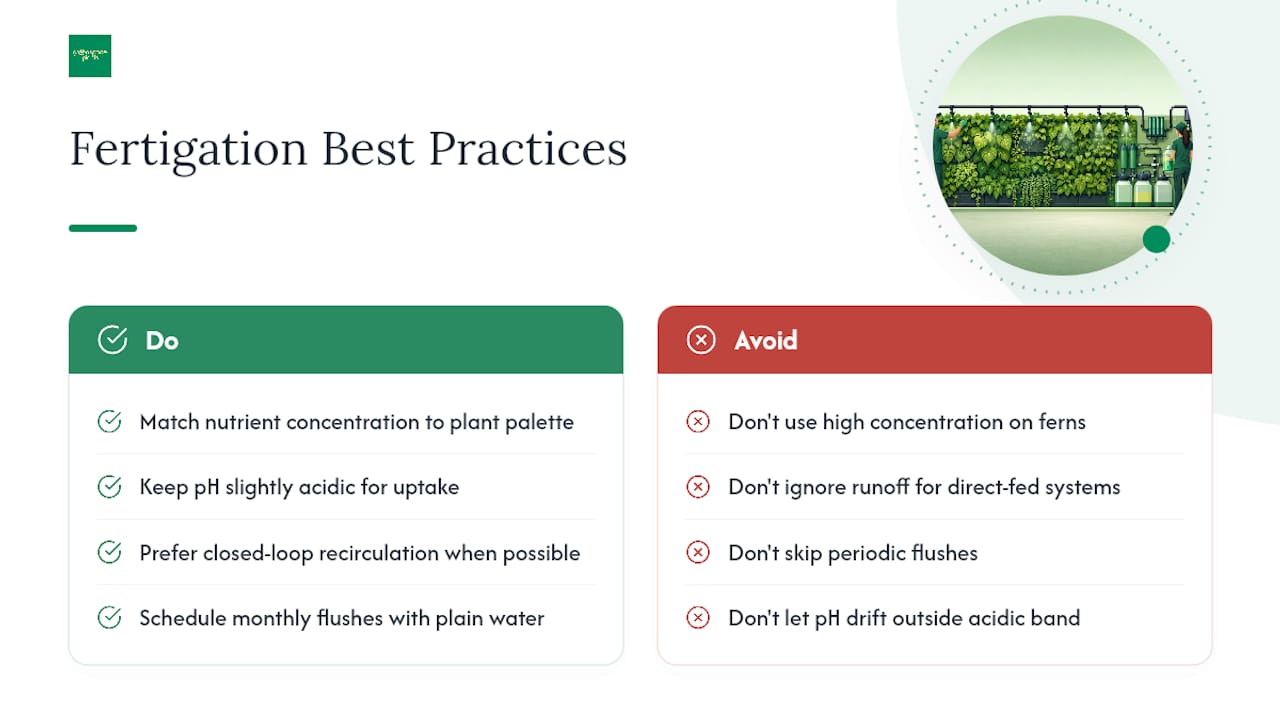
Fertigation, delivering dissolved nutrients through the same irrigation lines that carry water, is how most hydroponic and semi-hydroponic living walls feed their plants, since there's no soil reservoir of nutrients to draw from. A dosing unit injects a measured nutrient concentrate into the water stream before it reaches the emitters, either continuously at a low concentration or in scheduled pulses.
Getting fertigation right depends on a few interlocking variables. Concentration has to match the plant palette; a wall dense with heavy feeders like pothos or philodendron tolerates a stronger feed than one built around ferns, which scorch easily at high salt concentrations. pH matters just as much as concentration, since most foliage plants pull nutrients most efficiently in a slightly acidic range, and drift outside that band locks nutrients up even when they're present in the water.
Closed-loop systems make fertigation more practical because the nutrient solution recirculates rather than draining away after a single pass, which cuts both fertilizer cost and runoff. Direct-fed systems can still fertigate, but usually at a lower concentration since the water isn't reused, and any runoff needs a drainage plan that accounts for nutrient-laden water rather than plain irrigation runoff.
Flush intervals matter more in fertigated systems than plain-water setups. Salt buildup in substrate is a real risk when nutrient solution is dosed continuously, so periodic flushes with plain water prevent the slow accumulation that eventually burns root tips. Most professional maintenance programs schedule these flushes on a monthly basis, adjusted for how heavily the wall is fertigated and what the plant palette can tolerate.
How Does Plant Selection Change Your Irrigation Strategy?
The plant palette you choose determines almost every irrigation parameter that follows, not the other way around. Picking plants first and figuring out watering later is backwards, and it's one of the most common design mistakes on new installations.
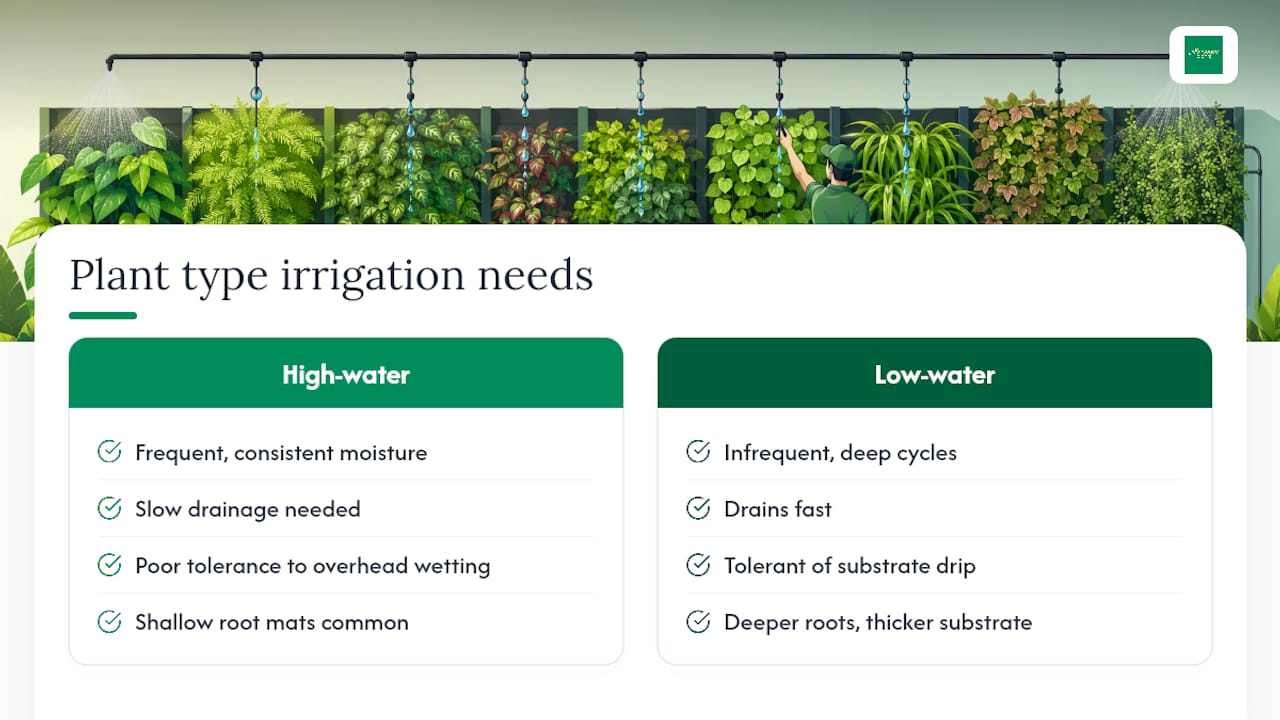
Succulents and drought-tolerant species need infrequent, deep watering cycles and drain fast, which makes them a poor match for a system tuned to ferns or calathea, plants that want consistent moisture and suffer visibly during dry spells. Mixing high-water and low-water species on the same irrigation zone is a near-guaranteed way to overwater one group while starving the other, since a single schedule can't serve both needs.
Leaf structure affects tolerance for overhead versus substrate-level delivery too. Plants with dense, overlapping foliage, pothos being a common example, can trap moisture against leaves when watered from above, raising fungal risk in poorly ventilated spaces. Substrate-level drip avoids that problem entirely, which is part of why top-fed drip dominates commercial interior walls over overhead misting.
Root depth and substrate preference matter as well. Some species establish shallow root mats that dry out fast near the surface, demanding shorter, more frequent cycles, while others root deeper into thicker substrate and tolerate longer intervals between waterings. The practical takeaway for anyone specifying a wall: group plants by water need into the same irrigation zones from the start, and let the plant palette drive zone boundaries rather than fitting plants into zones that were drawn for architectural reasons alone.
What Sustainability Benefits Come From Efficient Irrigation?
Efficient green wall irrigation is one of the clearest cases where doing the technical thing right also happens to be the environmentally responsible choice. Green walls contribute real cooling and air quality benefits, lowering surface temperatures around a building and adding evapotranspirative cooling to nearby air, but those benefits only hold up if the water delivery behind them is managed well rather than wasted.
Closed-loop recirculating systems can cut water consumption dramatically compared to single-pass drip, since the same water gets reused multiple times rather than draining to waste after one pass through the substrate.
There's an energy dimension to that which often gets overlooked. Pump runtime is a direct energy cost, and systems tuned to run only when substrate moisture actually calls for it, rather than on a fixed timer regardless of conditions, cut electricity use alongside water use. Reduced pump cycling also extends equipment life, which means fewer replacement parts and less embodied carbon from manufacturing new components.
The broader sustainability case for green walls, cooling buildings, filtering air, adding biophilic value to dense urban spaces, depends entirely on the irrigation behind them being efficient rather than wasteful. A green wall that's overwatered and dripping excess into a floor drain isn't delivering on that promise; it's just decorative plumbing with plants attached.
Why Early Irrigation Decisions and Maintenance Matter
Every green wall failure we've diagnosed traces back to the same root cause: irrigation treated as an afterthought instead of a design decision. Getting the system right at the schematic stage, then backing it with scheduled professional maintenance, is what actually prevents the slow failures that catch facility teams off guard months later.
Our approach pairs that design discipline with regular monitoring, timely part replacements, and the maintenance cadence a living wall actually needs. If your wall's irrigation feels like a guessing game, that's the moment to bring in a professional maintenance partner rather than wait for visible plant loss.
— Nicole
Greenspace+: Design, Install, and Maintain Your Green Wall Under One Plan
Every system covered here, closed-loop reservoirs, direct-fed drip, sensor automation, still needs someone accountable for keeping it running correctly month after month. That's the gap a maintenance partner who offers plant design, installation, and ongoing care under a fixed monthly service fee, with no upfront cost and no long-term commitment.

Facility managers and commercial property owners get the most value from this setup, since it removes the operational burden of tracking irrigation schedules, emitter checks, and seasonal tuning across a busy building. Installations are backed by a healthy plant guarantee, so replacements happen automatically rather than becoming a line item to chase down. Whether you're specifying a new green wall or inheriting a struggling one, our interior plant services team can walk your space and outline what a properly maintained wall actually requires. If exterior greenery is part of the plan too, our outdoor patio plantscapes page covers what that looks like beyond the interior wall itself. Reach out for a walkthrough and a straightforward quote.
Sources
- Effects of Irrigation Frequency on the Water Balance of Green Walls for Greywater Treatment (MSc thesis)
- Irrigation efficiency in green wall systems utilizing IoT (graduate thesis / experimental study)
- Biofilm prevention and treatment (Hawthorne Gardening)
FAQ
What Are the Downsides of Green Walls?
Green walls demand consistent water delivery because their limited substrate volume dries out fast, and skipping proper irrigation design leads to drought stress, uneven growth, or costly water damage from poor drainage planning.
How Much Does a Green Wall Cost?
Cost depends heavily on wall size, plant palette, and whether the irrigation system is closed-loop or direct-fed, with ongoing maintenance and plant replacement adding to the total; Greenspace Plants prices its all-inclusive Greenspace+ service on a fixed monthly basis rather than a single upfront figure.
What Are the Best Plants for a Green Wall?
The best plants match the irrigation system and light conditions on site. Foliage plants like pothos and philodendron tolerate consistent moisture well, while ferns need steadier humidity and succulents need infrequent, deep watering rather than frequent misting.
How Often Should Irrigation Run on a Green Wall?
Short, frequent cycles, often multiple short intervals per day, distribute moisture more evenly than one long session, and schedules should shift seasonally based on evapotranspiration and plant-specific needs.
Can I Retrofit Automated Irrigation Into an Existing Green Wall?
Retrofitting is possible but harder than designing it in from the start, since existing walls may lack space for pumps, reservoirs, or the electrical routing that automated zoning requires without opening up finished construction.