
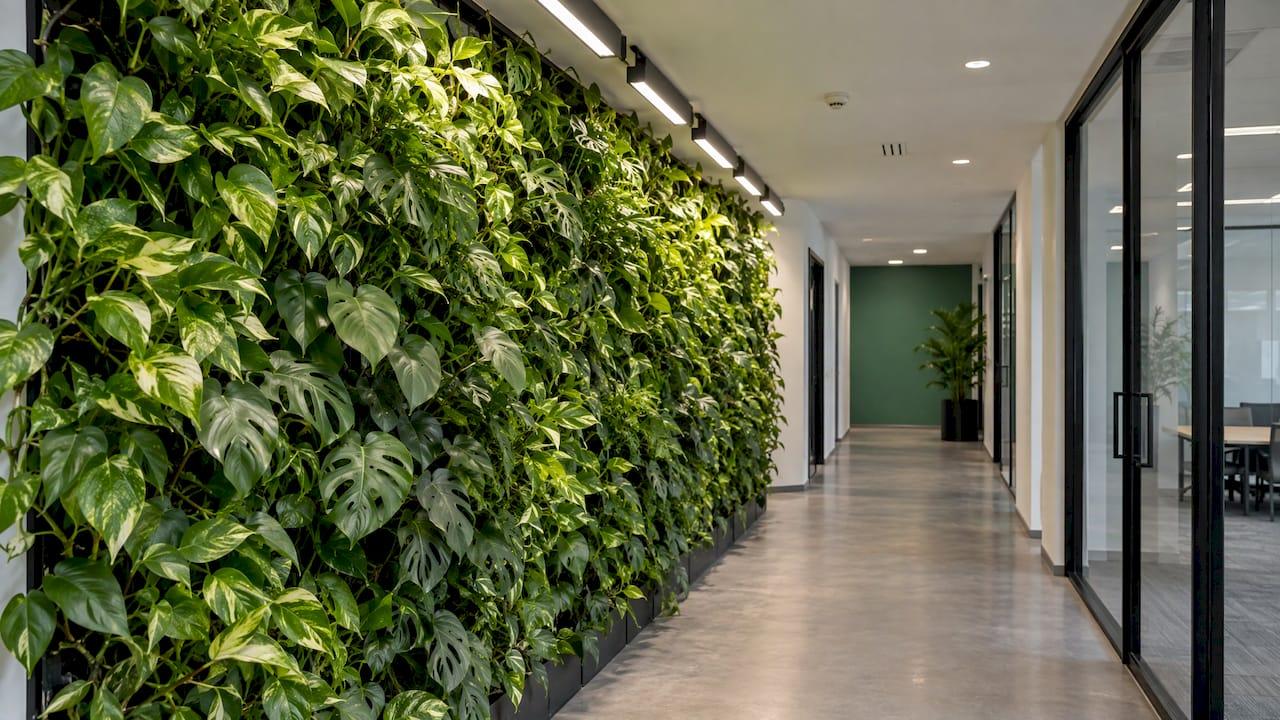
A green wall needs light that is even, bright enough for photosynthesis and on for about 12 hours a day. Aim for wall-washing fixtures, roughly 2,500 lux at the leaves, and enough distance that the fixtures never scorch the foliage. Get that right and the wall looks lush for years. Get it wrong and the plants thin out, lean and fade.
We design, install and care for plants in offices, hotels, restaurants and retail across Toronto, Vancouver and Calgary. Lighting is the first question we ask on any green wall project. This guide covers what we have learned, and what the research says.
Key Takeaways
- Plants need light that suits them, not just light that suits people. Quality, intensity and daily duration all matter.
- Light the wall evenly with wallwash or oval-flood optics. Narrow spotlights and standard downlights leave some plants in shade.
- A common rule of thumb is about 12 hours a day at roughly 2,500 lux on the leaf surface, adjusted for the species.
- Keep fixtures a sensible distance from the leaves. Too far starves the plants. Too close creates hot spots.
- Plan the lighting with your plantscaper and your electrician before the wall goes in.
Table of Contents
- Why a green wall needs more than ordinary room lighting
- The three things plants want from a light
- How to place lights so the whole wall glows evenly
- Heat, and keeping fixtures from scorching leaves
- Make the lighting part of the design
- Safety, wiring and Canadian codes
- Running costs and upkeep
- Our perspective
- Let us handle the lighting plan and the plants
- Frequently asked questions
- Sources
Why a green wall needs more than ordinary room lighting
Most offices, lobbies and dining rooms are lit for people. Plants are fussier. A living wall can be several metres tall and sit far from any window, so the lower and inner plants get very little.
A study on lighting systems for indoor living walls (Egea et al., 2014) found that when vegetation gets little or no natural light indoors, supplementary light is needed. Good artificial lighting balances three things: quality (the spectrum), intensity and photoperiod (hours per day).
If your space has big south-facing windows, you may need less help. If the wall sits in a corridor, a restaurant back wall or a windowless lobby, plan for full-time lighting from day one.
We cover the basics of matching plants to your light in our guide to office plant lighting levels. It is a good companion to this page.
The three things plants want from a light
Spectrum: the colour of the light
Plants do not use every colour equally. The same research notes that blue and red make up most of the wavelengths absorbed by chlorophyll, and that not all wavelengths are equally effective for photosynthesis.
In practice, this is why a pretty warm-white bulb from a decor shop is rarely enough. You want a fixture with a suitable spectrum for plants. Many designers choose a white light that still renders the greens beautifully, so the wall looks natural to guests as well as healthy to the plants.
Intensity: how bright at the leaf
Intensity drops quickly with distance from the source. Different species also have different needs, based on where they grow in nature. The Egea study confirms that light intensity falls with distance and that species differ in their requirements.
For targets, lighting designers talk in two ways:
- Illuminance at the wall. One lighting design interview notes that green walls typically require upwards of 150 foot-candles. That is about 1,600 lux, using the standard conversion of 10.76 lux per foot-candle.
- Rule of thumb in lux. ERCO, a lighting manufacturer, suggests about 2,500 lux on the leaf surface, depending on the species, for healthy growth.
The two figures differ because species, plant density and wall depth differ. Treat them as a range to discuss with your plantscaper, not a number to guess.
Lumens and lux describe light as people see it. Plants respond to light in the wavelengths they absorb, which is measured as PPFD. If your lighting designer is writing a spec, ask for PPFD to be addressed, not only lux. Our post on matching plants using lux, PPFD and DLI explains the terms in plain language.
Photoperiod: hours per day
Photoperiod is the length of the daily light exposure. The Egea paper defines it as the duration of daily exposure to light and notes that it shapes development, such as flowering.
Many green wall plants come from the tropics. ERCO's guidance is therefore a 12-hour lighting period for most walls. Put the lights on a timer so the schedule never depends on someone remembering a switch.
Two more points on timing:
- A Canadian controls guide from Argus says it is usually more efficient to give a lower amount of light over a longer period than a high dose over a short one.
- For spaces open around the clock, a lighting designer in an industry interview describes two layers of lighting. One layer switches off while the other stays on at chosen wavelengths, so the plants still get a rest.
How to place lights so the whole wall glows evenly
This is where most walls go wrong. A few spotlights make bright patches and dark gaps. The plants in the gaps fade first, and you see it.
Use wallwash or oval-flood optics
ERCO recommends uniform lighting with wallwash or oval-flood distributions. It advises against conventional downlights or narrow spotlights because they do not give every plant the same light.
That matches what we see on site. Even light means even growth, and even growth means a wall that looks designed rather than patchy.
A starting rule for spacing
ERCO gives a handy rule of thumb. Place wallwashers at a distance of one third of the wall height from the front of the plants. Space the fixtures at the same distance as they sit from the wall. The same guide suggests light from above, which helps leaves align naturally.
Here is what that looks like on a few common walls:
| Wall height | Fixture distance from plants (one third of height) | Fixture spacing along the wall |
|---|---|---|
| 2.4 m | about 0.8 m | about 0.8 m |
| 3 m | about 1 m | about 1 m |
| 4.5 m | about 1.5 m | about 1.5 m |
The figures are simple arithmetic from that rule. Your ceiling height, planter depth and plant mix will move them, so use them as a starting point for the conversation with your lighting designer.
Tall walls need layers
For walls taller than about 10 feet, one designer describes staggering fixtures high and low. One row aims at the upper part with a wider spread. Another aims lower with a narrower spread. The result is an even wash from top to bottom.
Distance matters for growth
In the Egea trials on peace lily and baby's tears, differences in growth only showed when the wall sat about 1 metre from the light source, not at 1.5 metres. Distance changes outcomes, so do not leave placement to chance.
Heat, and keeping fixtures from scorching leaves

LEDs run cooler than older lamps, and that is why they are the usual choice. They can still cause trouble if they sit right on top of the foliage. Fixtures that are too close can create hot spots. Fixtures that are too far give weak light at the leaf.
Our advice is simple:
- Leave a modest gap between the fixture body and the nearest leaf.
- Check the wall again once the plants have grown in. Plants get closer to the lights over time.
- Keep drivers and power supplies out of damp zones, and away from the irrigation line.
- Ask your plantscaper to confirm fixture locations before the electrician installs anything.
That last step matters most. We work out throw distance and coverage against the actual wall, so you do not discover the problem after the ceiling is finished.
Make the lighting part of the design
A green wall is a feature. The light is part of the look. Done well, it turns a plant wall into a focal point at night, in the reception, behind the bar or along a retail feature wall.
Think about the surrounding space too. The wall light needs to work with the room's wider scheme, so the wall does not glare against dark surroundings. If you are planning mood lighting nearby, these ambient wall lighting ideas show how softer wall fixtures can frame a room without added wiring.
Some design tips we use:
- Keep brightness balanced. A wall that is much brighter than the room can feel harsh. A wall that is much darker looks dull.
- Hide the hardware. Mount fixtures so guests see the glow, not the lamp.
- Think about reflections. Glass storefronts and polished floors can bounce light in odd ways.
- Choose plants for the light you have. Pothos and philodendron handle a wider range than fussier species. Our guide to living wall plants shows how we match plants to exposure.
Our role of lighting in plant selection article goes deeper on this.
Safety, wiring and Canadian codes
Water and electricity share a wall here, so wiring is not a place to improvise. Your electrician and your building authority own the details. A few points are worth knowing.
In British Columbia, the Building Code requires that electrical installations conform to the Electrical Safety Regulation. Technical Safety BC has confirmed that the Section 9.34 requirements remain in the code and are enforced by local building authorities across the province. Rules in Ontario and Alberta differ, so check with your local authority.
In Toronto, Vancouver or Calgary, a few habits keep a project smooth:
- Use a licensed electrician for all fixture and controller wiring.
- Put the lighting on a timer or controller, not a wall switch.
- Ask your plantscaper where water lines, drainage and drivers will sit before the electrician starts.
- Ask about fire performance of the wall assembly. We explain what architects look for in our post on living wall fire safety.
Running costs and upkeep
LED lighting is efficient, but a wall that runs 12 hours a day still adds to the power bill. Ask your electrician for the total wattage of the planned fixtures. Multiply by the hours and your utility rate for a realistic monthly figure.
Upkeep is small but real. Fixtures collect dust. Timers drift after power cuts. Plants grow toward the lights and need trimming. These are things a regular visit catches early. Our green wall maintenance playbook lists what we check, and our note on green wall lifespan explains how good light supports a wall for years.
Our perspective
We see the same story again and again. A lovely wall goes in. Six months later, the bottom corner looks tired. Nine times in ten, the culprit is light.
That is why we start with the light, not the plants. We walk the space, note the windows, the ceiling and the hours you operate. Then we choose plants that suit the conditions, and we tell your electrician or designer what the wall needs.
We are Canada's leading commercial-only indoor plant service, founded in 2014. We look after 60,000+ plants in 400+ commercial locations. We are WBE Canada certified, a woman-owned business.
What we care about is how the space looks and feels. A wall that glows evenly makes a reception warmer and a restaurant more inviting. It says something about your brand before anyone speaks.
And you should not have to think about it afterwards. Our team handles the care, and our healthy plant guarantee means tired plants get replaced.
Nicole
Let us handle the lighting plan and the plants
You do not need to become a lighting expert to have a wall that looks great. With Greenspace+, you pay a fixed monthly fee from $299 per month. It covers plant design, installation, regular maintenance and plant replacements. There are no upfront costs and no long-term commitments.

If you are planning a feature wall, our team can look at your space and advise on plants that suit the light. See our green wall options or talk to us about indoor plant design. We also run national programs for multi-location brands, including in the US.
Frequently asked questions
How many hours a day should green wall lights be on?
A common guideline is 12 hours a day, because many green wall plants are tropical. ERCO's guidance gives that figure along with about 2,500 lux at the leaves. Use a timer so the schedule stays steady, and let your plantscaper adjust it for your species.
Can I use regular household bulbs on a green wall?
Usually they fall short. Plants absorb mostly blue and red wavelengths, and not every wavelength helps photosynthesis equally. A fixture designed for the job, with even wall coverage, will give you healthier plants and a better look.
How far should lights be from the plants?
A starting rule from ERCO is to place wallwashers at one third of the wall height from the front of the plants. Keep a modest gap from the leaves so the fixtures do not cause hot spots. Your plantscaper should confirm the final positions on site.
Does a green wall need lights if it is near a window?
Sometimes less, but rarely none for the full wall. Light fades with distance from the glass, so lower and inner areas often need support. Research on indoor living walls says supplementary light is needed when natural light is low or absent.
Sources
- Lighting systems evaluation for indoor living walls (Egea et al., 2014)
- Lighting for green walls, ERCO
- Lighting Green Walls: An Interview with David J. Seok, The Lighting Practice
- Light and Lighting Control Guide, Argus Controls
- Division B, Section 9.34 Electrical Facilities, Vancouver Building By-law 2019
- Information Bulletin: Luminaires in Buildings, Technical Safety BC
- 7 Ambient Wall Lighting Ideas, NOGAN