
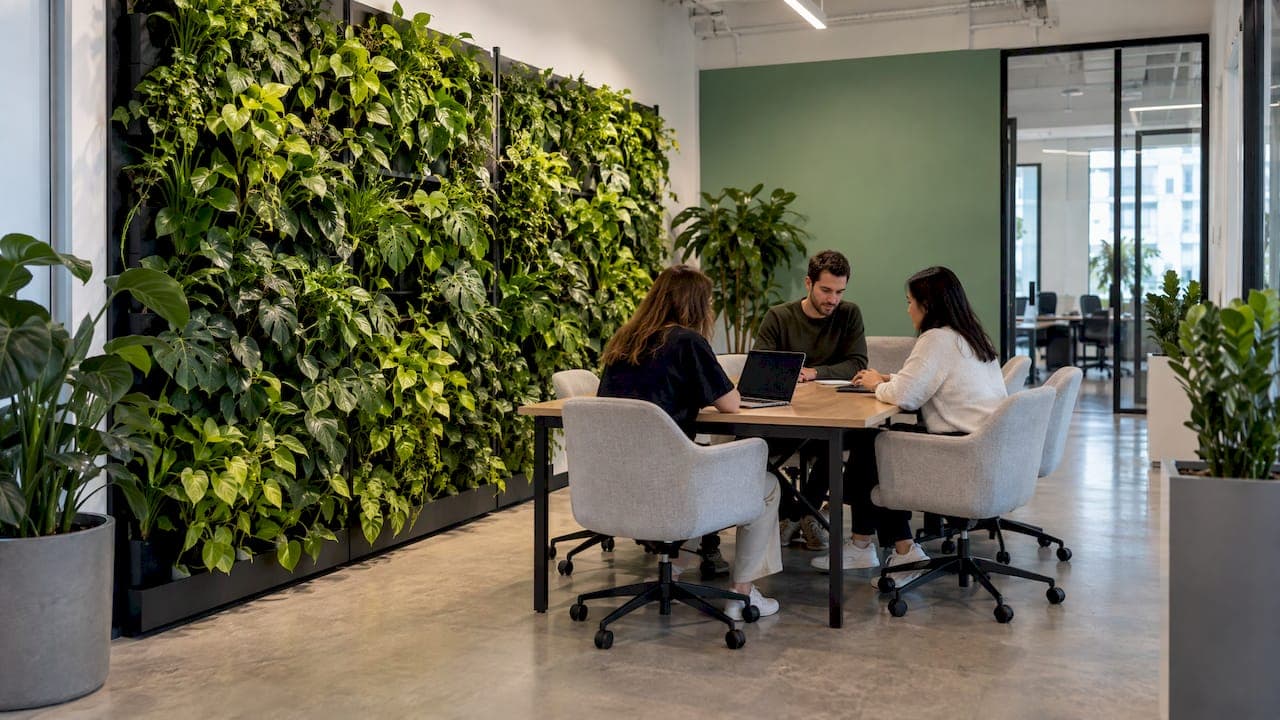
A modular living wall is a wall of pre-grown plant panels, fixed to a frame and fed by its own irrigation. You get a full, finished look on day one, and a damaged section can be swapped out without redoing the whole wall. For offices, restaurants, hotels and retail, it is one of the strongest ways to make a space look and feel considered.
We are Greenspace Plants, Canada's leading commercial-only indoor plant service, founded in 2014. We design, install and care for plants in offices, hotels, restaurants and retail across Toronto, Vancouver and Calgary. This guide covers what to know before you commission a wall.
Key Takeaways
- A modular living wall uses pre-grown panels or trays on a supporting frame, with irrigation and often lighting built in.
- Light is the first thing to check. Insufficient lighting is a frequent cause of living-wall failures.
- Cost depends on system type, height, automation and plant choice. Care is part of the budget, not an afterthought.
- Canadian winters change how a wall is watered and drained. Plan for that at the design stage.
- The easiest wall to live with is one designed, installed and maintained by the same team.
Table of Contents
- What a modular living wall is
- How the parts work together
- Modular walls compared with other green walls
- Where a modular wall works best
- Planning a wall: what to settle first
- Choosing plants that look good and last
- What a modular living wall costs
- Keeping the wall healthy
- Our point of view
- Work with us on your wall
- FAQ
- Sources
What a modular living wall is
Think of it as a vertical planting system built from repeatable units. Each unit is a panel or tray. It arrives with plants already growing in it. The units lock onto a structure fixed to the wall.
Academic sources describe a living wall system as an engineered layer that supports plants independently of the ground. That is the key difference from a green facade, where climbing plants root in soil and grow up a trellis.
The U.S. Green Building Council's 2024 guide notes that panel systems use pre-grown plant panels, indoors or outdoors. Tray systems use removable pre-grown trays. Those trays make replacement simpler and help avoid spilled soil or water.
In practice, "modular" means three things for you:
- Instant fullness. The wall looks mature at handover.
- Easy repair. One tired panel comes out. A fresh one goes in.
- Design control. Panels can be arranged in patterns, bands or blocks of colour and texture.
How the parts work together
A living wall is a small system, not just a picture of plants. The same USGBC guide lists the supporting lattice, irrigation, plant substrate and lighting as the working parts. It also says the wall must carry its fully saturated weight.
Here is how each part earns its place.

Frame and backing
The frame holds the panels. Behind it, a backboard protects your wall. Research on living wall design says a backboard can add rigidity, keep water away from the cavity and act as a root barrier. Materials include cement particle board, PVC or polypropylene.
The same research notes the secondary structure can include a ventilated cavity. That helps with thermal performance and moisture control.
Growing medium
Plants root in an engineered substrate inside each panel. It is built to hold moisture while staying light enough for a vertical hang. This is not garden soil.
Irrigation
Water is usually delivered from the top and moves down through the panels. Drainage and collection need a plan. In some retrofits that plan decides which system you can use at all. One architect's guide notes a modular system suits retrofits where a cold water and drainage line are not in the design, so ask early what plumbing your space has.
Lighting
Most interior walls need supplemental grow lighting. Light affects colour, density and how long the planting lasts. We cover this below.
Modular walls compared with other green walls
You will hear several terms. Here is the short version.
| Type | How it grows | Best for |
|---|---|---|
| Modular panel or tray wall | Pre-grown plants in panels on a frame | Interiors and exteriors where you want a finished look at once and easy replacement |
| Green facade | Climbers rooted in soil, trained on a trellis | Large exterior surfaces with ground access |
| Continuous felt or mat wall | Plants rooted in a continuous layer | Custom shapes, with more specialized care |
| Preserved moss wall | Treated moss, no watering | Spaces with very low light or no plumbing |
If you want living plants and a flexible layout, modular is a strong fit. If a wall sits in a dim corridor with no water access, a preserved moss wall may serve you better. We install both, and we are happy to talk through which suits your room. Our moss wall maintenance guide explains what each type needs.
Where a modular wall works best
Reception and lobbies. The wall becomes the first thing a visitor sees. It tells them how your organization thinks about people and place.
Offices and workplace hubs. A wall can define a collaboration zone, soften a hard boundary or give a long, blank corridor a point of view. Plants also support the sense of calm that workplace experience teams aim for.
Restaurants and hotels. A green backdrop behind a host stand, bar or banquette adds depth, texture and atmosphere. It photographs well too.
Retail and showrooms. A wall can anchor a display or carry a brand colour through foliage.
Outdoor patios. Some systems work outdoors, but Canadian winters change the plant list and the water plan. Ask us about our wider green wall options.
Planning a wall: what to settle first
Good walls begin with questions, not products. Work through these in order.
- Pick the wall. Is it a feature at eye level, a full-height statement or a screen? Visibility drives size and detail.
- Measure the light. Note daylight from windows and ceiling lighting hours. Plan for added grow lights if needed.
- Check structure. A saturated wall is heavy. Confirm the substrate wall can carry it.
- Find your water and drain points. The nearest supply and drain shape your system choice.
- Think about moisture in the building. Calgary's design guidelines for envelope retrofits call for careful integration with existing wall assemblies, including hygrothermal modelling to find where condensation may occur. This matters most on exterior walls.
- Choose plants for the conditions. Then choose for looks.
- Decide who maintains it. Settle this before install, not after.
A Canadian study from the Université de Sherbrooke makes a similar point. Expectations for upkeep should shape the wall model and the plant choice at the design stage. We agree. A wall designed without a care plan is a wall waiting to fail.
Choosing plants that look good and last
Plant choice shapes both the look and the workload. The USGBC guide says plants are selected for climate tolerance, sunlight cycles and changing colour and texture.
For a design-led wall, we think about it this way:
- Leaf shape. Mix fine, broad and trailing foliage for depth.
- Colour. Greens do most of the work. Variegation and deeper tones add accents.
- Texture. Contrast keeps the eye moving across the wall.
- Habit. Trailing plants soften the lower edge. Upright ones give structure.
- Light fit. A plant that loves bright light will not last in a dim lobby, however nice it looks on a mood board.
If you like to build a shortlist yourself, a tool that lets you filter plants by light and water needs can help you compare site conditions before you talk to a designer. Our own guide to living wall plants matched to system and exposure goes deeper on what thrives where. For broader office planting, see our indoor plant selection page.
What a modular living wall costs
We do not publish a fixed price for living walls. Each one depends on size, system, lighting, plumbing and plants. We quote after we understand your space.
Independent sources show why the range is wide. The Sherbrooke study says plant choice, system type, installation, maintenance, height and feasibility all affect cost and performance. It adds that more automation can reduce risk and improve establishment, but it costs more up front.
For a rough sense of scale, a 2009 report from ConstructConnect put living wall installation at about $70 to $150 per vertical square foot, against $10 to $30 for a green facade. Those figures are old. Use them to understand the gap between system types, not as a quote today.
Three ways to keep a budget sensible:
- Right-size the wall. A well-placed smaller wall often has more impact than a large one in a poor spot.
- Match automation to the space. More control suits a hard-to-reach or high-profile wall.
- Include care from day one. An unmaintained wall costs more in the end.
Keeping the wall healthy
A living wall is a working system. The USGBC guide lists ongoing care as servicing irrigation and drainage, feeding, pruning, deadheading, weeding and replacing plants. Lighting may need adjusting too. It also says indoor or outdoor placement and plant choice affect the workload.
In Canada, seasons matter. The Sherbrooke study reports that irrigation and fertilization must be adjusted by season. The substrate should stay moist year-round. Systems should be drained after watering where winter freezing is a risk.
What that looks like for us:
- We check irrigation, emitters and drainage.
- We inspect the plants for stress, pests and gaps.
- We prune and tidy so the pattern stays crisp.
- We feed on a schedule suited to the season.
- We replace any plant that is not thriving, so the wall never looks tired.
Watering is where many walls go wrong. Our guides on green wall irrigation and water use in Canadian conditions explain why we adjust to the wall, not the calendar. For the full routine, read our green wall maintenance guide. Vancouver teams may prefer the Vancouver edition. And to see how long a wall can run before a refresh, read about green wall lifespan.
Our point of view
We have spent over a decade looking after plants in commercial spaces. Here is what we have learned about living walls.
A wall is a promise. When it is full and green, it tells people your space is cared for. When it is patchy, it says the opposite. The difference is almost never the design. It is the care behind it.
That is why we do not treat installation as the finish line. We design the wall, install it and look after it, so one team owns the result. Our guaranteed healthy plants mean a struggling panel is our job to fix, not yours.
We are Canada's leading commercial-only indoor plant service. We care for 60,000+ plants in 400+ commercial locations. We are WBE Canada certified, a woman-owned business. Our teams work across Toronto, Vancouver and Calgary, and we run national programs for multi-location brands, including in the US.
If you are choosing between a modular wall and something simpler, we will tell you honestly which fits your light, your budget and your brand. Sometimes that is a wall. Sometimes it is a handful of well-placed planters.
Nicole
Work with us on your wall
We handle design, installation and ongoing care, so you never need to think about watering schedules or replacement plants. Our all-inclusive Greenspace+ service starts from $299 per month, with no upfront costs and no long-term commitments. It covers plant design, installation, regular maintenance and plant replacements. See the details on the Greenspace+ page.

For a moss wall or a living wall project, we scope and quote it to your space. Start with our green walls page, or browse our look-book to see how other spaces look. Have several locations? Our national account program keeps every site consistent.
FAQ
What is the difference between a modular living wall and a green wall?
"Green wall" is the broad term. It covers green facades, felt systems and modular panels. A modular living wall is one type, built from pre-grown panels or trays on a frame. It gives you a finished look right away and easier replacement.
Do modular living walls need a lot of light?
Yes, light is the main factor. Insufficient lighting is a frequent cause of living-wall failures, according to the USGBC. Many interior walls use supplemental grow lights, so we assess your daylight and ceiling lighting before choosing plants.
Can a modular living wall work in a Canadian winter?
Indoors, yes. Outdoors, it needs a winter plan. Research from the Université de Sherbrooke says systems should be drained after watering where freezing is a risk. Irrigation and feeding also need seasonal adjustment.
How much maintenance does a living wall need?
It needs regular care: irrigation checks, feeding, pruning, and replacing plants that decline. How often depends on plant choice, automation and location. We handle all of it under a care plan, so you do not have to.
Is a moss wall the same thing?
Not quite. A preserved moss wall uses treated moss and needs no watering or light. A living wall uses live plants. Both can look striking, and we can help you choose between them.
Sources
- 6.5.1: Kinds of green walls, Engineering LibreTexts
- Living Wall article, U.S. Green Building Council, April 2024
- A comprehensive framework for living wall design, E3S Web of Conferences, 2024
- Design Guidelines, City of Calgary
- Living wall study, Université de Sherbrooke, September 2024
- Cost concerns for increasingly popular green walls, ConstructConnect, September 2009
- Evergreen Landscape Design: A Practical Guide to Year-Round Structure, GreenCurate