

A good office planter grouping uses odd numbers, mixed heights and one clear purpose: a focal point, a soft divider or a calm corner. Place it where the light is right and the walkway stays clear. Then keep it healthy, so it still looks full in month twelve.
We are Greenspace Plants, Canada's leading commercial-only indoor plant service, founded in 2014. We design, install and care for plants in offices, hotels, restaurants and retail across Toronto, Vancouver and Calgary. This guide shows how we think about grouping.
Key Takeaways
- Group in odd numbers (3, 5 or 7) and vary heights so the eye has a path to follow.
- Match the job to the planter size: tall for lobby focal points, wide and stable for screens, low for edges.
- Light decides placement first. Style comes second.
- Leave open space around a cluster and keep walkways clear.
- A grouping only works if it stays healthy, so plan the care before the design.
Table of Contents
- Start With What the Grouping Is For
- The Basic Rules of a Balanced Grouping
- Match Planter Size to the Job
- Placement: Light First, Then Layout
- Grouping Ideas That Work in Real Offices
- Keep It Healthy: The Part Most Plans Skip
- Mistakes That Make Groupings Look Off
- How We Do It at Greenspace Plants
- Our Point of View
- FAQ
- Sources
Start With What the Grouping Is For
Before you pick a single pot, decide the job. A grouping can do one of four things:
- Welcome people. A lobby or reception focal point.
- Divide space. A soft edge between desks and a collaboration zone.
- Add privacy. A screen at seated height.
- Calm a corner. A dead spot by a printer wall or a window.
The job sets the size, the plants and the position. Many offices skip this step. They end up with a lone pot in every corner, which looks scattered and does little.
A Vancouver horticulturist told CBC News the practical approach is abundant greenery everywhere, not one box of snake plants. The same piece describes plants used in place of dividers and blinds to separate rooms, buffer noise and filter light. Think in groups, not in single pots.
The Basic Rules of a Balanced Grouping
Use odd numbers
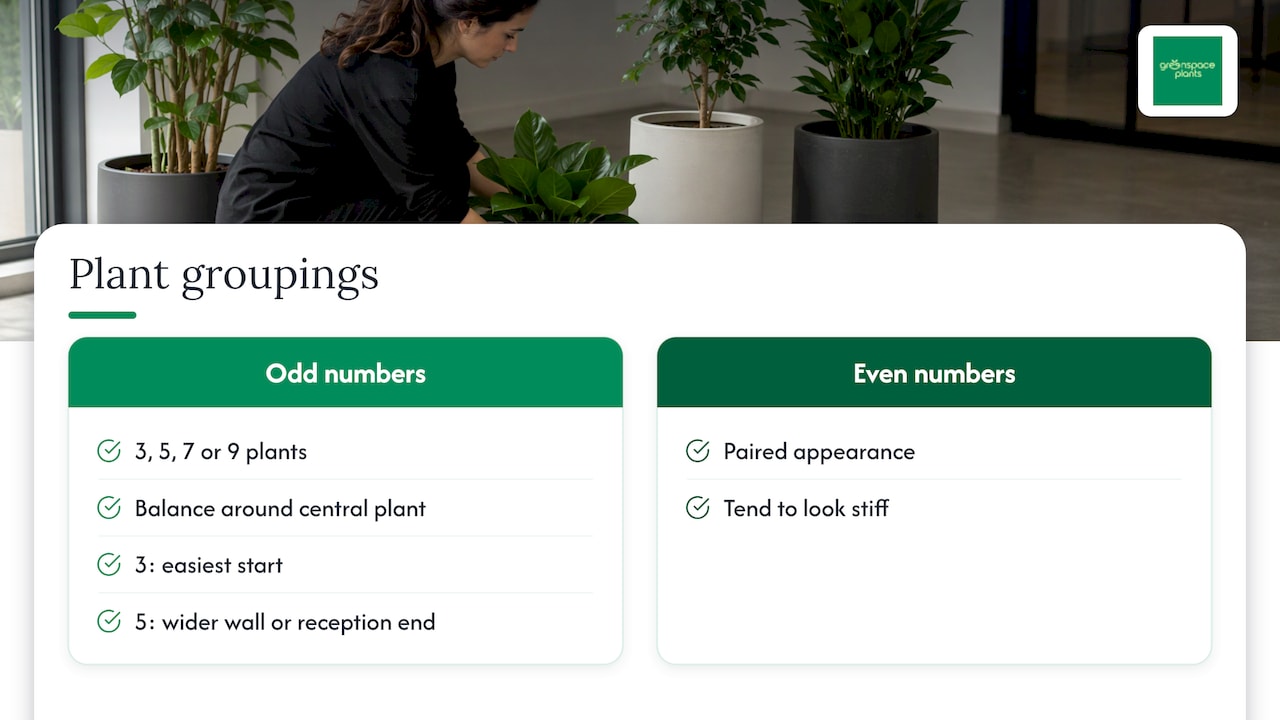
Illinois Extension notes that odd numbers such as 3, 5, 7 or 9 balance around a central plant. Three is the easiest start. Five suits a wider wall or a reception end. Even numbers tend to look paired and stiff.
Mix three kinds of plant
The same source describes a simple formula: something tall, something round and mounding, and something that trails. In an office that might be:
- Tall: a kentia palm or a dracaena for height.
- Mounding: a ZZ plant or aglaonema for body.
- Trailing: a pothos spilling over the rim of a raised planter.
The tall plant anchors the group. The mounding one fills the middle. The trailing one softens the edge.
Watch the proportion
The same Illinois Extension page suggests a pleasing proportion of one-third container to two-thirds plant height. A plant that is 90 cm tall looks right in a pot about 45 cm high or less. A tiny plant in a huge pot looks lost. A big plant in a tiny pot looks top-heavy and tips.
Decide: matched or varied heights
RHS horticulturist Fran Bailey explains that uniform sizes create an ordered, harmonious display, while different but proportional sizes create contrast that leads the eye to a focal point. So the feel is your choice:
| Look | How to get it | Where it suits |
|---|---|---|
| Formal, calm | Matched heights and repeated planters | Reception, boardroom, hotel lobby |
| Dynamic, relaxed | Varied heights, mixed shapes | Open-plan areas, lounges, cafés |
For a group of similar dark green plants, the same RHS page suggests adding a few small, brightly coloured plants to lift it.
Keep the planters related
Plants carry the variety. Planters should carry the calm. Pick one material or colour family and repeat it, then change only the size. This is what makes a grouping look designed and on brand. We source standard, premium, luxury and custom planters, so the container can match your finishes and your brand colours.
Match Planter Size to the Job
Sizing is where most office groupings go wrong. A practical guide from a US planter retailer, Pots Planters & More, gives these ranges:
| Goal | Planter size | Note |
|---|---|---|
| Lobby focal point | 30 inches (about 76 cm) or larger | One strong anchor, then smaller companions |
| Privacy screen at seated height | 24 to 36 inches (about 60 to 90 cm) | Wide, stable base |
| Edges and pathways | 12 to 18 inches (about 30 to 45 cm) | Low profile |
The same guide recommends at least 36 inches (about 90 cm) of clear walking space, and a 5-foot (about 1.5 m) turning circle at corners. Treat those as a floor, not a target. If a grouping narrows a route, move it.
Placement: Light First, Then Layout
Light is the most important variable, according to Ashley Gaden of the Manitoba Master Gardener Association. In her office plant guide, south-facing windows are brightest, then east and west, then north. In Canada, winter makes all of this dimmer, so a spot that works in July may be weak in January.
For numbers, Soltech cites University of Minnesota Extension categories: low light is roughly 50 to 250 foot-candles, medium 250 to 1,000, and high above 1,000. A phone light meter app gives a rough read at plant height.
A simple pairing by light:
- Low light corridors: snake plant, ZZ plant, aglaonema. Our guide to plants for offices with little sun goes deeper.
- Medium light: dracaena, kentia palm.
- Bright windows: fiddle leaf fig, bamboo palm.
Keep plants in one group on similar light, soil and watering needs. Illinois Extension is clear that this makes combinations most successful. A thirsty plant next to a drought-lover means one of them suffers.
Practical layout rules
- Sketch it first. Draw a low, medium and tall trio on a floor plan.
- Leave breathing room. Give a cluster open space around it, so it reads as a feature and not clutter.
- Stay clear of exits, outlets and equipment. Gaden also advises placing plants where people will not trip.
- Think about the sightline. Stand at the entrance and at a typical desk. Where does the eye land?
- Plan for rotation. Plants lean toward light, so turning them is part of the routine.
Grouping Ideas That Work in Real Offices
The reception anchor
One tall plant in a large planter, flanked by two shorter ones in the same finish. Simple, confident, and on brand from the first second a visitor walks in.
The soft divider
A row of mid-height planters, staggered in a loose zigzag, between desks and a lounge. It separates zones without walls. For more on this, see our guide to open plan office plants.
The conference room corner
A trio in a corner, tall at the back, trailing at the front. It frames video calls and softens hard surfaces. Our list of conference room plants helps with choices.
The dining room edge
For restaurants, low planters along a banquette or a window line add warmth without blocking views or service paths. Keep them tight to the edge, and keep stems clear of guests' elbows.
The living wall
When floor space is short, go vertical. A moss wall or green wall can do the job of a grouping with no footprint. See our green walls.

Keep It Healthy: The Part Most Plans Skip
Offices are harder than homes. Gaden points out that staff have little control over light, drafts and humidity, spend less time on site and may be away for long stretches. Plant choice and placement must survive vacations, hybrid schedules and building emergencies.
That is why a grouping's real test is its second year. CBC reported that Vancouver's East Side Games office holds more than 100 plant varieties across 8,500 sq ft. Plants there are looked after once a week: watered, fertilized and pruned, with some foliage swapped seasonally.
A good care routine covers:
- Watering matched to each plant, not one schedule for all.
- Rotation, pruning and leaf cleaning.
- Pest checks.
- Swapping out anything that declines, so gaps never show.
We built our service around this. Our plant care maintenance covers regular visits, and plant replacements come with our healthy plant guarantee. You see the finished look, not the upkeep.
Mistakes That Make Groupings Look Off
- Pots in a straight line. It reads like a fence. Stagger them.
- Every plant the same height. Unless you want formal, add variety.
- Too many small pots. Fewer, larger planters look calmer and cost less to care for.
- Mismatched containers. Repeat one material.
- Wrong light. Even a perfect design fails in a dark corner.
- No plan for care. Gaps and yellow leaves undo the look quickly.
How We Do It at Greenspace Plants
We handle design, installation and care in one service. For a fixed monthly fee, Greenspace+ includes plant design, installation, regular maintenance and plant replacements, with no upfront costs and no long-term commitments. It starts from $299 per month.
We serve 60,000+ plants in 400+ commercial locations. We are WBE Canada certified (woman-owned). We also run national programs for multi-location brands, including in the US, so your look stays consistent from site to site.

If you want a grouping that fits your space and brand, start with our indoor plant design service. You can see finished work in our client look-book.
Our Point of View
A grouping is a design decision and a care decision. Most people only make the first one.
We see offices as places people want to be in. A grouping should lift the room, say something about your brand and never become a chore. That is why we work with fixed monthly service: you get the look and none of the watering cans.
Start with the job the grouping has to do. Pick the light. Choose planters that feel like part of your interiors. Then let someone else keep it thriving.
Nicole
FAQ
How many plants should be in an office planter grouping?
Three is a reliable start, and five or seven suit larger areas. Odd numbers look more natural and balance around a central plant. Vary the heights and keep open space around the group.
Where should I put planters in an open-plan office?
Put them where light is good and where they define a zone, such as between desks and a lounge. Keep clear walking space, at least about 90 cm, and stay away from exits, outlets and equipment. Staggered mid-height planters work well as soft dividers.
What size planters work for a reception or lobby?
A planter of about 30 inches (76 cm) or larger makes a strong focal point. Flank it with smaller planters in the same finish. Choose a plant that suits the light by the entrance.
Can plants really replace dividers?
Yes, in many layouts. A Vancouver horticulturist told CBC that plants can separate rooms, buffer noise and filter light in place of dividers and blinds. Wide, stable planters at seated height give the most privacy.
Sources
- Illinois Extension: Container gardens, plants
- RHS: Houseplant design principles, scale
- Manitoba Master Gardener Association: Ode to the Office Plant
- Soltech: How to design a room with plants
- Pots Planters & More: Best planters for office common areas
- CBC News: Plants aren't just taking over homes